On eBird ↗
Ruddy Shelduck
Live sightings near you, the range map, bar charts of when it is seen, and Macaulay Library photos and recordings.
Ruddy Shelduck
Tadorna ferruginea
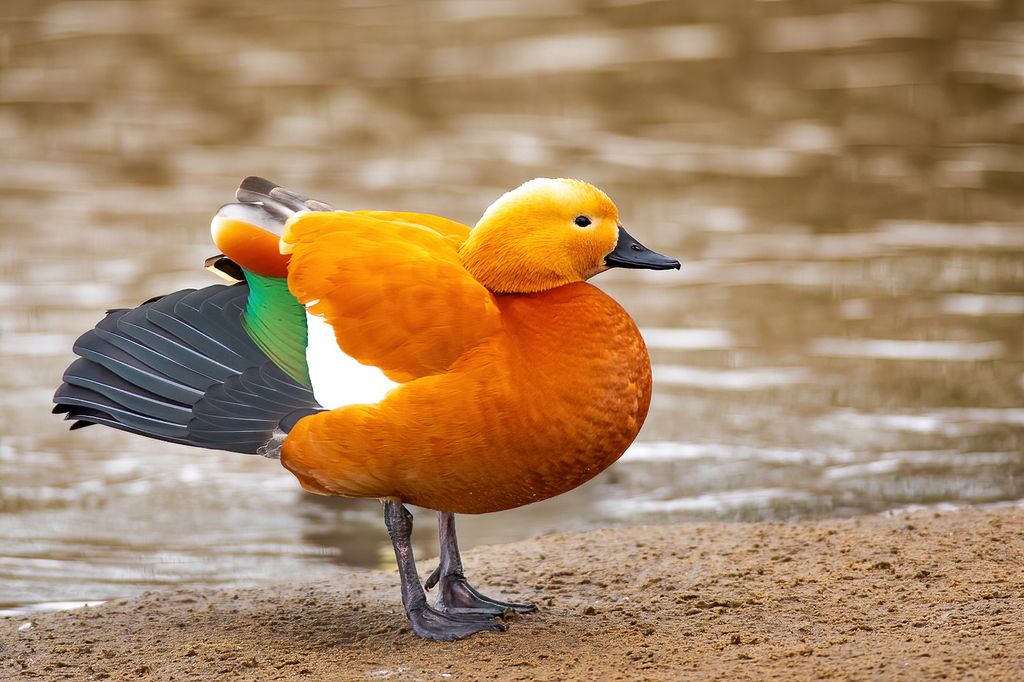
The ruddy shelduck (Tadorna ferruginea) is a bird species in the family Anatidae. It is a distinctive waterfowl, 58 to 70 cm (23 to 28 in) in length with a wingspan of 110 to 135 cm (43 to 53 in). It has orange-brown body plumage with a paler head, while the tail and the flight feathers in the wings are black, contrasting with the white wing-coverts. It is a migratory bird, wintering in the Indian subcontinent and breeding in southeastern Europe and central Asia, though there are small resident populations in North Africa. It has a loud honking call.
The ruddy shelduck mostly inhabits inland water-bodies such as lakes, reservoirs and rivers. The male and female form a lasting pair bond and the nest may be well away from water, in a crevice or hole in a cliff, tree or similar site. A clutch of about eight eggs is laid and is incubated solely by the female for about four weeks. The young are cared for by both parents and fledge about eight weeks after hatching.
From the article Ruddy shelduck on Wikipedia (CC BY-SA), quoted section by section
Description
The ruddy shelduck grows to a length of 58 to 70 cm (23 to 28 in) and has a 110–135 cm (43–53 in) wingspan. The male has orange-brown body plumage and a paler, orange-brown head and neck, separated from the body by a narrow black collar. The rump, flight feathers, tail-coverts and tail feathers are black and there are iridescent green speculum feathers on the inner surfaces of the wings. Both upper and lower wing-coverts are white, this feature being particularly noticeable in flight but hardly visible when the bird is at rest. The bill is black and the legs are dark grey. The female is similar but has a rather pale, whitish head and neck and lacks the black collar, and in both sexes, the colouring is variable and fades as the feathers age. The birds moult at the end of the breeding season and the male loses the black collar, but a further partial moult between December and April restores it. Juveniles are similar to the female but are a darker shade of brown. The call is a series of loud, nasal honking notes, it being possible to discern the difference between those produced by the male and the female. The calls are made both on the ground and in the air, and the sounds are variable according to the circumstances in which they are uttered.
Range & habitat
There are very small resident populations of this species in Northwest Africa and Ethiopia, but the main breeding area of the bird is from southeast Europe across the Palearctic to Lake Baikal, Mongolia, and western China. Eastern populations are mostly migratory, wintering in the Indian subcontinent. This species has colonised the island of Fuerteventura in the Canary Islands, first breeding there in 1994, and reaching a population of almost fifty pairs by 2008. The ruddy shelduck is a common winter visitor in India where it arrives by October and departs by April. Its typical breeding habitat is large wetlands and rivers with mud flats and shingle banks, and it is found in large numbers on lakes and reservoirs. It breeds in high altitude lakes and swamps in Jammu and Kashmir. Outside the breeding season it prefers lowland streams, sluggish rivers, ponds, flooded grassland, marshes and brackish lagoons. This shelduck mostly frequents open locations on inland bodies of water such as lakes, reservoirs and rivers. It is seldom seen in forested areas but does occur in brackish water and saline lagoons. …
Wikipedia: “Distribution and habitat”
What it does
The ruddy shelduck is a mainly nocturnal bird. It is omnivorous and feeds on grasses, the young shoots of plants, grain and water plants as well as both aquatic and terrestrial invertebrates. On land it grazes on the foliage, in the water it dabbles in the shallows, and at greater depths, it up-ends, but it does not dive. The ruddy shelduck is usually found in pairs or small groups and rarely forms large flocks. However, moulting and wintering gatherings on chosen lakes or slow rivers can be very large. Gatherings of over four thousand birds have been recorded on the Koshi Barrage and in the Koshi Tappu Wildlife Reserve in Nepal, and over ten thousand at Lake Düden in Turkey. The birds arrive at their main breeding locations in central Asia in March and April. There is a strong pair bond between the male and female and it is thought they pair for life. In their breeding quarters, the birds are very aggressive towards their own kind and towards other species. The female in particular approaches intruders with head lowered and neck outstretched, uttering anger calls. If the intruder stands its ground, the female returns to the male and runs round him, inciting him to attack. He may or may not do so. Mating takes place on the water after a brief courtship ritual involving neck stretching, head dipping and tail raising. …
Wikipedia: “Behaviour”
In human culture
The ruddy shelduck (Tadorna ferruginea) is a member of the shelduck genus Tadorna in the wildfowl family Anatidae. The bird was first described in 1764 by the German zoologist and botanist Peter Simon Pallas who named it Anas ferruginea, but later it was transferred to the genus Tadorna with the other shelducks. Some authorities place it in the genus Casarca along with the South African shelduck (T. cana), the Australian shelduck (T. tadornoides) and the paradise shelduck (T. variegata). Phylogenetic analysis shows that it is most closely related to the South African shelduck. In captivity, the ruddy shelduck has been known to hybridise with several other members of Tadorna, with several members of the dabbling duck genus Anas, and with the Egyptian goose (Alopochen aegyptiaca). No subspecies are recognised. The generic name Tadorna comes from the French tadorne, the common shelduck, and may originally derive from a Celtic word meaning "pied waterfowl". The English name "sheld duck" dates from around 1700 and means the same. The specific name ferruginea is Latin for "rusty" and refers to the colour of the plumage.
Wikipedia: “Taxonomy and etymology”
Listen
Looking for field recordings…
Where it lives
Recorded sightings
—
geo-referenced records in GBIF, from museums, herbaria and field observers.
Drag the globe to turn it. Dots are where records exist, not a range map; darker means more records.
In the stacks
Searching the stacks…
Every page naming Tadorna ferruginea in the Biodiversity Heritage Library →
This page is assembled live from iNaturalist, GBIF, Wikipedia, the Source Library and the Internet Archive. It is not yet part of the hand-edited codex. iNaturalist taxon 7068.