On eBird ↗
White-cheeked Pintail
Live sightings near you, the range map, bar charts of when it is seen, and Macaulay Library photos and recordings.
White-cheeked Pintail
Anas bahamensis
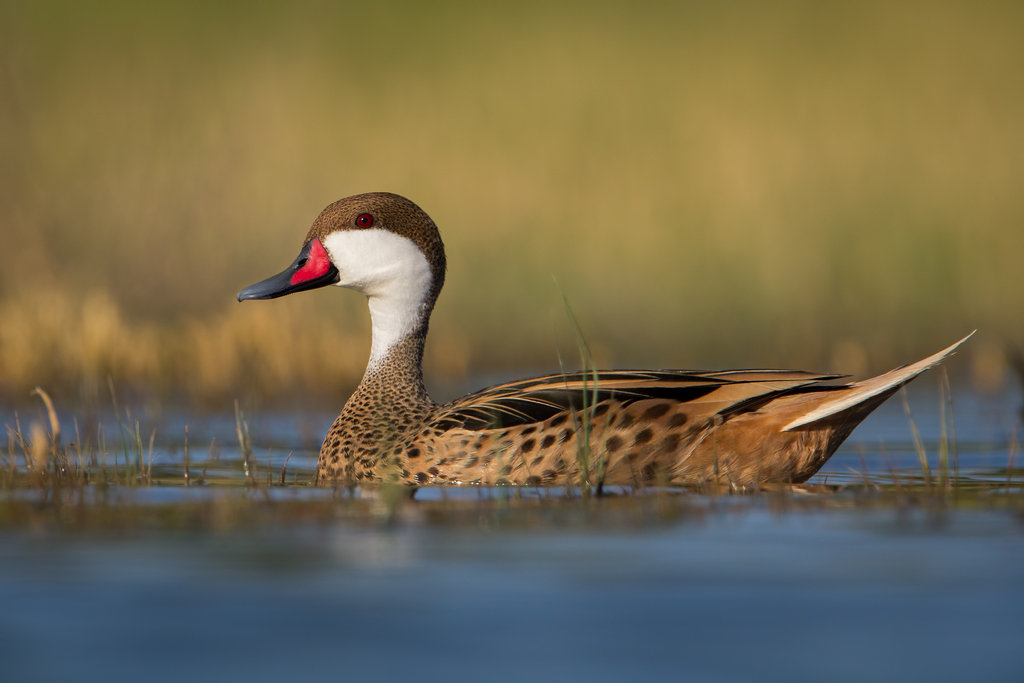
The white-cheeked pintail (Anas bahamensis), also known as the Bahama pintail, Bahama duck, or Galápagos duck is a species of dabbling duck that is patchily distributed throughout South America and the Caribbean. It was first described by Carl Linnaeus in his landmark 1758 10th edition of Systema Naturae under its current scientific name.
From the article White-cheeked pintail on Wikipedia (CC BY-SA), quoted section by section
Description
Like many southern ducks, the sexes are similar, though females are slightly smaller and duller in plumage. It is mainly brown with white cheeks and a red-based grey bill; juveniles have duller bill. The wing has an iridescent green speculum. Like the other pintails, it has a slender, acutely pointed tail, though not so marked as in the northern pintail A. acuta. It cannot be confused with any other duck in its range.
Range & habitat
It is found in the Caribbean, South America, and the Galápagos Islands. It often occurs on waters with some salinity, such as brackish lakes, estuaries and mangrove swamps, but also on freshwater pools and lakes. It usually occurs in coastal lowlands, but A. b. rubrirostris occurs as high as 2,550 m in Bolivia.
Wikipedia: “Distribution and habitat”
What it does
The white-cheeked pintail feeds on aquatic plants (such as Ruppia), grass seeds, algae and small creatures (such as insects and small aquatic invertebrates) obtained by dabbling. The nest is on the ground under vegetation and near water.
Wikipedia: “Behaviour”
In human culture
It is popular in wildfowl collections, and escapees are occasionally seen in a semi-wild condition in Europe. A leucistic (whitish) breed is known in aviculture as the silver Bahama pintail.
Wikipedia: “Aviculture”
Listen
Looking for field recordings…
Where it lives
Recorded sightings
—
geo-referenced records in GBIF, from museums, herbaria and field observers.
Drag the globe to turn it. Dots are where records exist, not a range map; darker means more records.
In the old herbals & bestiaries

In the stacks
Searching the stacks…
Every page naming Anas bahamensis in the Biodiversity Heritage Library →
This page is assembled live from iNaturalist, GBIF, Wikipedia, the Source Library and the Internet Archive. It is not yet part of the hand-edited codex. iNaturalist taxon 6951.