On eBird ↗
Velvet Scoter
Live sightings near you, the range map, bar charts of when it is seen, and Macaulay Library photos and recordings.
Velvet Scoter
Melanitta fusca
The velvet scoter (Melanitta fusca), also called a velvet duck, is a large sea duck, which breeds over the far north of Europe and Asia west of the Yenisey basin.The genus name is derived from Ancient Greek melas "black" and netta "duck". The species name is from the Latin fuscus "dusky brown".
From the article Velvet scoter on Wikipedia (CC BY-SA), quoted section by section
Description
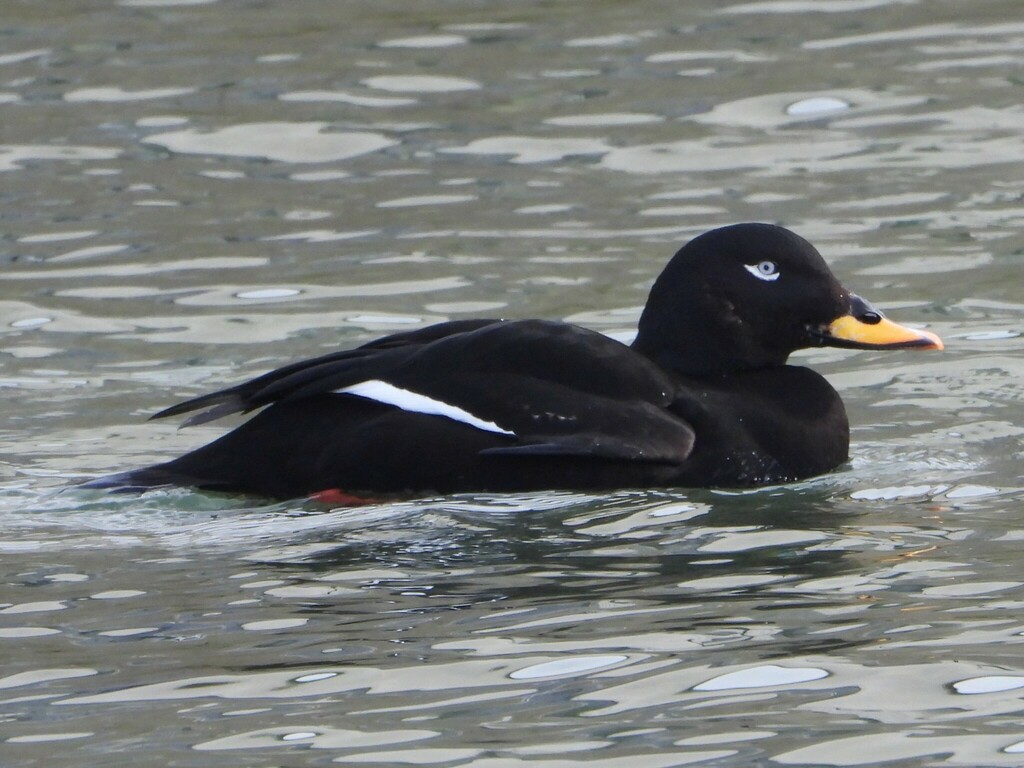
The velvet scoter is 51–56 cm (20–22 in) in length and has a wingspan of 90–99 cm (35–39 in). It is a relatively large sea duck with a thick neck, a long broad bill and a pointed tail. The plumage of the male is glossy black with large white wing patches and small white patches behind the eye. The bill is partly orange. The female is similar to the male but lacks the gloss on the feathers and is duller and browner.
Range & habitat
They breed in northern Europe, from Norway to the Yenisey River in central Siberia and also northeast Kazakhstan. It winters farther south in temperate zones, Europe as far south as Great Britain, and on the Black and Caspian Sea. Small numbers reach France and northern Spain. It forms large flocks on suitable coastal waters. These are tightly packed, and the birds tend to take off together. Lake Tabatskuri in the region of Samtskhe–Javakheti, Georgia, holds the last breeding population of velvet scoters in the Caucasus. Studies into this population in 2017–2018 found 25–35 pairs at the lake, with substantially fewer nesting. Telemetry studies revealed this population winters in the Black Sea, particularly the Samsun Bay in Turkey. Competition for nesting locations, predation on velvet scoters by gulls, and disturbance by fishing activities were identified as contributing factors to reproductivity rates that were considered as "poor".
Wikipedia: “Distribution”
Listen
Looking for field recordings…
Where it lives
Recorded sightings
—
geo-referenced records in GBIF, from museums, herbaria and field observers.
Drag the globe to turn it. Dots are where records exist, not a range map; darker means more records.
In the stacks
Searching the stacks…
Every page naming Melanitta fusca in the Biodiversity Heritage Library →
This page is assembled live from iNaturalist, GBIF, Wikipedia, the Source Library and the Internet Archive. It is not yet part of the hand-edited codex. iNaturalist taxon 850858.