- Animals
- ›Chordates
- ›Vertebrates
- ›Mammals
- ›Therians
- ›Placental Mammals
- ›Primates, Rodents, and Allies
- ›Primates
- ›Monkeys, Apes, and Tarsiers
- ›Monkeys and Apes
- ›Apes and Old World Monkeys
- ›Old World Monkeys
- ›Colobines
- ›Colobuses
- ›Piliocolobus
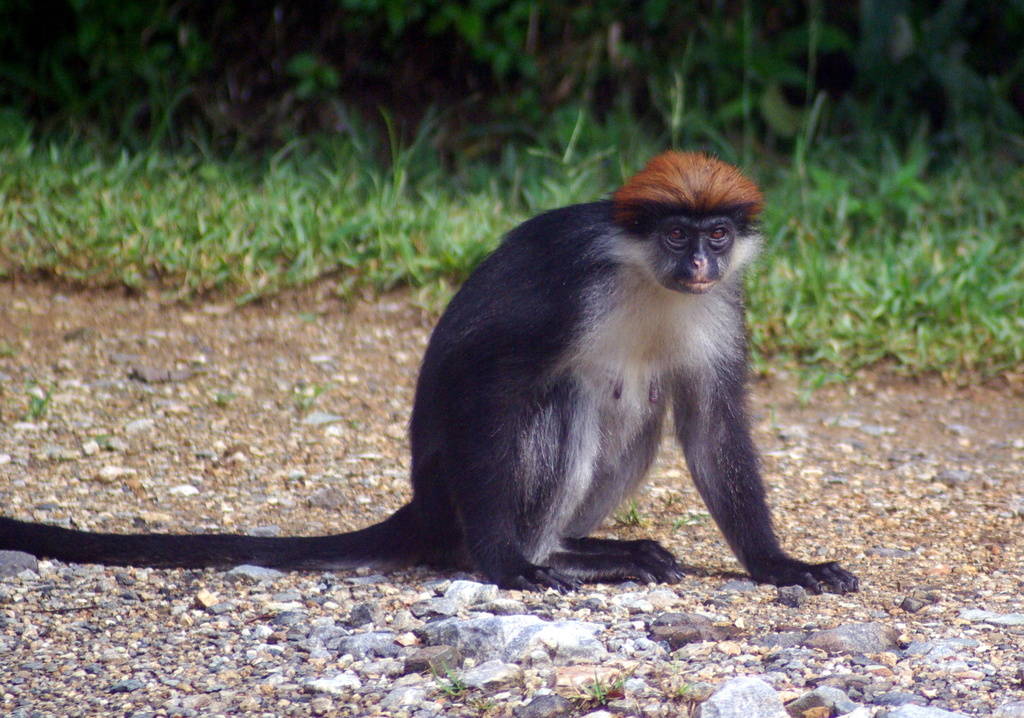
Udzungwa Red Colobus
Piliocolobus gordonorum
The Udzungwa red colobus (Piliocolobus gordonorum), also known as the Uzungwa red colobus or Iringa red colobus, is a species of the primate family Cercopithecidae that is endemic to riverine and montane forests in the Udzungwa Mountains in Tanzania. It is classified as Vulnerable in the IUCN Red List.
From the article Udzungwa red colobus on Wikipedia (CC BY-SA), quoted section by section
Description
The Udzungwa red colobus is a medium-sized monkey with a long tail. The males do not differ much in size from the females, but have longer canine teeth and a thicker tail. The body is covered with predominantly black fur with some greyish hairs. The sides of the face and underside are covered with white hairs. It has a tuft of brown or red hair like a crown on top of the head. The face is black with white colored lips and nose.
Wikipedia: “Morphology”
Range & habitat
The Uzungwa red colobus is endemic to riverine and montane forests in the Udzungwa Mountains in the Kilolo District of the Iringa Region in Tanzania. It occurs in a variety of habitats from dry lowland forests to wet montane forests. It is found in large numbers in low-altitude semi-evergreen and deciduous forests with high precipitation. A 2009 study estimated the population at 25,000 to 35,000 mature individuals. It is threatened by habitat loss and is classified as a vulnerable species on the IUCN Red List.
Wikipedia: “Distribution and habitat”
What it does
The red colobus is mostly diurnal, and spends more than one-third of the day feeding. The diet mainly consists of leaves. The animals are also known to dig and eat the soil, presumably to get minerals to aid in digestion and serve as an antitoxin. The primates often live in large social groups, and solitary individuals are rare in the wild. The groups tend to be larger in forested areas and smaller in dry lands. Adult males rarely show aggression and often engage in social behaviour within the group.
== References ==
Wikipedia: “Behaviour”
Listen
Looking for field recordings…
Where it lives
Recorded sightings
—
geo-referenced records in GBIF, from museums, herbaria and field observers.
Drag the globe to turn it. Dots are where records exist, not a range map; darker means more records.
In the stacks
Searching the stacks…
Every page naming Piliocolobus gordonorum in the Biodiversity Heritage Library →
This page is assembled live from iNaturalist, GBIF, Wikipedia, the Source Library and the Internet Archive. It is not yet part of the hand-edited codex. iNaturalist taxon 326023.