- Animals
- ›Chordates
- ›Vertebrates
- ›Mammals
- ›Therians
- ›Placental Mammals
- ›Primates, Rodents, and Allies
- ›Primates
- ›Monkeys, Apes, and Tarsiers
- ›Monkeys and Apes
- ›Apes and Old World Monkeys
- ›Old World Monkeys
- ›Colobines
- ›Langurs, Surilis, and Lutungs
- ›Simias
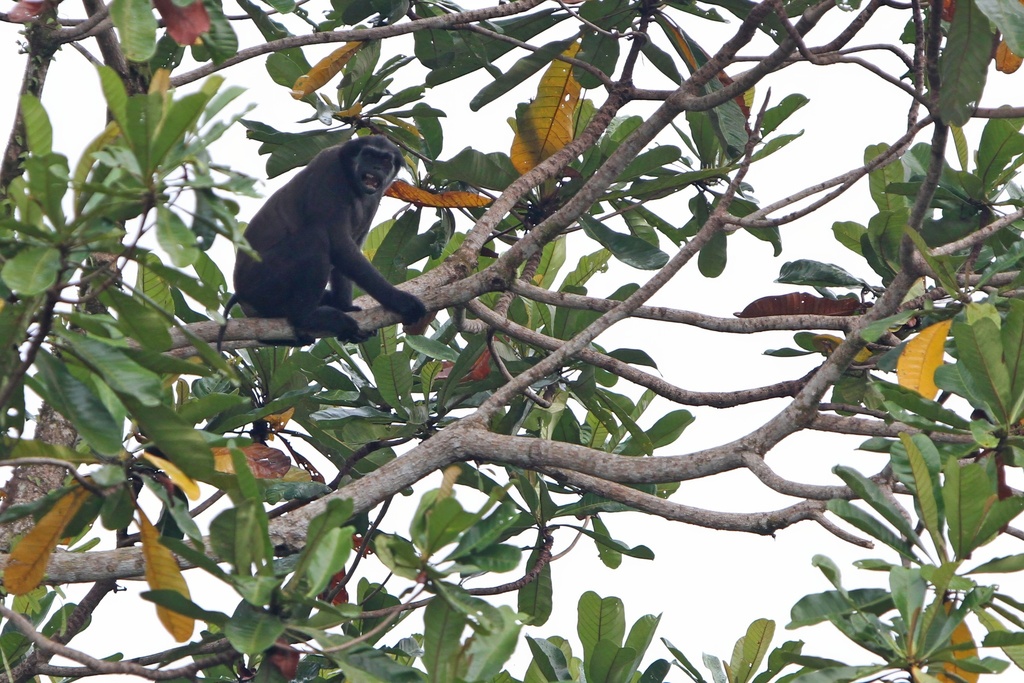
Pig-tailed Langur
Simias concolor
The pig-tailed langur (Simias concolor), monotypic in genus Simias, is a large Old World monkey, endemic to several small islands off the coast of Sumatra in Indonesia. Its face is black, its fur is black-brown and it has a relatively short tail. It is a diurnal species, feeding in the rainforest canopy on leaves, and to a lesser extent, fruit and berries. Little is known of its natural history, but it is heavily hunted, its populations have been declining rapidly and the International Union for Conservation of Nature has assessed its conservation status as being "critically endangered". It has been included on a list of the World's 25 Most Endangered Primates.
As an arboreal primate the pig-tailed langur spends most of its time in the canopy devoting the majority of its activity budget towards resting and feeding. The structure of groups is single-male, multi-female. Group sizes range from around 3 to 9 individuals depending on locations and hunting pressures. There are two subspecies of this primate, Simias concolor concolor which lives in the southern Mentawai islands, and Simias concolor siberu which lives exclusively in the northern island of Siberut. Sexual dimorphism and sexual swelling is exhibited by this species.
From the article Pig-tailed langur on Wikipedia (CC BY-SA), quoted section by section
Description
The pig-tailed langur is a large and rather heavily built Old World monkey, adapted to climbing with its long arms. Its fur is black-brown, and its hairless face is also black. It is the only monkey in the subfamily Colobinae to have a relatively short tail; the tail is only slightly furred and is only 15 cm (5.9 in) long. The short nose is pointed upward. The pig-tailed langur reaches a full grown length of approximately 50 cm (20 in) and a weight of 7 kg (15 lb). Sexual dimorphism is exhibited by this species with adult males being larger and heavier than adult females. Sexual swelling is exhibited by this species which is rare for single male multi female groups of Colobinae monkeys.
Range & habitat
This primate is endemic to the Mentawai Islands, there are two subspecies, Simias concolor concolor also known as simasepsep which resides on the southern islands of Sipora, North Pagai, and South Pagai. The second subspecies is Simias concolor siberut also known as simakobou which lives only on the island of Siberut. It is a diurnal and arboreal rain forest dweller, often spending most of its time in the canopy but occasionally comes to ground. The activity budget of this primate is mostly resting and feeding with a small fraction of time devoted towards travel and social behavior. Some studies in the Siberut area show relatively low group sizes (mean group size 2.6). Other parts in Siberut show relatively high group sizes (mean group size 8.7). The reason for different group sizes is not factually known, however many researchers suggest that it could be due to anthropogenic factors such as hunting and deforestation. The pig-tailed langur has single-male, multi-female groups. The mating system of this species follows a polygynous structure although it was originally thought to be monogamous.
Wikipedia: “Distribution and social systems”
What it does
It is an omnivore with a diet consisting of leaves, flowers, fruits and occasionally insects. The availability of these foods in this area are abundant especially in unripe and ripe fruits. Leaves are the most abundant in their diet followed by fruits. As with all other Colobinae primates, this species is diurnal.
Wikipedia: “Diet”
Toxicity
This species is classified as Critically endangered by the International Union for Conservation of Nature. It was classified as Endangered (IUCN status) up until 2008 were the endangerment status was changed to Critically Endangered. It is among The World's 25 Most Endangered Primates due to the many anthropogenic pressures it faces on the islands which include, destruction of forest for commercial use, hunting and illegal pet trade. Population size estimates have been conducted across many years with varying islands being chosen for research areas. In the 1980s population estimates of the Pig-tailed langur was 19,000 on the island of Siberut and 26,000 across all four islands. In 2004 Lisa M. Paciulli dedicated their PhD dissertation towards studying threats to Mentawai island primates and determining population densities associated with logging pressures. Population estimates were found to be around 6,700-17,300 across all islands with a large amount of variation being attributed due to hunting and logging pressures. Population densities were 2.5 individuals/km2 in logged areas whereas unlogged areas had a population density of 5 individuals/km2. An extensive population density survey was conducted by the University of Indonesia on four endemic Mentawai primates. …
Wikipedia: “Endangerment status and threats to conservation”
Listen
Looking for field recordings…
Where it lives
Recorded sightings
—
geo-referenced records in GBIF, from museums, herbaria and field observers.
Drag the globe to turn it. Dots are where records exist, not a range map; darker means more records.
In the stacks
Searching the stacks…
Every page naming Simias concolor in the Biodiversity Heritage Library →
This page is assembled live from iNaturalist, GBIF, Wikipedia, the Source Library and the Internet Archive. It is not yet part of the hand-edited codex. iNaturalist taxon 75081.