- Animals
- ›Chordates
- ›Vertebrates
- ›Mammals
- ›Therians
- ›Placental Mammals
- ›Primates, Rodents, and Allies
- ›Primates
- ›Monkeys, Apes, and Tarsiers
- ›Monkeys and Apes
- ›Apes and Old World Monkeys
- ›Old World Monkeys
- ›Colobines
- ›Langurs, Surilis, and Lutungs
- ›Semnopithecus
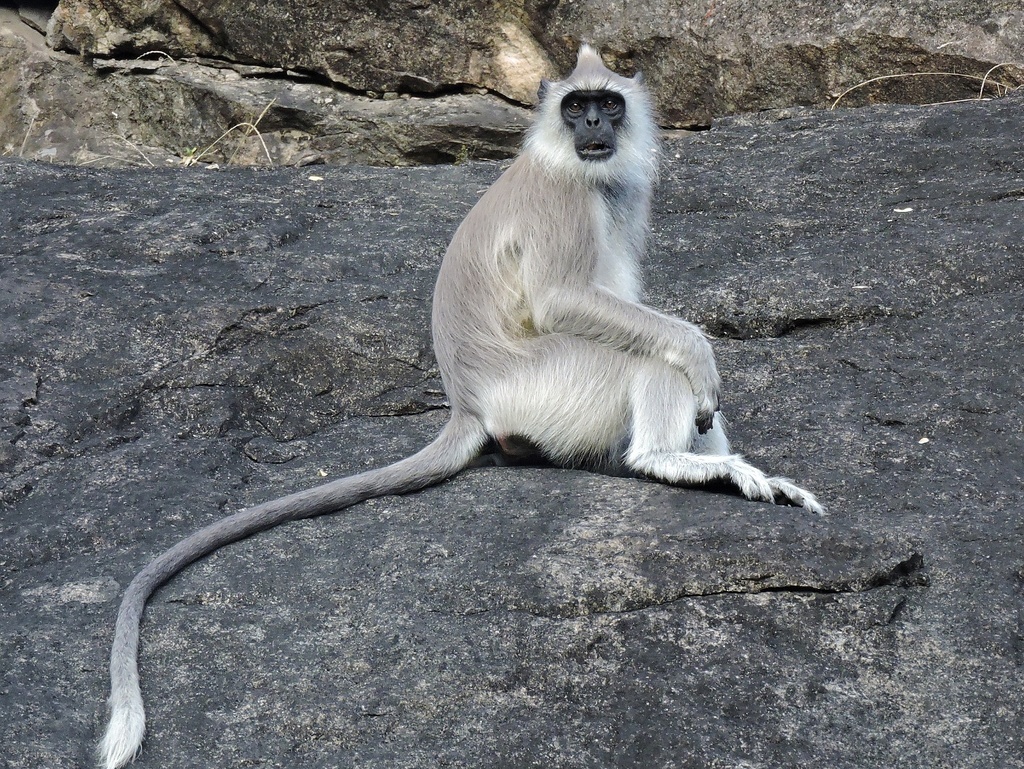
Tufted Gray Langur
Semnopithecus priam
The tufted gray langur (Semnopithecus priam), also known as Madras gray langur, and Coromandel sacred langur, is an Old World monkey, one of the species of langurs. This, like other gray langurs, is mainly a leaf-eating monkey. It is found in southeast India and Sri Lanka. It is one of three Semnopithecus species named after characters from The Iliad, S. hector and S. ajax being the others. In Sinhala it is known as හැලි වඳුරා (Heli wandura).
From the article Tufted gray langur on Wikipedia (CC BY-SA), quoted section by section
Range & habitat
In Sri Lanka, tufted gray langurs are abundant in dry zone forests and also within human dwellings. Many numerous troops are found at archeologically important areas, such as Polonnaruwa, Dambulla, Anuradhapura, and Sigiriya. The animal is also found in southward of the island, such as Hambantota, Yala National Park, and Tissamaharama.
Wikipedia: “Habitat”
What it does
Generally a shy animal, tufted gray langurs are partially arboreal, semi-terrestrial and diurnal in habit. They always find a way to come to the ground when there is no danger. Unlike the canopy-dweeling sympatric relatives, they are rather common in urban settlements, found in gardens, and other large fruit trees such as Mangifera indica, and Artocarpus heterophyllus.
Diet. Mostly folivorous, tufted gray langurs are fond of eating anything vegetarian. They are known to eat fruits and seeds. Langurs are differ from leaf monkeys, where latter is known to eat mature, fleshy fruits, and langurs are like to eat partially drier fibrous fruits. The leaves of Drypetes sepiaria, Dimocarpus longan, Ficus microcarpa, Holoptelea integrifolia, and fruits and seeds of Hydnocarpus venenata, Ficus arnottiana, Macaranga peltata are known to eat by Sri Lankan subspecies. Sometimes, the troops can be seen near the water bodies, where they feed on Nelumbo nucifera seeds. Insects and everygreen leaves are eaten when others foods are less abundant and bark is only eaten when there is no other food available. The Gray Langur's diet is high in strychnine, which can be harmful to animals. Therefore, it will commonly ingest the gum of the Sterculia urens to counteract the effects. This gum is marketed in England as a prescription laxative known as Normacol.
Predators. …
Wikipedia: “Ecology”
Listen
Looking for field recordings…
Where it lives
Recorded sightings
—
geo-referenced records in GBIF, from museums, herbaria and field observers.
Drag the globe to turn it. Dots are where records exist, not a range map; darker means more records.
In the stacks
Searching the stacks…
Every page naming Semnopithecus priam in the Biodiversity Heritage Library →
This page is assembled live from iNaturalist, GBIF, Wikipedia, the Source Library and the Internet Archive. It is not yet part of the hand-edited codex. iNaturalist taxon 1071036.