- Animals
- ›Chordates
- ›Vertebrates
- ›Ray-finned Fishes
- ›Carps, Characins, Catfishes and Allies
- ›Catfishes
- ›Loricarioidei
- ›Pencil Catfishes
- ›Vampire Catfishes
- ›Vandellia
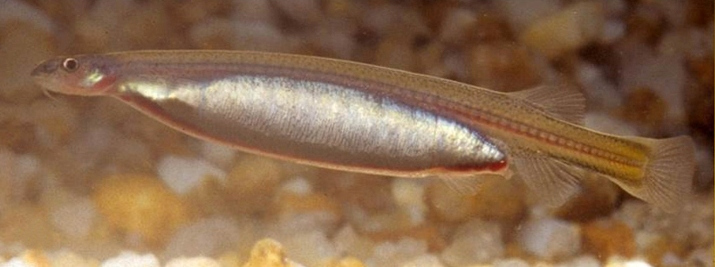
Candiru
Vandellia cirrhosa
Vandellia cirrhosa, known by the common names candiru, cañero, toothpick fish, or vampire fish, is a species of parasitic freshwater catfish in the family Trichomycteridae native to the Amazon basin where it is found in the countries of Bolivia, Brazil, Colombia, Ecuador, and Peru. The name "candiru" is also used to refer to other catfish species, including the entire genus Vandellia.
This species is known for an alleged tendency to invade and parasitize the human urethra and other bodily openings; however, despite ethnographic reports dating back to the late 19th century, the first documented case of the removal of a candiru from a human urethra did not occur until 1997, and even that incident has remained a matter of controversy. Scientifically, this fish only parasitizes larger fish which it shares its habitat with; it consumes their host's blood from their gill openings, thus the candiru is a hematophagic species.
From the article Vandellia cirrhosa on Wikipedia (CC BY-SA), quoted section by section
Description
Vandellia cirrhosa is a small, freshwater catfish. Members of the genus Vandellia can reach up to 17 cm (7 in) in standard length, but some others can grow to around 40 cm (16 in). The fish has an elongated body with an anterior dorsal fin and pelvic fin, and an anal fin slightly larger than the dorsal fin. The caudal fin is fairly small with a truncated shape. Each has a rather small head and a belly that can appear distended, especially after a large blood meal. The body is translucent, making it quite difficult to spot in the turbid waters of its home. Blood is often visible through the translucent body after feeding. The fish has small eyes with yellow irises. There are short sensory barbels around the head, together with short, backward pointing spines on the gill covers. These spines have been described as popping out in an umbrella-like fashion, which could be used to help lodge the fish into its host. All members of the subfamily Vandelliinae share the traits of blood parasitism, with parasitism in general being a shared ancestral trait of all members of Trichomycteridae. They have individual claw-like teeth for this purpose. Their bodies are very small and elongated to easily slip into the gills of host fish.
Range & habitat
Candiru inhabits the Amazon and Orinoco basins of lowland Amazonia. This fish lives in shallow water with muddy, sandy, or rocky bottoms. It can be found in riffles. Its distribution is patchy and it does not seem to move very far from its spawning sites. One location that Vandellia cirrhosa is specifically known to inhabit is the Purus River of Brazil. This location is hard to study due to its geographic isolation, something that is common among the habitats of candiru.
Wikipedia: “Habitat and distribution”
What it does
Candiru are hematophagous and parasitizes the gills of larger Amazonian fish, especially catfish of the family Pimelodidae (Siluriformes) and members of the family Characidae. However, it has been known to parasitize many species in the same location, suggesting that its feeding habit is based more on availability than species preference. Vandellinae is one of only two groups of jawed vertebrates that exclusively feed on blood. The feeding mechanism of the candiru was not understood until fairly recently, but many theories had been proposed before. Some suggested that it uses its sharp teeth to latch onto an artery or vein and stays attached to the host until it has ingested enough blood. It then lets go of the host and continues swimming. Others suggested that it extracts blood from its hosts by latching onto the gill filaments, which bleed freely into the alimentary tract of the candiru. In one experiment involving Vandellia cirrhosa, no evidence of gill damage was found on the fish hosts. Thus, the experimenter suggested a hypothetical blood-pumping mechanism in which the candiru is able to quickly ingest large amounts of blood without permanently damaging the host. Modern experiments have shown that the candiru feeds by approaching a host fish and swimming alongside it until close to the gill cover. It then attempts to penetrate the gill chamber by forcing itself underneath. …
Wikipedia: “Diet”
Where it lives
Recorded sightings
—
geo-referenced records in GBIF, from museums, herbaria and field observers.
Drag the globe to turn it. Dots are where records exist, not a range map; darker means more records.
In the stacks
Searching the stacks…
Every page naming Vandellia cirrhosa in the Biodiversity Heritage Library →
This page is assembled live from iNaturalist, GBIF, Wikipedia, the Source Library and the Internet Archive. It is not yet part of the hand-edited codex. iNaturalist taxon 418813.