- Animals
- ›Chordates
- ›Vertebrates
- ›Ray-finned Fishes
- ›Spiny-rayed fishes
- ›Rivulines, Killifishes, and Livebearers
- ›Cyprinodontoidei
- ›Topminnows
- ›Fundulus
- ›Plancterus
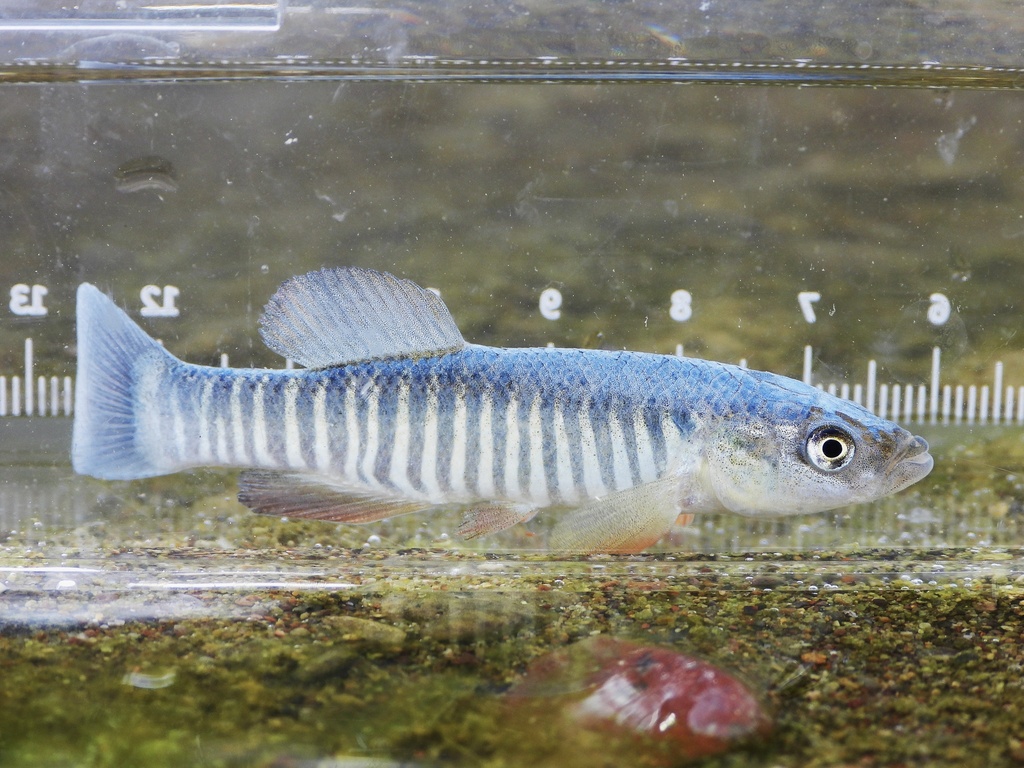
Southern Plains Killifish
Fundulus zebrinus
Fundulus zebrinus is a species of fish in the Fundulidae known by the common name plains killifish. It is native to North America, where it is distributed throughout the Mississippi River, Colorado River, and Rio Grande drainages, and other river systems; many of its occurrences represent introduced populations.
From the article Fundulus zebrinus on Wikipedia (CC BY-SA), quoted section by section
Description
This fish grows up to about 6.9 cm (2.7 in), with a maximum length of 8–10 cm (3.1–3.9 in). Its lifespan is up to 3 years, but most fish do not exceed two. It has a flat head with a protruding jaw that allows it to feed at the water's surface. It is variable in color, being brown, black, greenish, or straw-colored, with paler yellowish or silvery coloration on the belly. The fish is striped with the 12 to 28 dark vertical bars that give the species its scientific name, meaning "like a zebra". The males have wider, darker bars than the females. The breeding male develops bright orange coloration on most of his fins. This species feeds on chironomid larvae, copepods, nematodes, and other small animals. It is also herbivorous. It may feed by scooping up and swallowing mouthfuls of riverbed substrate to obtain buried food objects. The fish often spits out most of the sand and undigestible material, but the digestive tract usually contains an amount of sand. The fish eats mosquito larvae when available, and studies suggest it might be useful in mosquito abatement efforts. The fish lives in a number of shallow river and stream habitat types. It may occur in lower, moderate and swift, turbid water flows. It may be found in lakes. It is tolerant of brackish, alkaline, and salty water, more so than most other local fish species. …
Range & habitat
This species has a wide range, mostly in the central United States. Its native range is mostly within the Great Plains. It includes much of the Mississippi River drainage, parts of the Colorado and Brazos Rivers, and some areas in the Rio Grande region, especially the Pecos River. Its distribution was influenced by Pleistocene changes in the geography of the local river systems, such as glaciation. Many occurrences of the fish represent introductions, such as populations at Lake Powell in Arizona and Utah, the Fort Peck Reservoir in Montana, and several tributaries of the Colorado River in Colorado, Utah, and Nevada. Some occurrences may or may not be native. Fish introductions began in earnest around the 1930s. Most introductions occurred when plains killifish were used as bait by anglers and escaped into the wild to establish new populations.
== References ==
Wikipedia: “Distribution”
Where it lives
Recorded sightings
—
geo-referenced records in GBIF, from museums, herbaria and field observers.
Drag the globe to turn it. Dots are where records exist, not a range map; darker means more records.
In the stacks
Searching the stacks…
Every page naming Fundulus zebrinus in the Biodiversity Heritage Library →
This page is assembled live from iNaturalist, GBIF, Wikipedia, the Source Library and the Internet Archive. It is not yet part of the hand-edited codex. iNaturalist taxon 101075.