- Animals
- ›Chordates
- ›Vertebrates
- ›Ray-finned Fishes
- ›Spiny-rayed fishes
- ›Rivulines, Killifishes, and Livebearers
- ›Cyprinodontoidei
- ›Topminnows
- ›Fundulus
- ›Fundulus
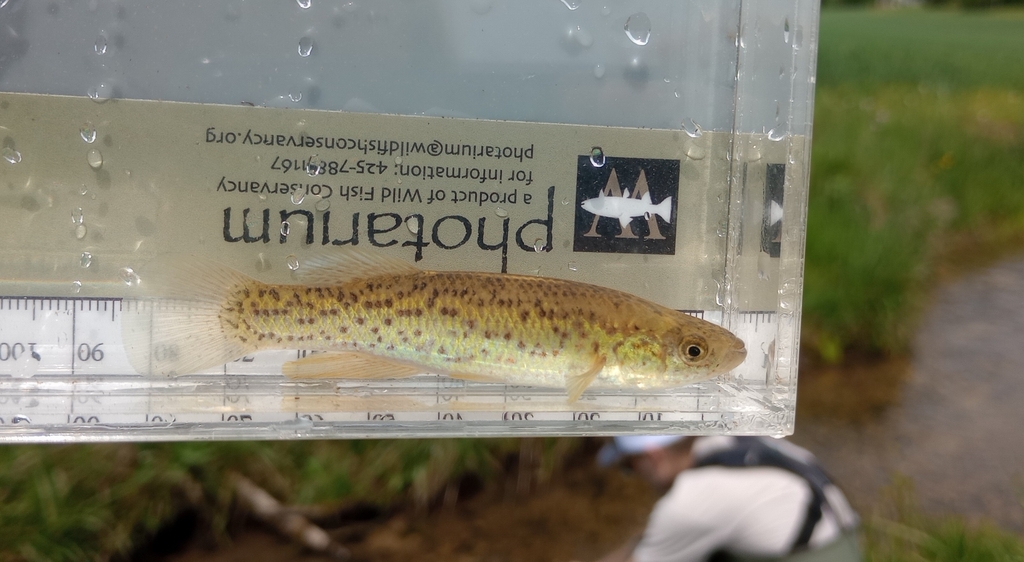
Barrens Topminnow
Fundulus julisia
The Barrens topminnow (Fundulus julisia) is a species of freshwater fish in the Fundulidae family, which is in need of management so that it may continue to and increasingly survive in the wild. There are many potential causes of decline of this species including the invasive western mosquitofish (Gambusia affinis) that will replace native species on a population level, wadding piscivorous birds preying on adults, and the overall restricted distribution of the species. Managing for this...
From the article Barrens topminnow on Wikipedia (CC BY-SA), quoted section by section
Range & habitat
F. julisia is not only found in one state, Tennessee, but also in only one region, the Barrens Plateau, a region of Middle Tennessee west of the Cumberland Plateau. In that specific region it is currently only found in the Elk River and a drainage creek of the Cumberland River, West Hickory Creek. However, that has not always been the only thought of location for F. julisia's habitat. They are often associated with springs, but drought conditions made them adapt to survive in springs where permanent water was near by. They prefer heavily vegetated areas of aquatic vegetation or algae in shallow, slow moving water. Given the above habitat, it is observed that F. julisia can tolerate warm temperatures of water and turbidity, the presence of competitors, and the presence of predators. This, along with spawning, make aquatic vegetation a limiting factor for the fish. Historically, F. julisia was also found in the Duck River. The population there is thought to have been extirpated by the 1960s.
Wikipedia: “Geographic distribution”
What it does
In overall behavior F. julisia does not differ greatly from other members of the genus Fundulus. It is an opportunistic carnivore that preys upon crustaceans, gastropods (snails and slugs), and insects that are both aquatic and that fall into the substrate. In an examination of gut contents it was found that crustaceans made up 64% of their diet while aquatic insects made up 23% and various other organisms made up the remaining 13%. It competes for this prey with F. catenatus (northern studfish) and Gambusia affinis (western mosquitofish). This is an interesting relationship because G. affinis is one of the leading causes of decline in F. julisia due to competition for the same prey. F. julisia is preyed upon by bass (Micropterus species) and sunfish (Lepomis species) within the substrate. Outside the water F. julisia is preyed upon by piscivorous birds that spear them with a sharp tipped beak or catch them with ridged edged beaks. During breeding season males are easily spotted due to their bright mating colors, which makes them easier prey. Males have been found to have two different morphs with the primary difference being the marginal and submarginal bands on the caudal and posterior dorsal fin. One morph has a pale yellow submarginal band and the other translucent blue with white and orange submarginal bands. …
Wikipedia: “Ecology”
In human culture
Breeding season for this species is annual and is believed to be as early as mid-March when the males were observed to first have their breeding colors. At this time the water temperature is roughly 14–15 °C (57–59 °F). Eggs have been collected in mid-April from clumps of algae. Females lay around 200 to 250 mature ova over a period of time, laying only a few daily. Though relatively opportunistic in spawning sites, F. julisia egg morphology suggests that submergent vegetation is most preferred and in turn most successful. Loss of successful spawning sites could be one of the main ecological factors that limit its distribution. Territoriality has been observed in the field, but it is more abundant in aquaria settings. In aquaria males have been observed defending portions of the tank that resulted in a single male's dominance. In the field males only slightly defend their clumps of filamentous algae. Females never exhibited territorial behavior in the field, but were seen defending feeding areas in the aquaria. Sexual maturity is reached at 1 year with a maximum lifespan of three years, though most individuals do not live that long and die off after spawning.
Wikipedia: “Life history”
Where it lives
Recorded sightings
—
geo-referenced records in GBIF, from museums, herbaria and field observers.
Drag the globe to turn it. Dots are where records exist, not a range map; darker means more records.
In the stacks
Searching the stacks…
Every page naming Fundulus julisia in the Biodiversity Heritage Library →
This page is assembled live from iNaturalist, GBIF, Wikipedia, the Source Library and the Internet Archive. It is not yet part of the hand-edited codex. iNaturalist taxon 101059.