 NL·0235
Herbarium of the Nature Library
- Name
- Astyanax mexicanus
- Family
- Acestrorhamphidae
- Native to
- Lower Rio Grande and Pecos (Texas) south through north-eastern and central Mexico; cave forms in about 30 caves of the Sierra de El Abra and Sierra de Guatemala, Tamaulipas and San Luis Potosí
- Habitat
- Rivers and streams, Limestone caves
Mexican tetra (blind cavefish)
Astyanax mexicanus
Also calledSardinita mexicana (Spanish) · Pez ciego de las cavernas (Spanish) · Blind cave tetra (aquarium)
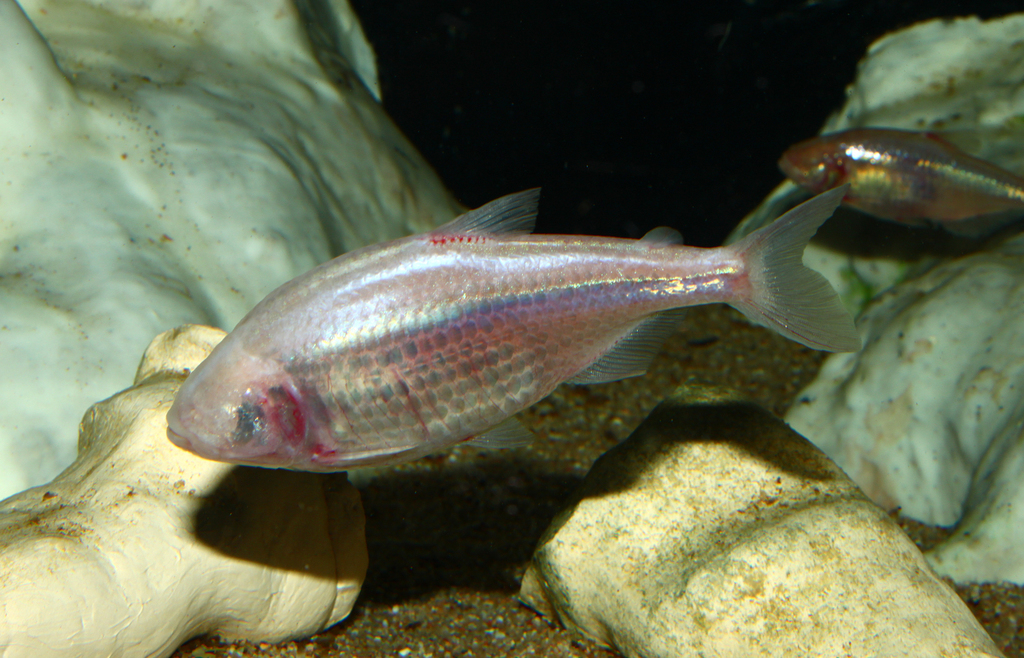
One species, two worlds: a silvery river tetra, and blind, pink cave-dwelling forms that lost their eyes and pigment in the darkness of Mexican caves. Biologists study the pair to see how evolution rewires genes.
The Mexican tetra, also known as the blind cave fish, blind cave characin or the blind cave tetra, is a species of freshwater ray-finned fish belonging to the family Acestrorhamphidae, the American characins. This fish is found in the lower Rio Grande, and the Nueces and Pecos Rivers in Texas, into the Central Plateau and eastern states of Mexico. Wikipedia
What it can do
- iCave forms begin to grow eyes as embryos, then the eyes degenerate and are covered by skin
- iiCavefish sleep far less than surface fish of the same species
- iiiCavefish resist starvation by storing fat and live healthily with high blood sugar and insulin resistance
- ivCompensates for blindness with more taste buds and an enhanced lateral line
In the field
Field marks
- aSurface form: silvery tetra with a dark spot or stripe at the tail base and reddish fins
- bCave form: pink-white, no visible eyes, skin over the eye sockets
- cAdipose fin present in both
- Not to be confused with
- Other Astyanax tetras in Central America (A. aeneus and others) are only told apart in the hand. In the caves of the Sierra de El Abra region, no other eyeless fish looks like it.
- Where to see it
- Cueva de El Pachón and Sótano de la Tinaja (permits needed); surface fish in the Río Tampaón and Río Guayalejo; aquaria and research labs
- When
- Resident; cavefish breed opportunistically year-round
Life & habits
- Diet
- Omnivore: insects, small crustaceans, algae and detritus; cavefish eat bat guano and organic debris
- Habitat
- Surface: clear streams and rivers; cave forms: pools and streams of limestone caves
- Size
- Up to about 12 cm
- Lifespan
- Up to about 15 years in captivity
Surface fish school by day, while cave fish forage alone along the bottom with their heads tilted down.
Where it lives
Recorded sightings
—
geo-referenced records in GBIF, from museums, herbaria and field observers.
Native range
Lower Rio Grande and Pecos (Texas) south through north-eastern and central Mexico; cave forms in about 30 caves of the Sierra de El Abra and Sierra de Guatemala, Tamaulipas and San Luis Potosí
Drag the globe to turn it. Dots are where records exist, not a range map; darker means more records.
In the stacks
Searching the stacks…
Every page naming Astyanax mexicanus in the Biodiversity Heritage Library →
Marginalia
Mexican biologist Salvador Coronado collected the first blind cavefish at the Cueva Chica in 1936, and they were described as a new genus, Anoptichthys, before they were found to interbreed with river tetras. Darwin, writing before this discovery, had argued that cave animals lose their eyes through disuse.
Curiosity
Blind cavefish and sighted surface fish can still interbreed, and some of the hybrids have partial eyes.
Kinship



Fact-checked: 1 correction made to this sheet. Photographs: iNaturalist contributors under the licences shown. Records: GBIF.org. Historical plates: Source Library (CC BY-SA 4.0; originals public domain). Summary text: Nature Library editors and Wikipedia (CC BY-SA). Medicinal and edibility notes are historical and educational, not advice. iNaturalist taxon 94765.