- Animals
- ›Chordates
- ›Vertebrates
- ›Ray-finned Fishes
- ›Spiny-rayed fishes
- ›Sawbellies and squirrelfishes
- ›Squirrelfishes and soldierfishes
- ›Squirrelfishes and Soldierfishes
- ›Holocentrinae
- ›Holocentrus
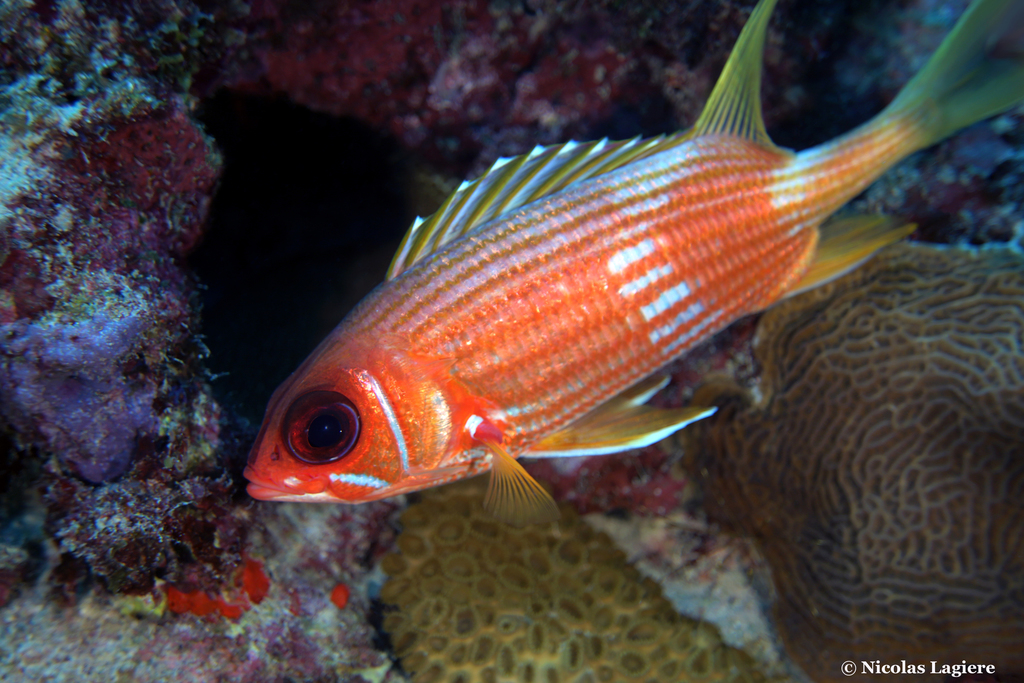
Longspine Squirrelfish
Holocentrus rufus
The longspine squirrelfish (Holocentrus rufus) is a silvery red, sea fish with orange-gold body stripes. One of about 150 species of squirrelfish, their most distinguishing characteristics are their large eyes and the long third spine of the anal fin. It is often included in public aquarium displays. The length of the longspine squirrelfish is about 18 cm (7.8 inches). It lives in coral reefs in tropical and warm temperate seas and eats zoobenthos. It is territorial and uses sounds called "grunts" and "staccatos" to defend its crevice, warn of danger and, in groups, intimidate predators such as the moray eel. The longspine squirrelfish is edible and harvested on a small scale.
From the article Longspine squirrelfish on Wikipedia (CC BY-SA), quoted section by section
Range & habitat
Longspine squirrelfish are marine fish that live in coral reefs. The length of the longspine squirrelfish is up to 18 cm (7.8 inches). They are found along the south eastern coast of the United States to Northern South America and Brazil, as well as in-between locations such as Bermuda and the West Indies. They hide in or near dark recesses. They are territorial and defend their crevices with visual and acoustic displays. They are rare on shallow reefs. They are more abundant with increasing depth and are most abundant between thirty and seventy meters. The juveniles are thin, silvery pelagics and seldom seen.
Wikipedia: “Distribution”
At the table
Most of the food longspine squirrelfish eat is zoobenthos, including crustaceans, mollusks, and gastropods. It tends to guard its territory during the day and feed more actively at night.
Wikipedia: “Food”
Where it lives
Recorded sightings
—
geo-referenced records in GBIF, from museums, herbaria and field observers.
Drag the globe to turn it. Dots are where records exist, not a range map; darker means more records.
In the stacks
Searching the stacks…
Every page naming Holocentrus rufus in the Biodiversity Heritage Library →
This page is assembled live from iNaturalist, GBIF, Wikipedia, the Source Library and the Internet Archive. It is not yet part of the hand-edited codex. iNaturalist taxon 49625.