- Animals
- ›Chordates
- ›Vertebrates
- ›Ray-finned Fishes
- ›Carps, Characins, Catfishes and Allies
- ›Minnows, Suckers, Carps, and Loaches
- ›Carps and Minnows
- ›Cyprinids
- ›Mahseers, Yellowfishes and Allies
- ›Labeobarbus
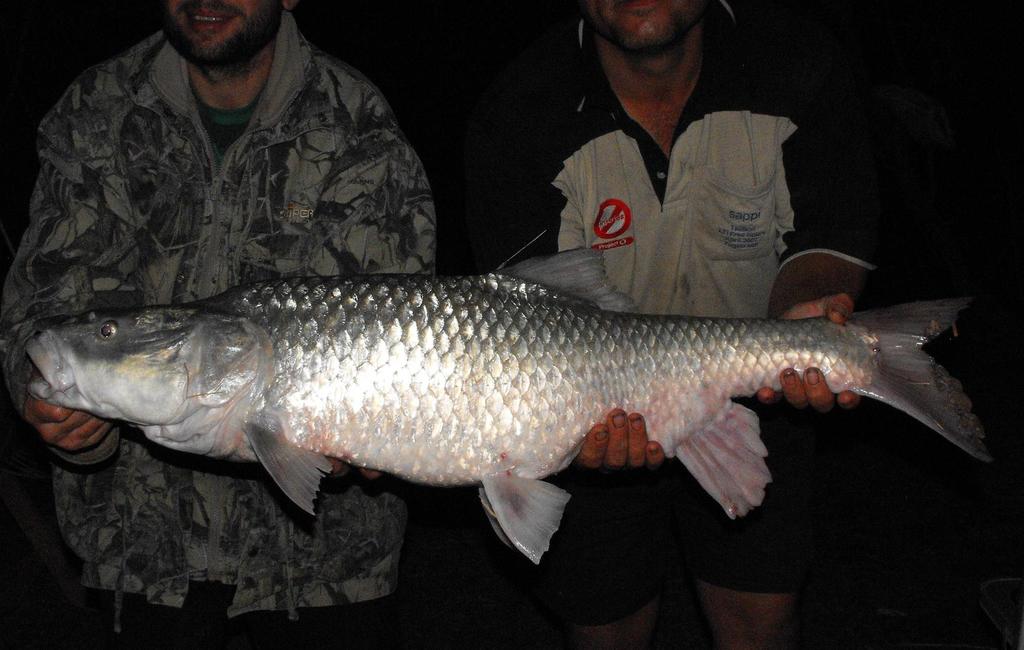
Largemouth Yellowfish
Labeobarbus kimberleyensis
The largemouth yellowfish or Vaal-Orange largemouth yellowfish (Labeobarbus kimberleyensis) is a ray-finned fish species in the family Cyprinidae. This large freshwater barb is found in southern Africa. It is listed as a near threatened species.
From the article Largemouth yellowfish on Wikipedia (CC BY-SA), quoted section by section
Range & habitat
The largemouth yellowfish occurs in the Orange and Vaal Rivers and their larger tributaries (e.g. the Riet River) in Lesotho, Namibia and South Africa. In the latter country, it is found in Eastern Cape Province, Free State, Gauteng, Mpumalanga, North-West Province and Northern Cape Province.
Wikipedia: “Distribution”
What it does
L. kimberleyensis is predominantly found in deep pools (deeper than 2 metres/yards) of large rivers, as well as in the slow-moving water before weirs and river dams (e.g., Sterkfontein Dam). Abundant water weeds, overhanging riparian vegetation and other forms of plant cover seem to be essential for its well-being. These fish are predators of aquatic large and small invertebrates, with adults feed almost exclusively on other fish. Spawning occurs in riffles during the summer season (around December/January), with a large female able to lay more than 60,000 eggs in a single spawning season. They are relatively slow-growing and long-lived fish, reaching a total length of 30 cm (12 in) only after five years.
Wikipedia: “Ecology”
Where it lives
Recorded sightings
—
geo-referenced records in GBIF, from museums, herbaria and field observers.
Drag the globe to turn it. Dots are where records exist, not a range map; darker means more records.
In the stacks
Searching the stacks…
Every page naming Labeobarbus kimberleyensis in the Biodiversity Heritage Library →
This page is assembled live from iNaturalist, GBIF, Wikipedia, the Source Library and the Internet Archive. It is not yet part of the hand-edited codex. iNaturalist taxon 103845.