- Animals
- ›Chordates
- ›Vertebrates
- ›Ray-finned Fishes
- ›Spiny-rayed fishes
- ›Butterflyfishes, Angelfishes, and Allies
- ›Surgeonfishes, Tangs, and Unicornfishes
- ›Acanthurus
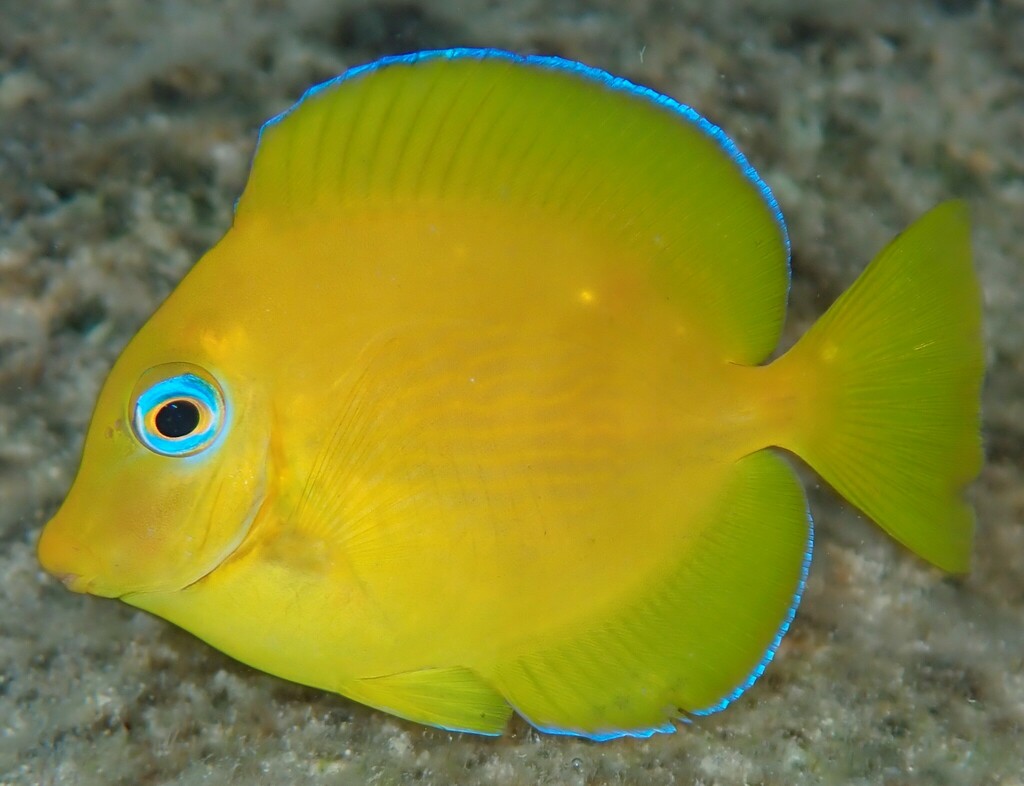
Atlantic Blue Tang
Acanthurus coeruleus
Acanthurus coeruleus is a species of marine ray-finned fish belonging to the family Acanthuridae, the surgeonfishes, unicornfishes and tangs, found in the Atlantic Ocean. It can grow up to 39 centimetres (15 in) long. Common names include Atlantic blue tang, blue barber, blue doctor, blue doctorfish, blue tang, blue tang surgeonfish, yellow barber, and yellow doctorfish.
From the article Acanthurus coeruleus on Wikipedia (CC BY-SA), quoted section by section
Description
Although the body of the reef fish can vary in shade from light to dark blue, the dorsal, anal and caudal fins are golden blue. As juveniles, the edges on their dorsal and anal fins and the rings around their eyes are purple-blue, blue or blue-green. Their colors change during growth from a yellow juvenile, yellow tailed blue subadult and the blue adult phase. Acanthurus coeruleus exhibits biofluorescence, that is, when illuminated by blue or ultraviolet light, it re-emits it as green, and appears differently than under white light illumination (see image to the right). Biofluorescence may assist in intraspecific communication and camouflage.
Range & habitat
Acanthurus coeruleus is present in the western Atlantic Ocean from New York to Florida, Mexico and Brazil, and Ascension Island in the Mid-Atlantic. Also found in the Mediterranean Sea since 2011.
Wikipedia: “Distribution”
What it does
Atlantic blue tangs inhabit coral reefs as well as nearby grassy and rocky coastal areas where algae are abundant. They are herbivorous, feeding primarily on filamentous algae, detritus and plankton. They eat the algae from the reefs in which they reside, as well as off the bodies of surrounding fish. By eating the algae off of other fish, the blue tang serve as cleaners for them. With the decline in the Diadema antillarum (sea urchin) population, the blue tang population increased since the algal resources that the two animals usually competed for were more abundant. Juvenile blue tangs feed frequently and at high rates. This heavy feeding requirement is due to their poor utilization of food resources. The blue tang's stomach and intestinal lining are proficient at absorbing crushed cellular content, but are not very effective at processing cellulose. This digestive system inefficiency leads blue tangs to spend more time and resources on foraging on a very abundant and fast-growing food source in close proximity. This close proximity to an abundant food source allows for continuous foraging.
Food competition. Food distribution, density, and accessibility can determine population density and territory size in blue tangs. Territories with low biogenic structure are larger than those of higher biogenic structure. …
Wikipedia: “Feeding”
Where it lives
Recorded sightings
—
geo-referenced records in GBIF, from museums, herbaria and field observers.
Drag the globe to turn it. Dots are where records exist, not a range map; darker means more records.
In the stacks
Searching the stacks…
Every page naming Acanthurus coeruleus in the Biodiversity Heritage Library →
This page is assembled live from iNaturalist, GBIF, Wikipedia, the Source Library and the Internet Archive. It is not yet part of the hand-edited codex. iNaturalist taxon 121196.