- Animals
- ›Chordates
- ›Vertebrates
- ›Ray-finned Fishes
- ›Spiny-rayed fishes
- ›Perches, Scorpionfishes, Sticklebacks, and Allies
- ›Icefishes and allies
- ›Crocodile Icefishes
- ›Chaenocephalus
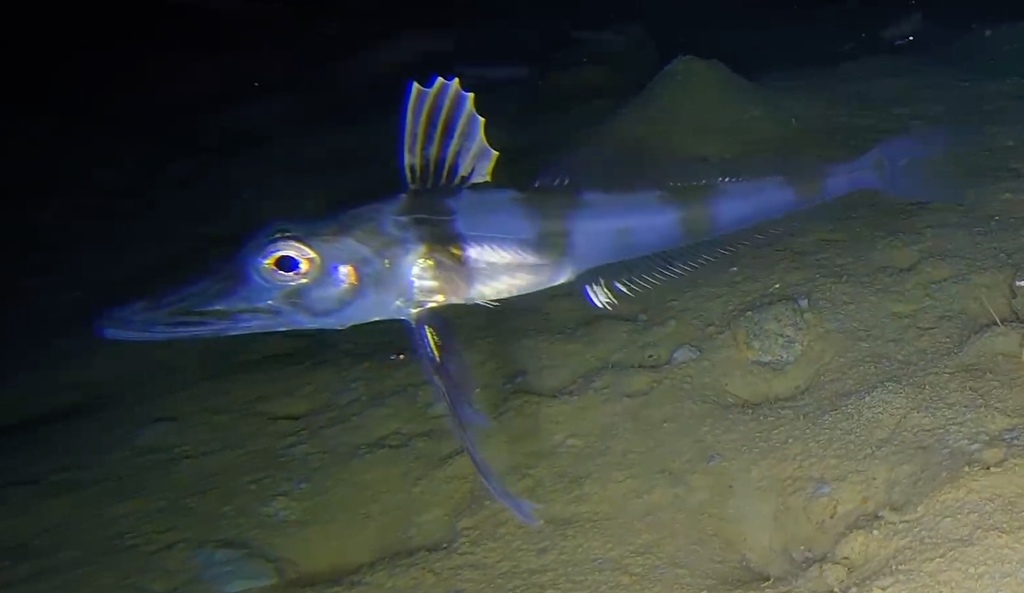
Blackfin Icefish
Chaenocephalus aceratus
The blackfin icefish (Chaenocephalus aceratus), also known as the Scotia Sea icefish, is a species of crocodile icefish belonging to the family Channichthyidae. The blackfin icefish belongs to Notothenioidei, a suborder of fishes that accounts for 90% of the fish fauna on the Antarctic continental shelf. Icefishes, also called white-blooded fishes, are a unique family in that they are the only known vertebrates to lack haemoglobin, making their blood oxygen carrying capacity just 10% that of other teleosts. Icefishes have translucent blood and creamy white gills.
From the article Blackfin icefish on Wikipedia (CC BY-SA), quoted section by section
Description
The blackfin icefish has an elongated, tapered body with a relatively weakly ossified skeleton. It lacks scales and has thin, highly vascularised skin. Its body structure makes it extremely vulnerable to injury. Its head and snout are depressed with a single nostril on either side of the head, and a large mouth with small teeth. This species can range from grey to brown in colour and can have dark vertical stripes along its side. It has two dorsal fins and thickened skin on the pelvic fins, which is thought to be an adaptation to allow the fish to rest on the ocean substrate, as it lacks a swim bladder to maintain buoyancy. This species is sexually dimorphic, with the males having longer and darker first dorsal fins than females. At sexual maturation, females (48–49 cm) are significantly larger than males (34–40 cm), and spawning females are larger than non-spawning females.
Wikipedia: “Morphology”
Range & habitat
The blackfin icefish is known to reside in the Southern Ocean around Antarctica. Most research on the blackfin icefish has been carried out around the Scotia Arc, encompassing South Georgia, the South Shetland Islands, Bouvet Island, the South Orkney Islands, and the Antarctic Peninsula. The ocean temperature in these regions usually remains within a few degrees of the freezing point of seawater, −2 °C (28 °F). Consequently, the blackfin icefish is a stenothermal ectotherm, meaning it has a narrow thermal tolerance range and a low upper thermal limit. The Southern Ocean has a high oxygen content, which allows the blackfin icefish to survive without haemoglobin. Blackfin icefish are typically found at depths of 0–770 m, depending on their life stage. Larvae and juveniles tend to be more active in the water column but are typically found closer to the shore, while adults more often exhibit benthic swimming behaviour.
Wikipedia: “Habitat”
What it does
Blackfin icefish primarily eat smaller fish and krill, but have occasionally been found with crustaceans in their stomachs. Younger icefish tend to eat krill, and then switch to mackerel icefish when they grow (about 30 cm). From data collected in different locations, researchers have determined that the blackfin icefish likely feeds sporadically, consuming large quantities of fish and krill at a time, but at irregular intervals. Their lack of haemoglobin supports this behaviour because burst activity would allow them to obtain energy anaerobically, reducing the need for oxygen. While larvae and juveniles are more active in the water column searching for krill, the adult blackfin icefish usually works as an ambush predator, sitting on the substrate until prey swim past.
Wikipedia: “Diet”
Where it lives
Recorded sightings
—
geo-referenced records in GBIF, from museums, herbaria and field observers.
Drag the globe to turn it. Dots are where records exist, not a range map; darker means more records.
In the stacks
Searching the stacks…
Every page naming Chaenocephalus aceratus in the Biodiversity Heritage Library →
This page is assembled live from iNaturalist, GBIF, Wikipedia, the Source Library and the Internet Archive. It is not yet part of the hand-edited codex. iNaturalist taxon 610056.