- Animals
- ›Chordates
- ›Vertebrates
- ›Ray-finned Fishes
- ›Spiny-rayed fishes
- ›Jacks, Flounders, Barracudas, and Allies
- ›Jacks, Remoras, and Allies
- ›Jacks
- ›Caranginae
- ›Trachurus
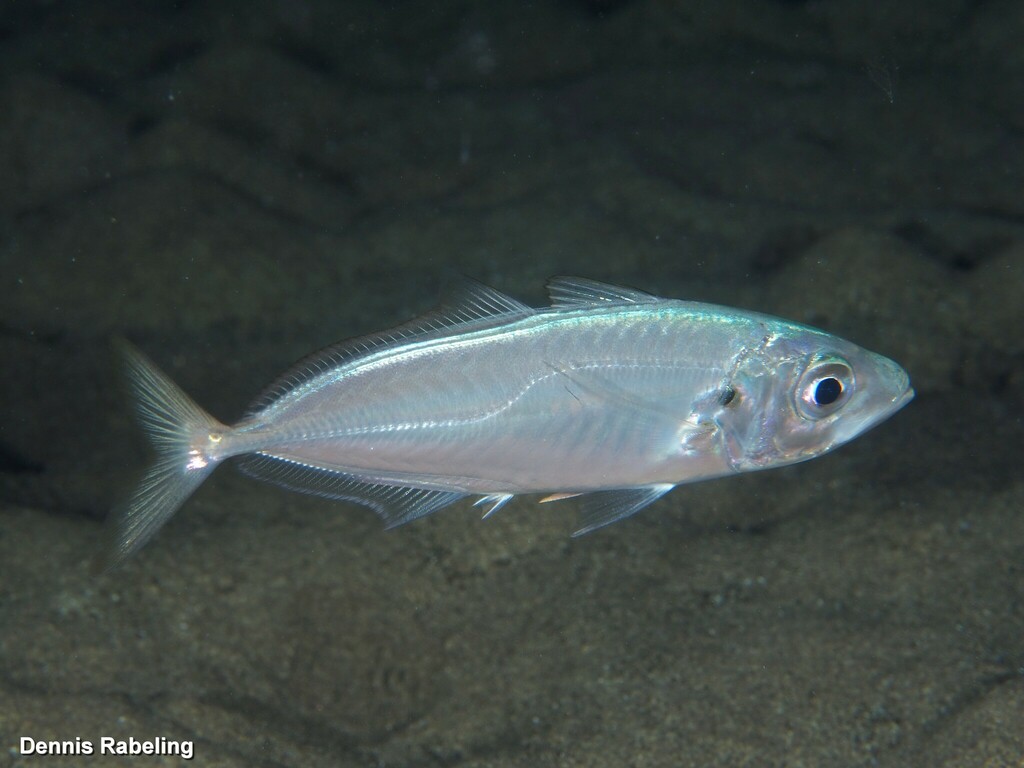
Atlantic Horse Mackerel
Trachurus trachurus
The Atlantic horse mackerel (Trachurus trachurus), also known as the European horse mackerel or common scad, is a species of jack mackerel in the family Carangidae, which includes the jacks, pompanos and trevallies. It is found in the eastern Atlantic Ocean off Europe and Africa and into the south-eastern Indian Ocean. It is an important species in commercial fisheries and is listed as a Vulnerable species on The IUCN Red List of Threatened Species.
From the article Atlantic horse mackerel on Wikipedia (CC BY-SA), quoted section by section
Description
The Atlantic horse mackerel has quite a slender, quite compressed body with a large head in which the rear of the upper jaw reaches the front of the eye and the lower jaw projects beyond the upper jaw. The eye has a well developed adipose eyelid. It has two dorsal fins, the first is tall and has seven thin spines, with the final spine being much shorter than the others. The second dorsal fin is separated from the first by a narrow gap and is considerably longer than the first with 29–33 soft rays. The anal fin is about as long as the second dorsal fin and there are two separate spines at its anterior end. The moderately sized pelvic fin has a single spine and five soft rays and has its origin below the end of the pectoral fin base. A curved line of 33–40 bony scutes runs from the head to the tail, each having a small spine which increase in size and become bonier towards the tail. The lateral line has a total of 66–67 scales, of which 31–36 are scutes. It is dark blue in colour with silvery flanks and a white belly, there is a dark spot on the operculum. This species attains a maximum fork length of 60 centimetres (24 in), although they are normally around 25 cm (10 in) and a weight of 1.5 kg (3 lb).
Range & habitat
The Atlantic horse mackerel occurs in the north and eastern Atlantic Ocean, the Mediterranean Sea and Sea of Marmara and the Black Sea. In the Atlantic it is found from Norway to South Africa where it may extend around the Cape of Good Hope along the southern African Indian Ocean coast Maputo in Mozambique. However, if Trachurus capensis is considered to be a valid species then this species is restricted to the north east Atlantic. It has been recorded in Cape Verde but is thought to occur there only as a vagrant.
Wikipedia: “Distribution”
At the table
The Atlantic horse mackerel is consumed fresh. It may be preserved by freezing, salting and drying, smoking and canning. It can be prepared by frying, broiling or baking. The flesh is said to have a pleasant flavour with an oily delicate texture which is a good source of omega-3 fatty acids. Nutritionally 100g of the flesh of the Atlantic horse mackerel provides 97 kcal of energy and is made up of:
Water: 77.4 g Protein: 19.8 g Fat: 2 g Cholesterol: 64.4 mg Total minerals: 1.3 g Phosphorus: 224 mg In Iberia it may be prepared as an escabeche while some are exported to Japan as aji to be used in sushi. They are also an important ingredient in Sicilian cuisine.
== References ==
Wikipedia: “Human uses”
Where it lives
Recorded sightings
—
geo-referenced records in GBIF, from museums, herbaria and field observers.
Drag the globe to turn it. Dots are where records exist, not a range map; darker means more records.
In the stacks
Searching the stacks…
Every page naming Trachurus trachurus in the Biodiversity Heritage Library →
This page is assembled live from iNaturalist, GBIF, Wikipedia, the Source Library and the Internet Archive. It is not yet part of the hand-edited codex. iNaturalist taxon 118695.