- Animals
- ›Chordates
- ›Vertebrates
- ›Ray-finned Fishes
- ›Spiny-rayed fishes
- ›Jacks, Flounders, Barracudas, and Allies
- ›Jacks, Remoras, and Allies
- ›Jacks
- ›Trevallies and Kingfishes
- ›Carangoides
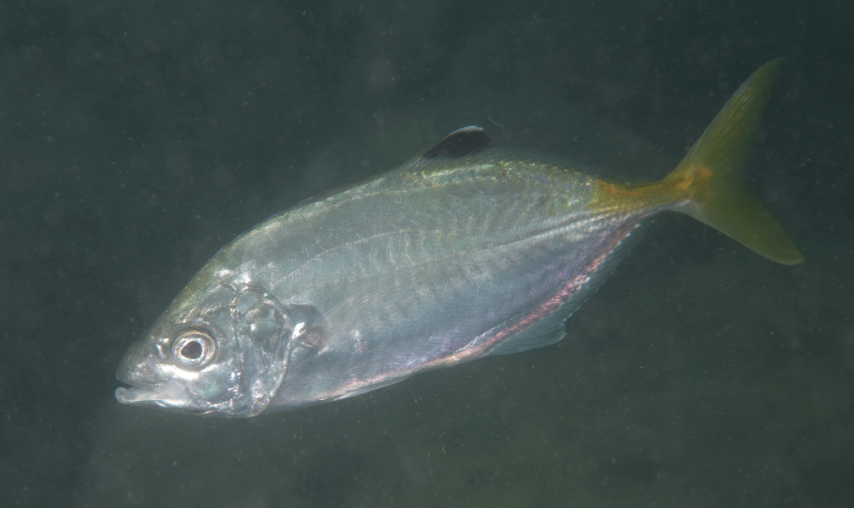
Brownback Trevally
Carangoides praeustus
The brownback trevally (Carangoides praeustus), also known as the brown-backed trevally, is a species of small inshore marine fish classified in the jack family, Carangidae. The brownback trevally is distributed in two populations through the tropical waters of the Indo-west Pacific region, ranging from the Persian Gulf east to India, South East Asia and the Indonesian islands. The species is distinguished from similar species by its completely scaled breast and black-tipped second dorsal fin, and is known to reach a maximum length of 25 cm. The brownback trevally inhabits inshore waters including bays and estuaries, where it preys on demersal crustaceans and small fish. Other aspects of its biology are poorly known, and it is of minor importance to fisheries, occasionally caught by hook and line or trawls. William Smith-Vaniz has recently suggested the two distinct populations may actually represent two distinct species.
From the article Brownback trevally on Wikipedia (CC BY-SA), quoted section by section
Description
The brownback trevally is a relatively small species of carangid, growing to a maximum recorded length of 25 cm, but is much more common at lengths less than 16 cm. The species has a similar body profile to other trevallies in the same genus, having an elongate, compressed form with the dorsal and ventral profiles approximately equal in convexity. The dorsal fin is in two parts, the first consisting of 8 spines while the second has 1 spine and 21 to 24 soft rays, with both dorsal fins of approximately equal height. The anal fin has two anteriorly detached spines followed by 1 spine and 18 to 20 soft rays. The lateral line has a moderate anterior arch, with the straight and arched sections being nearly equal in length. The straight part of the lateral line has 4 to 12 scales followed by 23 to 34 scutes. The breast is nearly completely scaled, occasionally having a partially naked midventral area, which rarely extends the entire length of the breast. In the western population, all individuals have this narrow naked midventral area extending the entire length of the breast. Both jaws have an irregular row of small conical teeth, with the upper jaw also having a narrow band of teeth anteriorly. The gill raker count also varies between the two populations, with the eastern population having 32 to 37 in total, while the western population has 40 to 47. …
Range & habitat
The brownback trevally is distributed in two distinct populations in the tropical waters of the Indo-west pacific region. The western population extends from the waters of Iran in the Persian Gulf to the Bay of Bengal off Bangladesh, with records also from the Maldives and Sri Lanka. The eastern population inhabits a wide region in the South East Asian and Indonesian region, from the Gulf of Thailand to Borneo, Philippines and Indonesia. The brownback trevally is a coastal species, inhabiting both rocky and coral reefs, as well as bay and estuary environments. The species prefers calm, sheltered waters.
Wikipedia: “Distribution and habitat”
Where it lives
Recorded sightings
—
geo-referenced records in GBIF, from museums, herbaria and field observers.
Drag the globe to turn it. Dots are where records exist, not a range map; darker means more records.
In the stacks
Searching the stacks…
Every page naming Carangoides praeustus in the Biodiversity Heritage Library →
This page is assembled live from iNaturalist, GBIF, Wikipedia, the Source Library and the Internet Archive. It is not yet part of the hand-edited codex. iNaturalist taxon 609908.