- Animals
- ›Chordates
- ›Vertebrates
- ›Ray-finned Fishes
- ›Spiny-rayed fishes
- ›Jacks, Flounders, Barracudas, and Allies
- ›Jacks, Remoras, and Allies
- ›Pompanos and queenfishes
- ›Trachinotinae
- ›Trachinotus
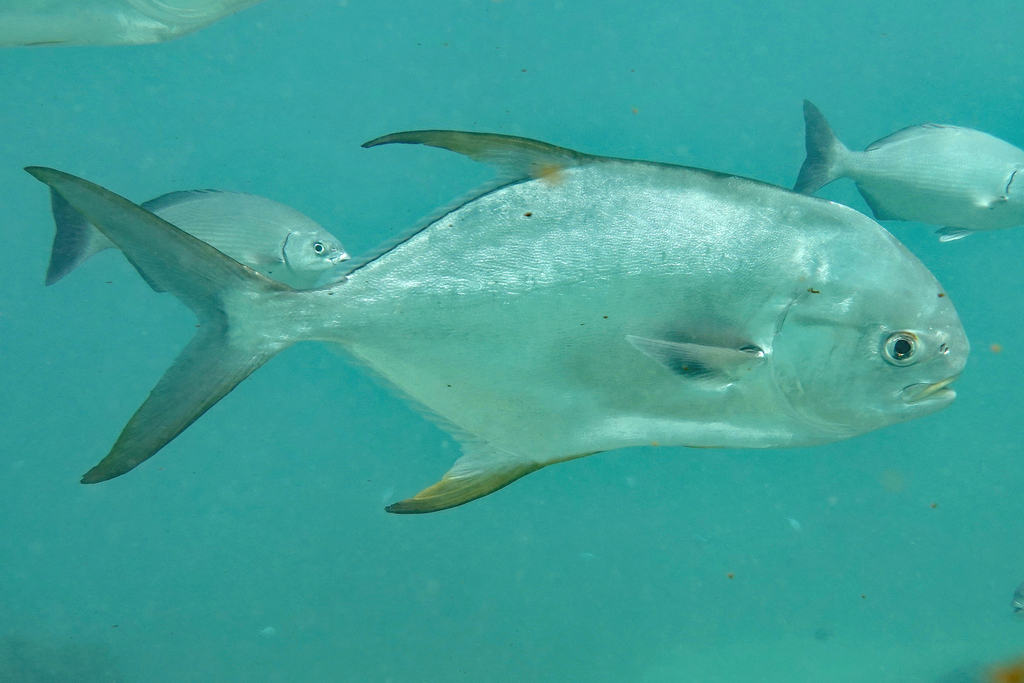
Snubnose Dart
Trachinotus blochii
Trachinotus blochii, also called the snubnose dart, golden pompano, and golden pomfret, is an Asia-Pacific species of pompano in the family Trachinotidae. It is a pelagic fish associated with rocky reefs, coral reefs as well as inshore habitats.
Other common names include buck-nosed trevally, dart, oyster cracker, snub-nosed dart, and snub-nosed swallow tail.
From the article Trachinotus blochii on Wikipedia (CC BY-SA), quoted section by section
Description
The fish body shape can be described as fusiform body plane. The shape is streamlined or torpedo resemblance. The body is also elongated helping to reduce drag as it is a burst swimmer. This is an adaptation to evade predators. Another adaptation it has to escape predators is the coloration, the dorsal side is darker to camouflage into the environment if predated from above. Likewise, it is lighter in color on the ventral, or abdominal, side to blend into the environment if predated from below. Its colouration is yellow hence the common names referring to it as "golden". Females are typically larger than the males, with one study finding them to be 17% larger than males after reaching 7 months of age. The length of the fish is between 40–65 cm (16–26 in). It typically weighs 3.4 kg (7.5 lb). It is metabolically active and continuously swims thus requiring a high energy diet.
Range & habitat
T. blochii is found from the Indian Ocean, the Red Sea and eastern Africa to the central Pacific Ocean. This range includes northern Japan and as far south as the coast of southern New South Wales.
Wikipedia: “Geographic range”
What it does
Juvenile pompano live in small schools, or groups, until they reach maturation. Adults are solitary.
Wikipedia: “Social behavior”
Where it lives
Recorded sightings
—
geo-referenced records in GBIF, from museums, herbaria and field observers.
Drag the globe to turn it. Dots are where records exist, not a range map; darker means more records.
In the stacks
Searching the stacks…
Every page naming Trachinotus blochii in the Biodiversity Heritage Library →
This page is assembled live from iNaturalist, GBIF, Wikipedia, the Source Library and the Internet Archive. It is not yet part of the hand-edited codex. iNaturalist taxon 180751.