- Animals
- ›Chordates
- ›Vertebrates
- ›Ray-finned Fishes
- ›Spiny-rayed fishes
- ›Jacks, Flounders, Barracudas, and Allies
- ›Jacks, Remoras, and Allies
- ›Pompanos and queenfishes
- ›Trachinotinae
- ›Trachinotus
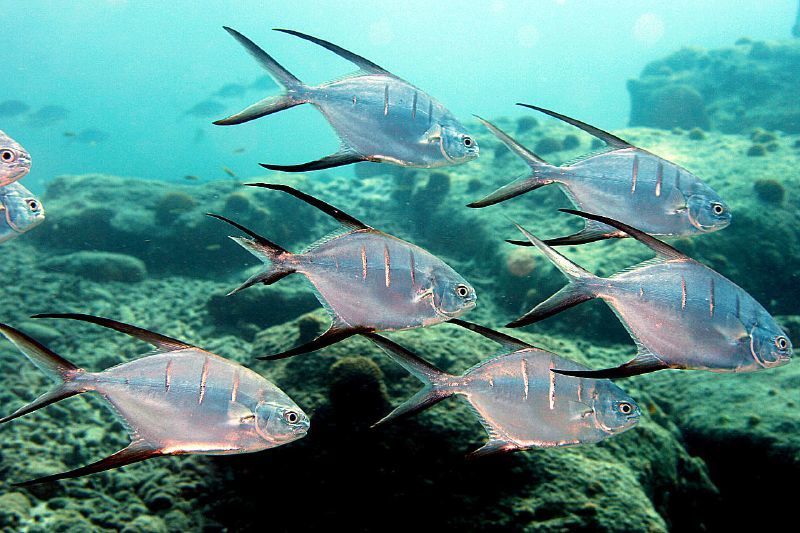
Palometa
Trachinotus goodei
Trachinotus goodei, the palometa, is an ocean-going game fish of the family Carangidae. Other common names include banner pompano, camade fish, cobbler, gafftopsail, great pompano, joefish, longfin pompano, old wife, sand mackerel, streamers jack, wireback, and zelwan. This fish is native to the western Atlantic Ocean from Massachusetts to Bermuda to Argentina. It can be found in the Gulf of Mexico and the Caribbean Sea.
From the article Trachinotus goodei on Wikipedia (CC BY-SA), quoted section by section
Description
The palometa is best recognized by its elongated dorsal and anal fins with dark anterior lobes. The dorsal fin usually has seven or eight spines and 19-20 soft rays, while the anal fin has two or three spines and 16-18 soft rays. Its coloration varies from gray to blue-green on the top of its head, and the sides are silver with four narrow, vertical bars. A faint fifth bar shows near the base of the tail. The breast usually has an orange tinge. The tail has no scutes, unlike many members of its family. The largest known palometa was 50 cm (1 ft 8 in) long. The heaviest was 560 g (1 lb 4 oz).
In human culture
The specific name of this fish honors the American ichthyologist George Brown Goode (1851-1896), who was assistant secretary of the Smithsonian Institution and who was the first to note the presence of this species in the waters of the United States.
Wikipedia: “Etymology”
Where it lives
Recorded sightings
—
geo-referenced records in GBIF, from museums, herbaria and field observers.
Drag the globe to turn it. Dots are where records exist, not a range map; darker means more records.
In the stacks
Searching the stacks…
Every page naming Trachinotus goodei in the Biodiversity Heritage Library →
This page is assembled live from iNaturalist, GBIF, Wikipedia, the Source Library and the Internet Archive. It is not yet part of the hand-edited codex. iNaturalist taxon 114269.