- Animals
- ›Chordates
- ›Vertebrates
- ›Cartilaginous Fishes
- ›Sharks and Rays
- ›Rays
- ›Stingrays
- ›Whiptail Stingrays
- ›Whiprays and allies
- ›Himantura
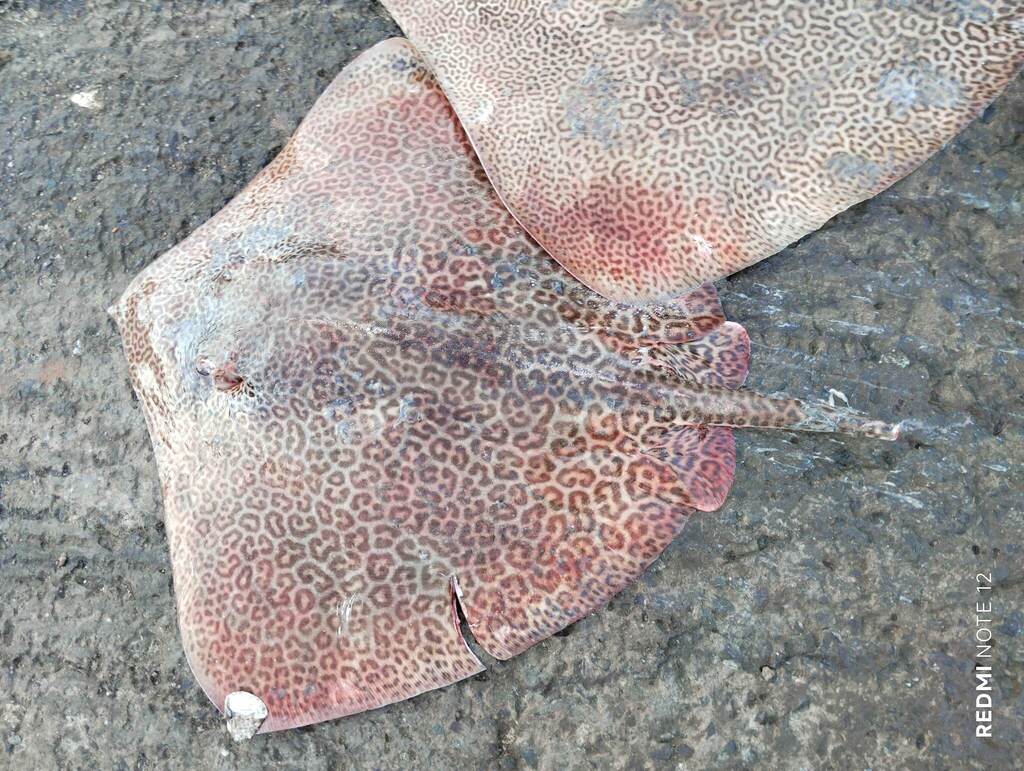
Leopard Whipray
Himantura leoparda
The leopard whipray (Himantura leoparda) is a little-known species of stingray in the family Dasyatidae, found in the central Indo-West Pacific region, from the Andaman Sea to the Coral Triangle. It is found close to shore at depths shallower than 70 m (230 ft), over soft substrates. Attaining a width of 1.8 m (5.9 ft), this species has a diamond-shaped pectoral fin disc with a pointed snout and an extremely long, whip-like tail without fin folds. Adult rays have a leopard-like dorsal pattern of dark brown rings on a yellowish brown background, as well as a row of enlarged, heart-shaped dermal denticles along the midline of the disc. Newborns and small juveniles have large, solid dark spots and few denticles. The leopard whipray is caught by fisheries in many parts of its range, primarily for meat.
From the article Leopard whipray on Wikipedia (CC BY-SA), quoted section by section
Description
A large species reaching 1.4 m (4.6 ft) across and 4.1 m (13 ft) long, the leopard whipray has a diamond-shaped pectoral fin disc wider than long and rather thick at the center, with narrowly rounded to angular outer corners. The leading margins are sinuous and converge to a broadly triangular snout; the tip of the snout protrudes as a distinct, pointed lobe. In juveniles the disc is nearly equal in length and width. The eyes are small and immediately followed by much larger, roughly rectangular spiracles. Between the long, narrow nostrils is a wide, skirt-shaped flap of skin with a finely fringed posterior margin. The mouth is strongly bow-shaped, with shallow furrows at the corners. There are four short papillae (nipple-like structures) on the floor of the mouth, as a central pair and a much smaller outer pair; papillae are also found on the lower jaw. The teeth are small, conical, and blunt, numbering around 59 rows in the upper jaw. The five pairs of gill slits are S-shaped. The pelvic fins are fairly slender; males have stout claspers. The very thin, whip-like tail measures 2.5–3.8 times as long as the disc, and bears usually one serrated stinging spine on top about half a disc width behind the tail base; there are no fin folds. Adults have a broad band of tiny, closely spaced granules extending from before the eyes, onto to the tail. …
Range & habitat
The leopard whipray has been reported from off the Andaman Sea, throughout Southeast Asia including the Philippines, southern Japan and Taiwan, New Guinea, and northern Australia from Coral Bay to the Cape York Peninsula. Bottom-dwelling in nature, the leopard whipray is found close inshore over soft-bottomed habitats. It is known to occur to a depth of 70 m (230 ft). Reported occurrences of the leopard whipray in the Indian Ocean west of the Andaman Sea, including Bangladesh, Sri Lanka and South Africa have not been genetically validated and could therefore be misidentifications.
Wikipedia: “Distribution and habitat”
What it does
The natural history of the leopard whipray is poorly understood, partly due to confusion with other species. It presumably preys on crustaceans and small fishes. Like other stingrays, it is aplacental viviparous, with the developing embryos sustained by histotroph ("uterine milk") produced by the mother. The newborns measure roughly 20 cm (7.9 in) across and 92 cm (36 in) long, smaller than in H. uarnak and H. undulata, and have few or no denticles. Also in contrast to those two species, young leopard whiprays 50 cm (20 in) across have still not developed the dorsal denticle band. Sexual maturity is attained at 70–80 cm (28–31 in) across for males. Known parasites of this species include the tapeworms Parachristianella indonesiensis and P. baverstocki.
Wikipedia: “Biology and ecology”
Where it lives
Recorded sightings
—
geo-referenced records in GBIF, from museums, herbaria and field observers.
Drag the globe to turn it. Dots are where records exist, not a range map; darker means more records.
In the stacks
Searching the stacks…
Every page naming Himantura leoparda in the Biodiversity Heritage Library →
This page is assembled live from iNaturalist, GBIF, Wikipedia, the Source Library and the Internet Archive. It is not yet part of the hand-edited codex. iNaturalist taxon 188808.