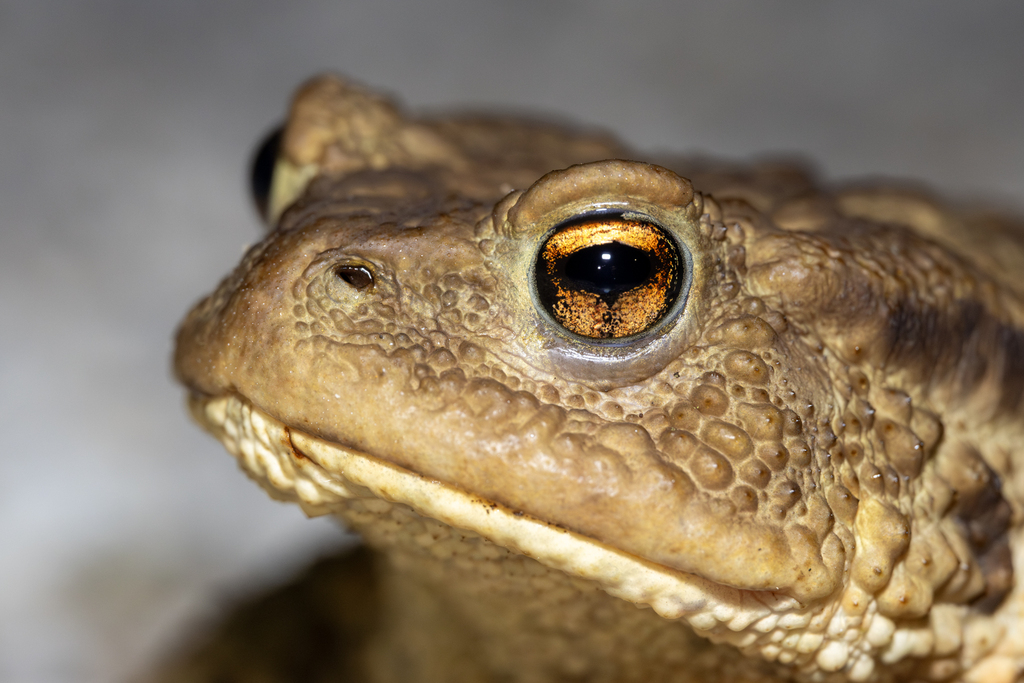
European Toad
Bufo bufo
The common toad, also known as European toad or simply the toad in Anglophone parts of Europe (Bufo bufo, from Latin bufo "toad"), is a toad found throughout most of Europe (excluding Iceland, Ireland, parts of Scandinavia, and some Mediterranean islands), western North Asia and a small part of Northwest Africa. It belongs to a group of closely related species descended from a common ancestral line of toads and forming a species complex. The toad is an inconspicuous animal, usually lying hidden during the day. It becomes active at dusk, hunting the invertebrates on which it feeds at night. It moves with a slow, ungainly walk or by jumping short distances, and has greyish-brown skin covered with wart-like lumps.
Although toads are usually solitary animals, large numbers of them converge on certain breeding ponds during the breeding season, where the males compete to mate with the females. The females lay their eggs in gelatinous strings in the water, which later hatch into tadpoles. After several months of growth and development, the tadpoles sprout limbs and undergo metamorphosis to become tiny toads. The juveniles then leave the water and remain largely terrestrial for the rest of their lives.
From the article Common toad on Wikipedia (CC BY-SA), quoted section by section
Description
The common toad can grow to around 15 cm (6 in) in length. Females are usually stockier than males, and southern specimens tend to be larger than northern ones. Its head is broad, with a wide mouth below the terminal snout, which has two small nostrils. There are no teeth. The bulbous, protruding eyes have yellow or copper-coloured irises and horizontal, slit-shaped pupils. Just behind the eyes are two bulging regions: the paratoid glands, which are positioned obliquely. These glands secrete a noxious substance called bufotoxin, which is used to deter potential predators. The head joins the body without a noticeable neck, and there is no external vocal sac. The broad. squat body is positioned close to the ground. The forelimbs are short, with the toes of the front feet turning inwards. During the breeding season, the male develops nuptial pads on his first three fingers. He uses these to grasp the female during mating. Its hind legs are shorter than those of other frogs and its hind feet have long, unwebbed toes. There is no tail. The skin is dry and covered in small, wart-like lumps. It is a fairly uniform shade of brown, olive-brown or greyish-brown, and is sometimes partly blotched or banded with a darker shade. The common toad tends to be sexually dimorphic, with the females being browner and the males greyer. …
Range & habitat
After the common frog (Rana temporaria), the edible frog (Pelophylax esculentus) and the smooth newt (Lissotriton vulgaris), the common toad is the fourth most common amphibian in Europe. It is found throughout the continent except in Iceland, the cold northern parts of Scandinavia, and a number of Mediterranean islands. These include Malta, Crete, Corsica, Sardinia and the Balearic Islands. It has been introduced to a number of places in Ireland, and appears to be thriving. Its easterly range extends to Irkutsk in Siberia and its southerly range includes parts of northwestern Africa in the northern mountain ranges of Morocco, Algeria and Tunisia. A closely related variant lives in eastern Asia including Japan. The common toad is found at altitudes of up to 2,500 metres (8,200 ft) in the southern part of its range. It is largely found in forested areas with coniferous, deciduous and mixed woodland, especially in wet locations. It also inhabits open countryside, fields, copses, parks and gardens, and is often found in dry areas far from standing water.
Wikipedia: “Distribution and habitat”
What it does
The common toad usually moves by walking rather slowly or making short shuffling jumps with all four legs. It spends the day concealed in a hollow it has made under foliage, a root or a stone, where its colouring makes it inconspicuous. It emerges at dusk and may travel some distance while hunting in the dark. It is most active in wet weather. By morning, it has returned to its lair, where it may remain for several months. It is voracious and eats woodlice, slugs, beetles, caterpillars, flies, ants, spiders, earthworms and even small mice. Small, fast-moving prey may be caught with a flick of the tongue while larger items are grabbed with the jaws. As it has no teeth, the species swallows food whole in a series of gulps. It does not recognise its prey as such, but will try to consume any small, dark-coloured, moving object it encounters at night. A research study showed that it would snap at a moving 1 cm (0.4 in) piece of black paper as if it were prey, but disregarded a larger moving piece. Toads seem to use visual cues for feeding and can see their prey at low light intensities where humans are unable to discern anything. Periodically, the common toad sheds its skin. …
Wikipedia: “Behaviour and lifecycle”
In human culture
The toad has long been considered to an ominous creature or a gateway to the spirit world. This may be because it is at home both on land and in the water. its drab, wart-like skin, slow movements and emergence from dark holes may cause repugnance. In Europe in the Middle Ages, the toad was associated with the Devil, for whom a coat-of-arms was invented bearing three toads. It was known that the toad could poison people and, as the witch's familiar, it was thought to possess magical powers. Even ordinary people made use of dried toads, their bile, faeces and blood. In some areas, the finding of a toad in a house was considered evidence that a witch was present. In the Basque Country, the familiars were believed to be toads wearing elegant robes. These were herded by children who were being trained as witches. Between 1610 and 1612, the Spanish inquisitor Alonso de Salazar Frías investigated witchcraft in the region and searched the houses of suspected witches for dressed toads. He found none. These witches were reputed to use undomesticated toads as ingredients in their liniments and brews. An English folk tale tells how an old woman, a supposed witch, cursed her landlord and all his possessions when he demanded the unpaid rent for her cottage. Soon afterwards, a large toad fell on his wife and caused her to collapse. …
Wikipedia: “Cultural significance”
Listen
Looking for field recordings…
Where it lives
Recorded sightings
—
geo-referenced records in GBIF, from museums, herbaria and field observers.
Drag the globe to turn it. Dots are where records exist, not a range map; darker means more records.
In the stacks
Searching the stacks…
Every page naming Bufo bufo in the Biodiversity Heritage Library →
This page is assembled live from iNaturalist, GBIF, Wikipedia, the Source Library and the Internet Archive. It is not yet part of the hand-edited codex. iNaturalist taxon 326296.