- Animals
- ›Chordates
- ›Vertebrates
- ›Mammals
- ›Therians
- ›Placental Mammals
- ›Ungulates, Carnivorans, and Allies
- ›Carnivorans
- ›Hyaenas
- ›Bone-cracking Hyaenas
- ›Hyaena
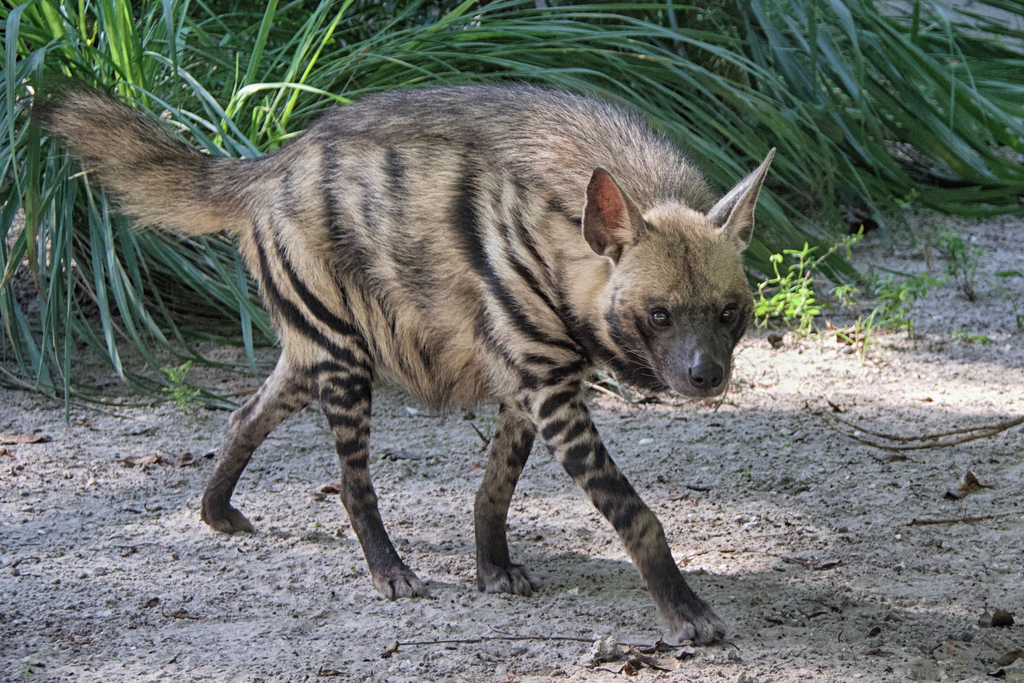
Striped Hyaena
Hyaena hyaena
The striped hyena (Hyaena hyaena) is a species of hyena native to North and East Africa, the Middle East, the Caucasus, Central Asia, and the Indian subcontinent. It is the only extant species in the genus Hyaena. It is listed on the IUCN Red List as near-threatened, as the global population is estimated to be under 10,000 mature individuals which continues to experience deliberate and incidental persecution along with a decrease in its prey base such that it may come close to meeting a continuing decline of 10% over the next three generations.
It is the smallest of the bone-cracking hyenas and retains many primitive viverrid-like characteristics lost in larger species, having a smaller and less specialised skull. Though primarily a scavenger, large specimens have been known to kill their own prey, and attacks on humans have occurred in rare instances. The striped hyena is a monogamous animal, with both males and females assisting one another in raising their cubs. A nocturnal animal, the striped hyena typically only emerges in complete darkness, and is quick to return to its lair before sunrise. Although it has a habit of feigning death when attacked, it has been known to stand its ground against larger predators in disputes over food.
From the article Striped hyena on Wikipedia (CC BY-SA), quoted section by section
Range & habitat
The striped hyena's historical range encompassed Africa north of and including the Sahel zone, eastern Africa south into Tanzania, the Arabian Peninsula and the Middle East up to the Mediterranean Sea, Turkey, Iraq, the Caucasus (Azerbaijan, Armenia, Georgia), Iran, Turkmenistan, Uzbekistan, Tajikistan, Afghanistan (excluding the higher areas of Hindukush), and the Indian subcontinent. Today the species' distribution is patchy in most ranges, thus indicating that it occurs in many isolated populations, particularly in most of west Africa, most of the Sahara, parts of the Middle East, the Caucasus, and central Asia. It does however have a continuous distribution over large areas of Ethiopia, Kenya, and Tanzania. Its modern distribution in Pakistan, Iran, and Afghanistan is unknown with some sizable large number in India in open areas of Deccan Plateau.
Wikipedia: “Distribution and habitat”
What it does
The striped hyena is a primarily nocturnal animal, which typically only leaves its den at the onset of total darkness, returning before sunrise. Striped hyenas typically live alone or in pairs, though groups of up to seven animals are known in Libya. They are generally not territorial, with home ranges of different groups often overlapping each other. Home ranges in the Serengeti have been recorded to be 44–72 km2 (17–28 sq mi), while one in the Negev was calculated at 61 km2 (24 sq mi). When marking their territory, striped hyenas use the paste of their anal pouch called hyena butter to scent mark grass, stalks, stones, tree trunks, and other objects. The composition of hyena butter differs based on the individual’s age and population of origin, and is partly determined by the fermentative bacterial composition of the hyena’s scent pouch, which include many anaerobic bacteria in the phylum Bacillota (also called Firmicutes). While the composition of juvenile scent pouch bacteria is variable, adult striped hyenas have more uniform bacterial communities in their scent pouches, with specific types and amounts of each taxon present. In aggressive encounters, the black patch near the thoracic and lumbar vertebrae is erected. When fighting, striped hyenas will bite at the throat and legs, but avoid the mane, which serves as a signaling device. …
Wikipedia: “Social and territorial behaviour”
At the table
A mural depicted on Mereruka's tomb in Sakkara indicates that Old Kingdom Egyptians forcefed hyenas in order to fatten them up for food, though archaeologist Burchard Brentjes argued that the depicted animals represent an extinct population of Egyptian aardwolves. European writers in the 19th and early 20th centuries recorded that striped hyenas were eaten by some Egyptian peasants, Arabian Bedouins, Palestinian laborers, Sinai Bedouins, Tuaregs, and in Somalia. Among some Bedouins of Arabia at the beginning of the 20th century, hyena meat was generally considered medicine, rather than food.
Wikipedia: “Striped hyenas as food”
In human culture
Striped hyenas are frequently referenced in Middle Eastern literature and folklore, typically as symbols of treachery and stupidity. In the Near and Middle East, striped hyenas are generally regarded as physical incarnations of jinn. Zakariya al-Qazwini (1204–1283) wrote in Arabic of a tribe of people called "Hyena People." In his book Marvels of Creatures and the Strange Things Existing (عجائب المخلوقات وغرائب الموجودات), he wrote that should one of this tribe be in a group of 1,000 people, a hyena could pick him out and eat him. A Persian medical treatise written in 1376 tells how to cure cannibalistic people known as kaftar who are said to be "half-man, half-hyena". Al-Doumairy in his writings in Hawayan Al-Koubra (1406) wrote that striped hyenas were vampiric creatures that attacked people at night and sucked the blood from their necks. He also wrote that hyenas only attacked brave people. Arab folklore tells of how hyenas can mesmerize victims with their eyes or sometimes with their pheromones. Until the end of the 19th century, the Greeks believed that the bodies of werewolves, if not destroyed, would haunt battlefields as vampiric hyenas which drank the blood of dying soldiers. The image of striped hyenas in Afghanistan, India, Pakistan and Palestine is more varied. …
Wikipedia: “In folklore, religion, and mythology”
Listen
Looking for field recordings…
Where it lives
Recorded sightings
—
geo-referenced records in GBIF, from museums, herbaria and field observers.
Drag the globe to turn it. Dots are where records exist, not a range map; darker means more records.
In the stacks
Searching the stacks…
Every page naming Hyaena hyaena in the Biodiversity Heritage Library →
This page is assembled live from iNaturalist, GBIF, Wikipedia, the Source Library and the Internet Archive. It is not yet part of the hand-edited codex. iNaturalist taxon 41888.