- Animals
- ›Chordates
- ›Vertebrates
- ›Mammals
- ›Therians
- ›Placental Mammals
- ›Primates, Rodents, and Allies
- ›Primates
- ›Monkeys, Apes, and Tarsiers
- ›Monkeys and Apes
- ›Apes and Old World Monkeys
- ›Old World Monkeys
- ›Cercopithecines
- ›Baboons, Macaques, and Mangabeys
- ›Mandrillus
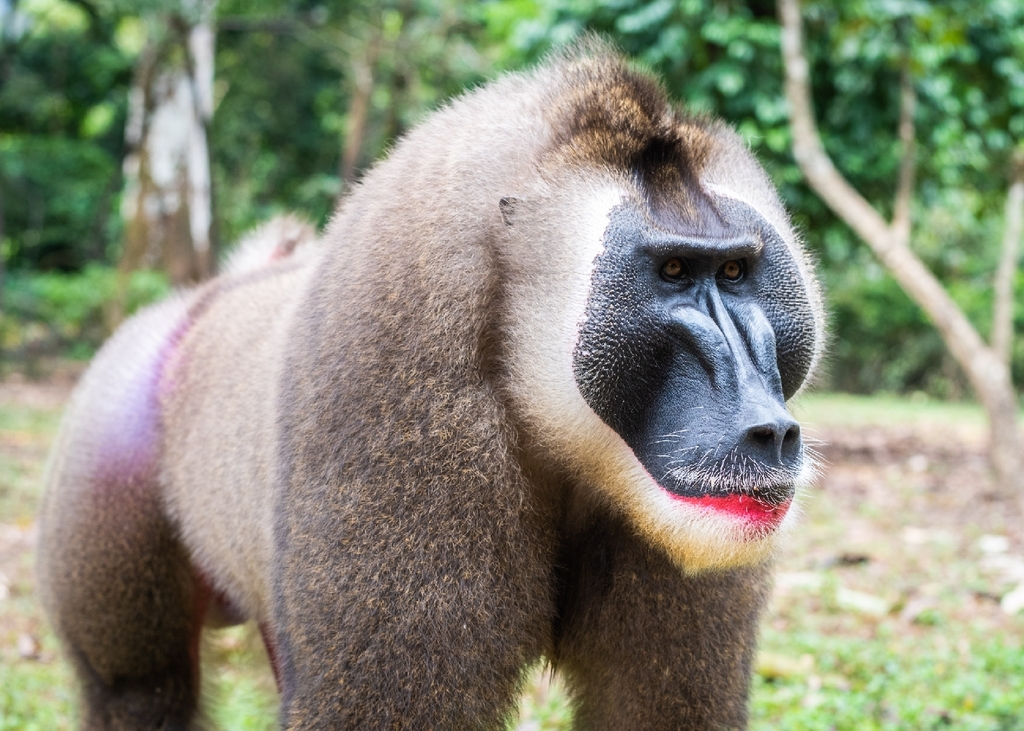
Drill
Mandrillus leucophaeus
The drill (Mandrillus leucophaeus) is a primate of the family Cercopithecidae (Old World monkeys), related to baboons and even more closely to the mandrill. The average wild drill has a lifespan of 20 years. The drill is currently listed as an endangered species that occurs across three African countries.
From the article Drill (animal) on Wikipedia (CC BY-SA), quoted section by section
Description
The drill is a large monkey with long extended snouts and a short tail. Its body is covered by brownish-gray hair in opposition to its black face. The fur around the face contains white fur. The drill has sharp nasal ridges and large cheek pads on both sides of its face. Canine teeth in males average 4.5 cm (1.8 in) in length and up to 5.08 cm (2.00 in), while average canines in femals are 1 cm (0.39 in). It also has hard molar teeth that are adapted to a wide range of food sources. Males have vibrantly colored chins, rear, and groin areas. Their chin contains red markings and their rear and groin areas contain various colors of fur: red, blue, white, etc. These colorings have a direct link to the rank of males within a troop's social structure. Brightly colored males were found to have higher ranks within the troop. They were also observed to be the most sexually active within the troop. However researchers found that females don't exhibit a mating preference in regards to the brightness of male fur. This evidence suggests that male interactions are more affected by coloration differences that male-female interactions. Females do not generally exhibit bright coloration of the chin, rear, and groin areas like their male counterparts. These areas are generally brown in color, like the rest of their body. …
Range & habitat
The drill occurs in Nigeria, Cameroon, and Equatorial Guinea. Its geographical range varies from 19,000 to 20,000 km2 (7,500 to 7,700 mi2). The area of occupancy is slightly smaller than the state of West Virginia, making a very small geographical home range. This range comprises populations that occur in fragmented pockets. These fragmented pockets of drills can be found as far south as the Sanaga River in Cameroon, and as far west as the Cross River in Nigeria. The total population of drills remaining in the wild is around 4,000 individuals. The drill lives in a variety of different habitats. The drills of Bioko Island live in lowland coastal forests and have even been observed on beaches along the coast. Other populations can be found in forests, savanna, mountain peaks, and inland cliffs.
Wikipedia: “Distribution”
What it does
The drill is an opportunistic omnivore. The drill dietary preference is that of fruiting trees, which are especially abundant during the rainy season. The most common fruit and plant species consumed by drills are fiddle-leaf figs, cola palms, and African corkwood trees. During seasons of less fruit abundance the drill will eat foods such as leaves and grasses. Generally, the drill's main diet is composed of seeds, plants, mushrooms, fruits, and even some invertebrate species. Ants provide a rich source of protein and are easily digestible by the drill due to its specialized gut and dental systems.
Wikipedia: “Diet”
Listen
Looking for field recordings…
Where it lives
Recorded sightings
—
geo-referenced records in GBIF, from museums, herbaria and field observers.
Drag the globe to turn it. Dots are where records exist, not a range map; darker means more records.
In the old herbals & bestiaries

Ortus sanitatis
1491 · p.540

Hortus Eystettensis
Basilius Besler · 1640 · p.225

Jean Baptiste Audebert — Histoire naturelle des singes et des makis (1800)
Jean Baptiste Audebert · 1800 · p.79

Six Groups of the History of Plants
Rembert Dodoens · 1583 · p.647

History of Rare Plants
Carolus Clusius · 1601 · p.520

Commentaries on the Six Books of Dioscorides
Pietro Andrea Mattioli · 1560 · p.409

Commentaries on the Six Books of Dioscorides
Pietro Andrea Mattioli · 1560 · p.409

Commentaries on the Six Books of Dioscorides on Medical Matter
Pietro Andrea Mattioli · 1563 · p.394

Commentaries on the Six Books of Pedanius Dioscorides on Medical Matter
Pietro Andrea Mattioli · 1565 · p.679

Stirpium adversaria nova
Matthias de Lobel · 1571 · p.107

Six Groups of the History of Plants
Rembert Dodoens · 1583 · p.648

Plant Touchstone (Phytobasanos)
Fabio Colonna · 1592 · p.34
In the stacks
Searching the stacks…
Every page naming Mandrillus leucophaeus in the Biodiversity Heritage Library →
This page is assembled live from iNaturalist, GBIF, Wikipedia, the Source Library and the Internet Archive. It is not yet part of the hand-edited codex. iNaturalist taxon 43532.