- Animals
- ›Chordates
- ›Vertebrates
- ›Mammals
- ›Therians
- ›Placental Mammals
- ›Primates, Rodents, and Allies
- ›Rodents
- ›Squirrels, Dormice, and Mountain Beavers
- ›Squirrels
- ›Typical and Flying Squirrels
- ›Typical Squirrels
- ›Sciurus
- ›Guerlinguetus
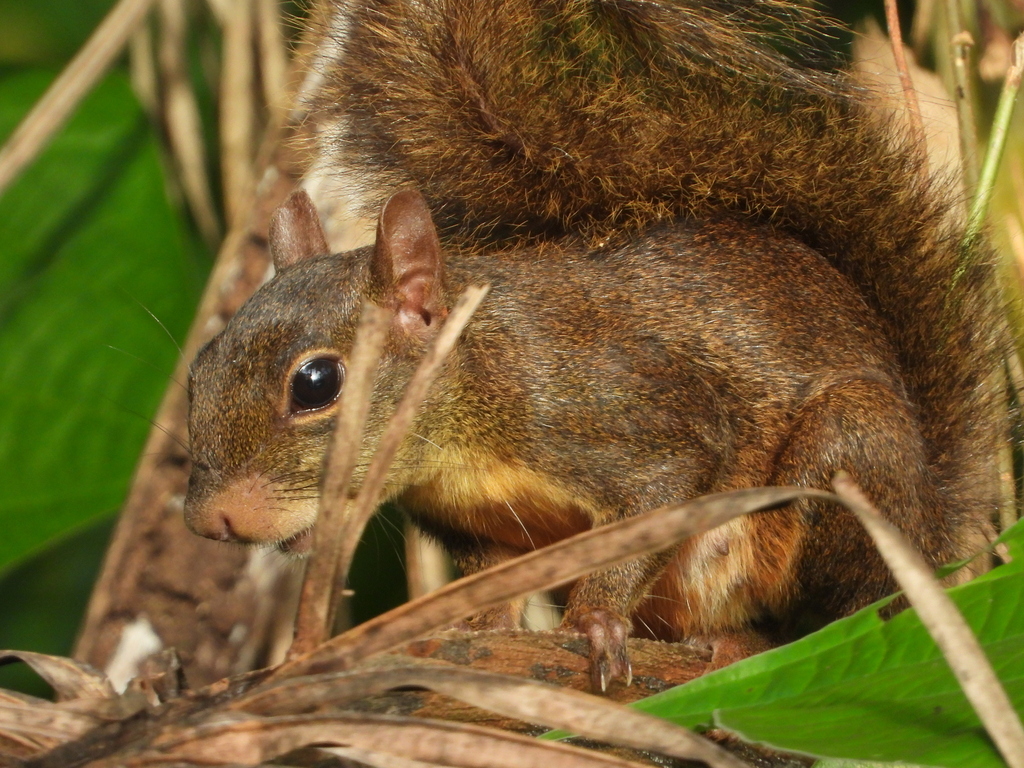
Guianan Squirrel
Sciurus aestuans
The Brazilian squirrel (or Guianan squirrel) (Sciurus aestuans) is a tree squirrel in the genus Sciurus endemic to South America. It is found in North-eastern Argentina, Brazil, Guyana, French Guiana, Suriname and Venezuela.
From the article Brazilian squirrel on Wikipedia (CC BY-SA), quoted section by section
Description
Brazilian squirrels have primarily olive-gray fur with brown or yellow grizzling. The eye is surrounded by a pale yellow-brown ring, and a pale yellow postauricular patch is sometimes present. The belly is paler than the rest of the body, typically white, cream, buff, or pale yellow. The overside of the tail is the same color as the main body, while the underside is typically reddish and more variable. The typical head and body length is 160–186 millimetres (6.3–7.3 in), with the tail comprising another 162–250 millimetres (6.4–9.8 in). Body mass is typically 160–380 grams (5.6–13.4 oz).
Range & habitat
The Brazilian squirrel inhabits forested regions through most of Brazil, alongside Guyana, Suriname, French Guiana, and parts of Colombia, Venezuela, and Argentina. Brazilian squirrels inhabit tropical rainforests, swamps and wet forests, and gallery forests. They can also be found in urban parks, gardens, and plantations.
Wikipedia: “Distribution and habitat”
What it does
Brazilian squirrels are diurnal. They are active at all levels of the forest but tend to be most frequent in the understory level, between 5–12 metres (16–39 ft) above the ground. Brazilian squirrels are not strongly territorial, and there is considerable overlap between their foraging ranges. Male ranges tend to be around twice the size of females'. Brazilian squirrels feed primarily on palm nuts, alongside acorns and other tree and shrub seeds. Distinct handling behaviors are used for distinct palm species' fruit in order to access their endosperm; this behavior is learned as juveniles. Males track females by scent, culminating in several males chasing a female through the canopy to mate. Females have been observed pregnant in winter and summer, suggesting two distinct breeding seasons. Observed predators of Brazilian squirrels include ocelots, margays, and Cebus monkeys. When alarmed, Brazilian squirrels run into trees to hide, sometimes chattering an alarm call.
== References ==
Wikipedia: “Ecology and behavior”
Listen
Looking for field recordings…
Where it lives
Recorded sightings
—
geo-referenced records in GBIF, from museums, herbaria and field observers.
Drag the globe to turn it. Dots are where records exist, not a range map; darker means more records.
In the stacks
Searching the stacks…
Every page naming Sciurus aestuans in the Biodiversity Heritage Library →
This page is assembled live from iNaturalist, GBIF, Wikipedia, the Source Library and the Internet Archive. It is not yet part of the hand-edited codex. iNaturalist taxon 45998.