- Animals
- ›Chordates
- ›Vertebrates
- ›Mammals
- ›Therians
- ›Placental Mammals
- ›Primates, Rodents, and Allies
- ›Rodents
- ›Squirrels, Dormice, and Mountain Beavers
- ›Squirrels
- ›Typical and Flying Squirrels
- ›Typical Squirrels
- ›Sciurus
- ›Hesperosciurus
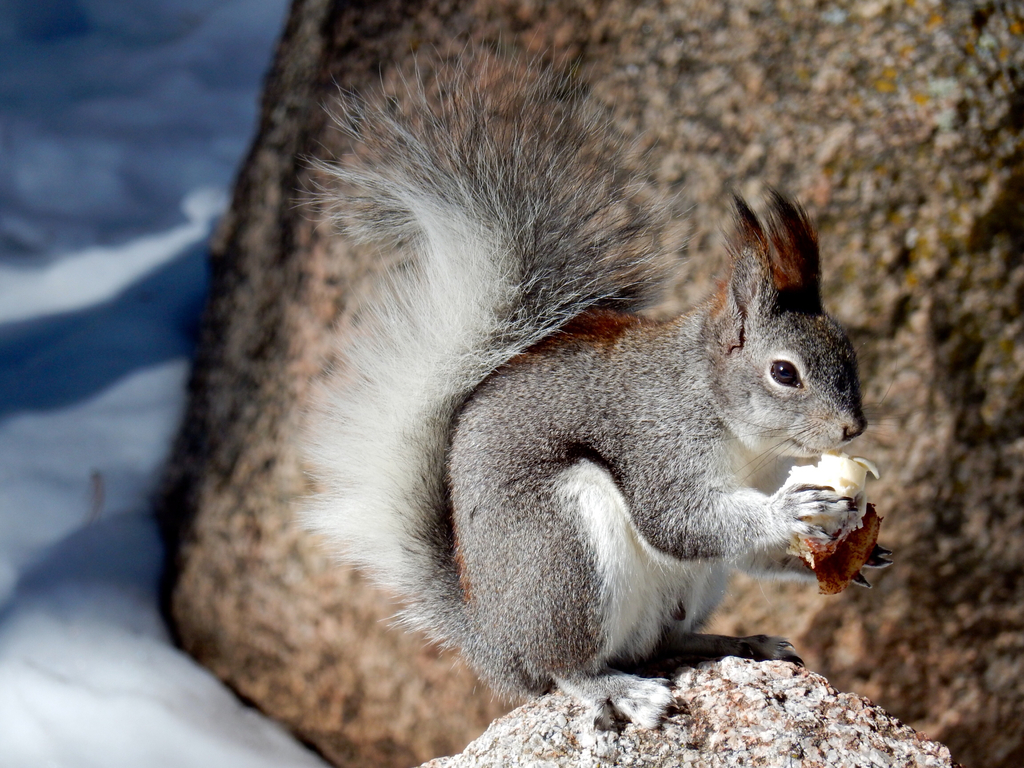
Abert's Squirrel
Sciurus aberti
Abert's squirrel or the tassel-eared squirrel (Sciurus aberti) is a tree squirrel in the genus Sciurus native to the southern Rocky Mountains from the United States to the northern Sierra Madre Occidental of Mexico, with concentrations found in Arizona, New Mexico, and southwestern Colorado. It is closely associated with, and largely confined to, mature ponderosa pine forests. It is named in honor of the American naturalist John James Abert; nine subspecies are recognised. It is recognizable by its tufted ears, gray color, pale underparts and rufous patch on the lower back. The squirrel feeds on the seeds and cones of the Mexican pinyon and the ponderosa pine when they are available, but will also take fungi, buds, bark, and carrion. Breeding normally occurs in summer, with a spherical nest being built high in the canopy.
From the article Abert's squirrel on Wikipedia (CC BY-SA), quoted section by section
Range & habitat
Abert's squirrel is confined to the Colorado Plateau and the southern Rocky Mountains of Colorado, Utah, Arizona, and New Mexico; its range extends south in the Sierra Madre Occidental to Chihuahua and Durango in Mexico. Abert's squirrel also extends into Wyoming where ponderosa pine (Pinus ponderosa) is present. The range of Abert's squirrel has been extended through deliberate introductions in Arizona and New Mexico. The populations established in the Hualapai, Pinaleño, and Santa Catalina Mountains in Arizona consist of the nominate aberti subspecies. Abert's squirrels transplanted to the Graham and Santa Catalina Mountains of Arizona have established stable populations. Mellott and Choate reported Abert's squirrels present in the Spanish Peaks State Wildlife Area, 43 miles (69 km) southeast of the previously known Abert's squirrel range. The distribution of Abert's squirrel subspecies in the Southwest is coincident with the disjunct ponderosa pine forests. Subspecies distributions are as follows:
S. a. aberti Woodhouse, 1853 – Arizona south of the Grand Canyon, southeastern Utah, southwestern Colorado, western New Mexico. S. a. barberi Allen, 1904 – western Chihuahua. S. a. chuscensis Goldman, 1931 – New Mexico-Arizona border area. S. a. durangi Thomas, 1893 – western Chihuahua and Durango. S. a. …
Wikipedia: “Distribution”
What it does
Abert's squirrels are diurnal. They are often active for a short time before sunrise and active for periods throughout the day, and they usually return to shelter before sunset. Abert's squirrel does not store food, as other North American squirrels do. The most apparent causes of Abert's squirrel mortality are food shortage and injuries (such as broken teeth) that lead to mortality.
Reproduction. The reproductive patterns of Abert's squirrels are strongly seasonal. Males possess external testes between winter and summer, which retract into the body cavity when the breeding season ends. Females are in estrus for a single day, during which males compete for access to them. Females typically breed with multiple males. Paternal care does not occur. In central Arizona, breeding occurs from May 1 to June 1 and there are young in the nest from June 10 to July 27. Farantinos reported a 46-day gestation period. Eight litters were composed of two to five young each. Three or four young per litter is typical. Young Abert's squirrels are born naked, with ears and eyes closed. At 2 weeks thin short hair is noticeable and the ears are slightly open. By 6 weeks the pelage has developed and the eyes are open. By 7 weeks the tail has broadened and is held over the back, ears are held erect. Mushrooms and bark have been added to the diet at this time. …
Wikipedia: “Ecology and behavior”
In human culture
Abert's squirrel is named after Colonel John James Abert, an American naturalist and military officer who headed the Corps of Topographical Engineers and organized the effort to map the American West in the 19th century.
Wikipedia: “Etymology”
Listen
Looking for field recordings…
Where it lives
Recorded sightings
—
geo-referenced records in GBIF, from museums, herbaria and field observers.
Drag the globe to turn it. Dots are where records exist, not a range map; darker means more records.
In the stacks
Searching the stacks…
Every page naming Sciurus aberti in the Biodiversity Heritage Library →
This page is assembled live from iNaturalist, GBIF, Wikipedia, the Source Library and the Internet Archive. It is not yet part of the hand-edited codex. iNaturalist taxon 46018.