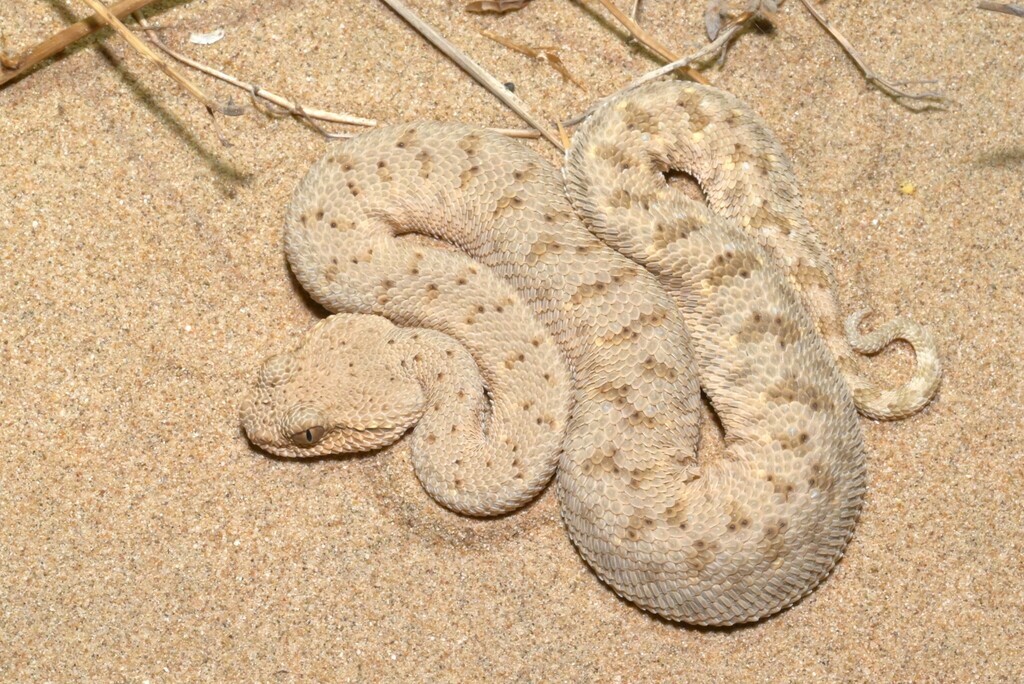
Arabian Horned Viper
Cerastes gasperettii
Common names: Arabian horned viper, desert horned viper, Middle Eastern horned viper.
Cerastes gasperettii, also known commonly as the Arabian horned viper and Gasperetti's horned viper, is a species of venomous snake in the subfamily Viperinae of the family Viperidae. The species is native to the Arabian Peninsula and north to Israel, Iraq, and Iran. It is very similar in appearance to C. cerastes, but the geographic ranges of these two species do not overlap. No subspecies of C. gasperettii are recognized.
From the article Cerastes gasperettii on Wikipedia (CC BY-SA), quoted section by section
Description
The average total length (including tail) of Cerastes gasperettii is 30–60 cm (12–24 in), with a maximum total length of 85 cm (33 in). Females are usually larger than males.
Range & habitat
In the Arabian Peninsula Cerastes gasperettii has been found in Saudi Arabia, Kuwait, Oman, Qatar, United Arab Emirates, and Yemen. It is found in the Arava valley, located on the border between southern Israel and Jordan, eastwards through Jordan and Iraq to Khuzestan province in southwestern Iran. The type locality given is "Beda Azan [23°41'N., 53°28'E.], Abu Dhabi [Abū Zaby]" [United Arab Emirates].
Wikipedia: “Geographic range”
What it does
The diet of Cerastes gasperettii is thought to primarily consist of rodents, with insects, particularly beetles, and lizards making up a less significant component of its diet.
Wikipedia: “Diet”
In human culture
The specific name, gasperettii, is in honor of John Gasperetti, an American surveyor, engineer, and herpetologist, who collected the holotype specimen.
Wikipedia: “Etymology”
Where it lives
Recorded sightings
—
geo-referenced records in GBIF, from museums, herbaria and field observers.
Drag the globe to turn it. Dots are where records exist, not a range map; darker means more records.
In the stacks
Searching the stacks…
Every page naming Cerastes gasperettii in the Biodiversity Heritage Library →
This page is assembled live from iNaturalist, GBIF, Wikipedia, the Source Library and the Internet Archive. It is not yet part of the hand-edited codex. iNaturalist taxon 30813.