- Animals
- ›Chordates
- ›Vertebrates
- ›Reptiles
- ›Snakes and Lizards
- ›Snakes
- ›Colubrid Snakes
- ›Colubrine Snakes
- ›Ptyas
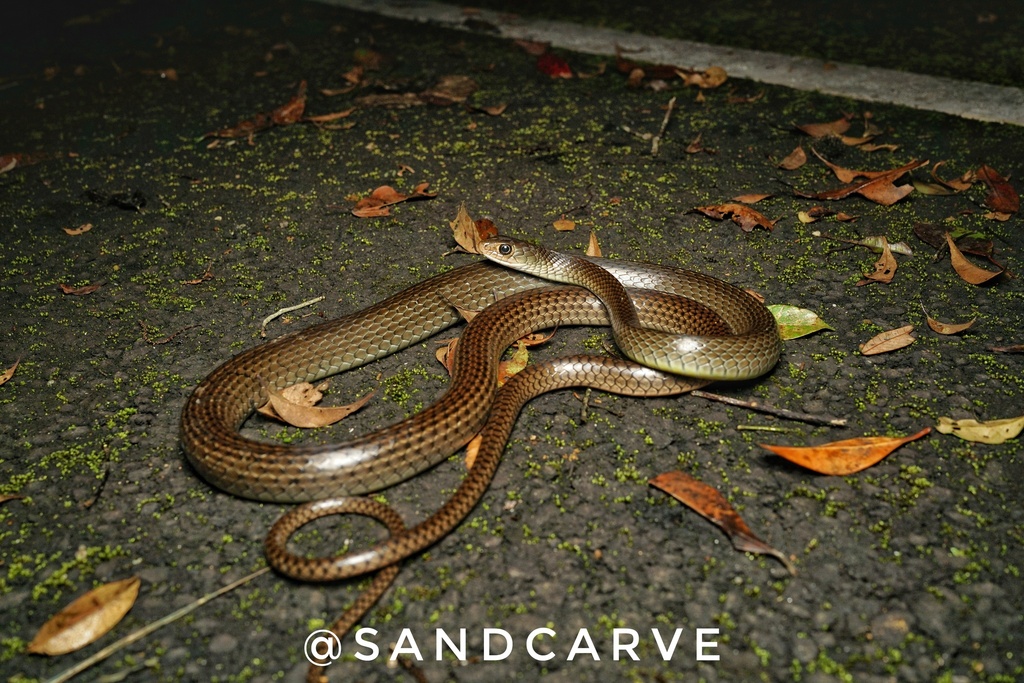
Indo-Chinese Rat Snake
Ptyas korros
Ptyas korros, commonly known as the Chinese rat snake or Indo-Chinese rat snake, is a species of colubrid snake endemic to Southeast Asia.
From the article Ptyas korros on Wikipedia (CC BY-SA), quoted section by section
Description
Snout obtuse, projecting; eye very large. Head broader than neck. Rostral visible from above; internasals shorter than the prefrontals; frontal as long as its distance from the tip of the snout or a little longer, as long as the parietals; two or three loreals; a large preocular, sometimes touching the frontal; a small subocular below; two postoculars; temporals 2 + 2; eight upper labials, fourth and fifth entering the eye; five lower labials in contact with the anterior chin-shields, which are shorter than the posterior. Dorsal scales smooth or feebly keeled on the posterior part of the body, in 15 rows at midbody; ventrals 160–177; anal divided; sub-caudals 122–145. Brown or olive above; the scales on the posterior part of the body and on the tail often yellow and edged with black. Lower surface yellow. Young specimens with transverse series of round whitish spots or with narrow yellow transverse bars. Length of head and body 1,080 mm (43 in); tail 700 mm (28 in).
Range & habitat
Nepal, Myanmar; Cambodia, China (Zhejiang, Jiangxi, Fujian, Guangdong, Hainan, Guangxi, Hunan, Yunnan, Hong Kong), Taiwan, India (Assam; Manipur; Arunachal Pradesh (Namdapha - Changlang district, Chessa, Chimpu, Itanagar - Papum Pare district), Tripura, Bangladesh, Indonesia (Sumatra, Borneo, Java, Bali), Laos, Thailand, Vietnam, West Malaysia and Singapore Island. Found up to 3000 m above sea level.
Wikipedia: “Distribution”
What it does
It is a diurnal species. Both arboreal and terrestrial. Found in forests as well near human habitation. Sleeps on bushes and trees. The diet includes rodents, birds, lizards and frogs. Females lay 4-12 eggs in June-July.
Wikipedia: “Behavior and diet”
Where it lives
Recorded sightings
—
geo-referenced records in GBIF, from museums, herbaria and field observers.
Drag the globe to turn it. Dots are where records exist, not a range map; darker means more records.
In the stacks
Searching the stacks…
Every page naming Ptyas korros in the Biodiversity Heritage Library →
This page is assembled live from iNaturalist, GBIF, Wikipedia, the Source Library and the Internet Archive. It is not yet part of the hand-edited codex. iNaturalist taxon 28870.