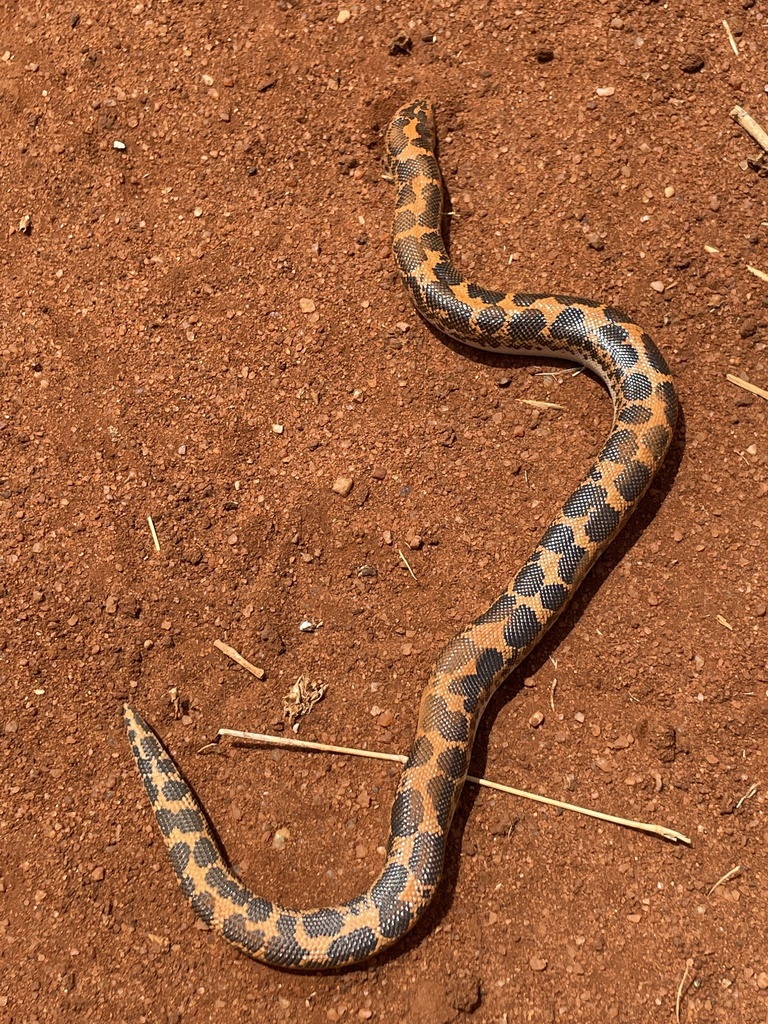
East African Sand Boa
Eryx colubrinus
Eryx colubrinus, also known as the Kenyan sand boa and several other common names, is a species of snake in the subfamily Erycinae of the family Boidae. The species is native to northern and eastern Africa. Three subspecies are recognized.
From the article Eryx colubrinus on Wikipedia (CC BY-SA), quoted section by section
Description
Eryx colubrinus is a heavily-built snake with a small head, small eyes, vertical pupils, and a short tail. Scale texture is extremely smooth, except on the tail, which tapers off into a keeled scale pattern. Adult female specimens of G. colubrinus are rarely more than 91 cm (3 feet) in total length (tail included). The average Egyptian sand boa grows no longer than 12-32" (30-80cm) long, with males being significantly smaller than females. The color pattern usually consists of a yellow or orange coloration overlaid with dark brown splotches. The belly is white or cream-colored. E. colubrinus is readily available in the pet trade due to its small size, docility and ease of care. In recent years, there have been a number of new color morphs made available by both commercial and hobby breeders. Some of the more popular morphs available include anerythristic (black and white lacking orange/red simple recessive trait), albino (lacking black pigment simple recessive trait), snow (double recessive combination of an anerythristic and an albino), stripes (normal-colored, anerythristic, albino and snow), hypo/ghost, paradox albinos (simple recessive trait), paradox snows (double recessive trait), splash (recessive trait), paint (recessive trait) and stripe combinations with any of the listed recessive traits. …
Range & habitat
Eryx colubrinus is found in North Africa from Egypt as far west as Niger (Aïr), including Somalia, Ethiopia, Sudan, Kenya, and northern Tanzania. A single specimen has been reported from Yemen. The type locality given is "Ægypto".
Wikipedia: “Geographic range”
What it does
Eryx colubrinus is most active at night, but may be irregularly active during the day. This species is fossorial and spends roughly 80% of its time underground. During the hotter times of the year, E. colubrinus seeks refuge beneath stones and in the burrows of small mammals. However, they have also been known to occasionally climb trees.
Wikipedia: “Behavior”
In human culture
The subspecific name loveridgei is in honor of British herpetologist Arthur Loveridge.
Wikipedia: “Etymology”
Where it lives
Recorded sightings
—
geo-referenced records in GBIF, from museums, herbaria and field observers.
Drag the globe to turn it. Dots are where records exist, not a range map; darker means more records.
In the stacks
Searching the stacks…
Every page naming Eryx colubrinus in the Biodiversity Heritage Library →
This page is assembled live from iNaturalist, GBIF, Wikipedia, the Source Library and the Internet Archive. It is not yet part of the hand-edited codex. iNaturalist taxon 32208.