- Animals
- ›Chordates
- ›Vertebrates
- ›Reptiles
- ›Snakes and Lizards
- ›Lizards
- ›Wall lizards, amphisbaenians, and allies
- ›Wall Lizards
- ›Eremiadinae
- ›Acanthodactylus
- ›Tristrami
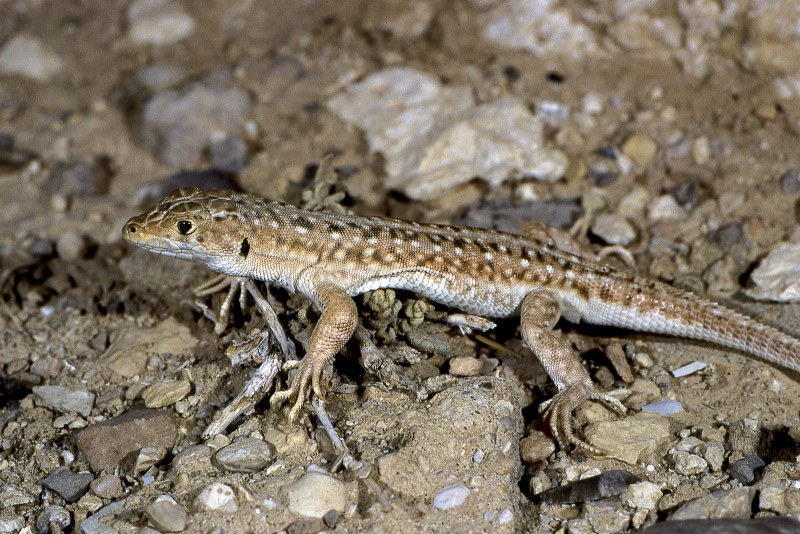
Acanthodactylus orientalis
Acanthodactylus is a genus of lacertid lizards, commonly referred to as fringe-fingered lizards, fringe-toed lizards (though the latter common name is also used for the New World lizard genus Uma), and spiny-toed lizards.
From the article Acanthodactylus on Wikipedia (CC BY-SA), quoted section by section
Description
Members of the genus Acanthodactylus possess the following combination of traits:
Lacking occipital scales, Flat ventral scales, Fingers with three or four series of scales, Toes with comb-like projections, Femoral pores present, Parietal foramen present. The coloration and pattern of spots of Acanthodactylus is extremely variable, so it is unsurprising that zoologists have, at one time or another, classified every variety as a separate species.
Range & habitat
The approximately 40 species in the genus Acanthodactylus are native to a wide area in North Africa, southern Europe and Western Asia; across the Sahara Desert, to the Iberian Peninsula, and east through the Arabian Peninsula, to Afghanistan and western India.
Wikipedia: “Geographic range”
What it does
Every saurian of the genus Acanthodactylus is very aggressive and gets continuously involved in skirmishes with other members of its species. The males strenuously defend the borders of their territories.
Wikipedia: “Behavior”
Where it lives
Recorded sightings
—
geo-referenced records in GBIF, from museums, herbaria and field observers.
Drag the globe to turn it. Dots are where records exist, not a range map; darker means more records.
In the stacks
Searching the stacks…
Every page naming Acanthodactylus orientalis in the Biodiversity Heritage Library →
This page is assembled live from iNaturalist, GBIF, Wikipedia, the Source Library and the Internet Archive. It is not yet part of the hand-edited codex. iNaturalist taxon 35420.