On eBird ↗
California Quail
Live sightings near you, the range map, bar charts of when it is seen, and Macaulay Library photos and recordings.
California Quail
Callipepla californica
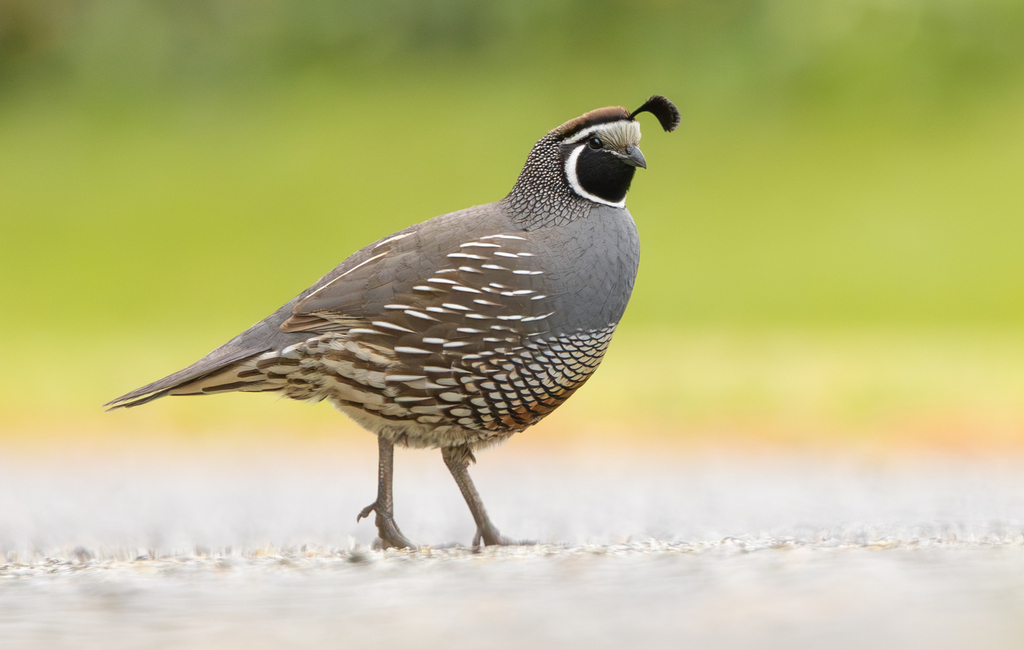
The California quail (Callipepla californica), also known as the California valley quail or valley quail, is a small ground-dwelling bird in the New World quail family. These birds have a curving crest or plume, made of six feathers, that droops forward: black in males and brown in females; the flanks are brown with white streaks. Males have a dark brown cap and a black face with a brown back, a grey-blue chest and a light brown...
From the article California quail on Wikipedia (CC BY-SA), quoted section by section
Description
These birds have a curving crest, plume or topknot, longer in males than females. Adult males are gray and brown colored, with a black face outlined by white stripes. Females are a plainer brown color and do not have the facial stripes. In terms of size, this bird typically measures 24–27 cm (9.4–10.6 in) in length, 32–37 cm (13–15 in) in wingspan, and weigh 140–230 g (4.9–8.1 oz).
What it does
The California quail is a highly sociable bird that often gathers in small flocks known as "coveys". One of their daily communal activities is a dust bath. A group of quail will select an area where the ground has been newly turned or is soft, and using their underbellies, will burrow downward into the soil some one to two inches. They then wriggle about in the indentations they have created, flapping their wings and ruffling their feathers, causing dust to rise in the air. They seem to prefer sunny places in which to create these dust baths. An ornithologist is able to detect the presence of quail in an area by spotting the circular indentations left behind in the soft dirt, some 7–15 cm (2.8–5.9 in) in diameter. They are year-round residents. Although this bird coexists well at the edges of urban areas, it is declining in some areas as human populations increase. They were originally found mainly in the southwestern United States but they have been introduced into other areas including British Columbia, Hawaii, Chile, Uruguay, Brazil, Argentina, Peru, South Africa, New Zealand, and to Norfolk Island and King Island in Australia. These birds forage on the ground, often scratching at the soil. They can sometimes be seen feeding at the sides of roads. …
Wikipedia: “Behavior”
Listen
Looking for field recordings…
Where it lives
Recorded sightings
—
geo-referenced records in GBIF, from museums, herbaria and field observers.
Drag the globe to turn it. Dots are where records exist, not a range map; darker means more records.
In the stacks
Searching the stacks…
Every page naming Callipepla californica in the Biodiversity Heritage Library →
This page is assembled live from iNaturalist, GBIF, Wikipedia, the Source Library and the Internet Archive. It is not yet part of the hand-edited codex. iNaturalist taxon 1409.