On eBird ↗
Rufous-necked Hornbill
Live sightings near you, the range map, bar charts of when it is seen, and Macaulay Library photos and recordings.
Rufous-necked Hornbill
Aceros nipalensis
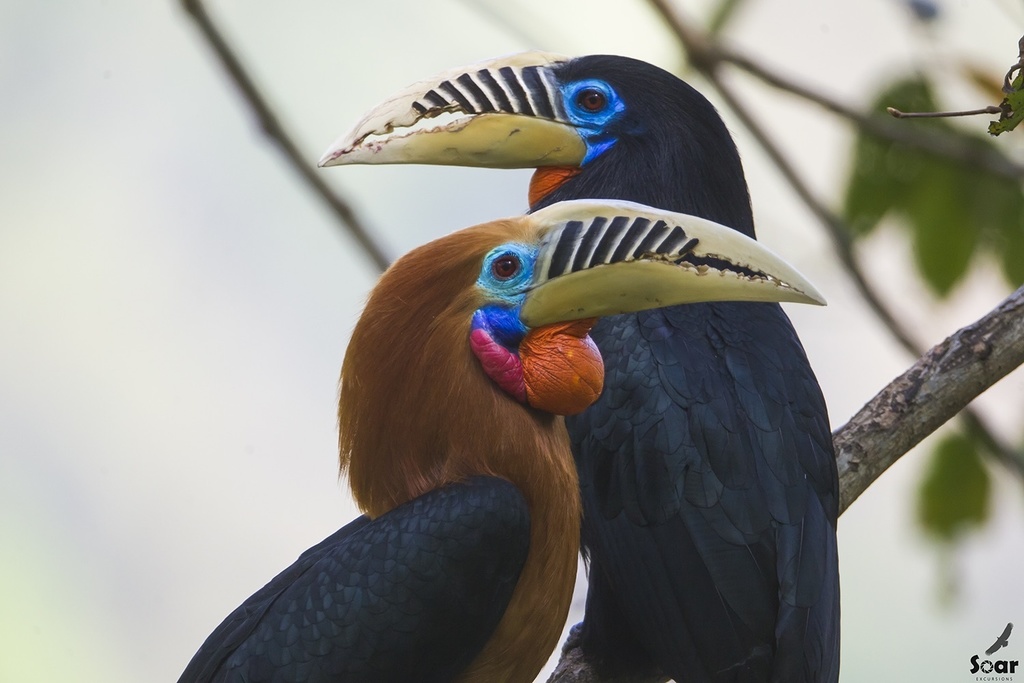
The rufous-necked hornbill (Aceros nipalensis) is a species of hornbill in the northeastern India, especially in Arunachal Pradesh, Indian Subcontinent and Southeast Asia. Numbers have declined significantly due to habitat loss and hunting, and it has been entirely extirpated from Nepal. It is estimated that there are now less than 10,000 adults remaining. With a length of about 117 centimetres (46 in), it is among the largest Bucerotine hornbills. The underparts, neck and head are rich rufous...
From the article Rufous-necked hornbill on Wikipedia (CC BY-SA), quoted section by section
Description
The head, neck, and lower body of the male are coloured rufous, with deeper colouration on the flanks and abdomen. The middle primaries and the lower half of the tail are tipped white. The rest of the hornbill's plumage is a glossy dark-green and black. The lower tail-covert feathers are coloured chestnut mixed with black. The female is black, except for the end-portion of her tail and the tips of the middle primaries, which are white. Juvenile hornbills resemble adults of the same sex, but lack the ridges at the base of the upper beak. The beak lacks a true casque but is thickened at its base. It has a number of dark ridges on the upper beak which are absent in the young and increase in number with age up to about seven. The commissure of the beaks is broken in both sexes.
Range & habitat
The rufous-necked hornbill has the northernmost distribution ranging from Northeast India, central Bhutan to western Thailand and northwestern Vietnam. It ranges over an area of 1,163,811 km2 (449,350 sq mi), of which 825,837 km2 (318,857 sq mi) is forested. Within this area, it lives in 90 protected areas comprising 54,955 km2 (21,218 sq mi) of protected forest but only including 7% of optimal hornbill habitat. Mahananda Wildlife Sanctuary in West Bengal represents its westernmost limit; it has also been recorded in Buxa Tiger Reserve, Manas National Park, Eaglenest Wildlife Sanctuary, Sessa Orchid Sanctuary, Kamlang Wildlife Sanctuary, Namdapha National Park and Pakke Tiger Reserve. It predominantly inhabits ridged and hilly forests, primarily temperate broadleaf and mixed forests at elevations of 150–2,200 m (490–7,220 ft), It has also been recorded in dry woodland.
Wikipedia: “Distribution and habitat”
What it does
The nesting period is from March to June, the trees preferred are tall and have broad girths. These hornbill communities move between one forest to another depending on seasonally to forage from fruiting trees that change with local conditions. Describing the egg, Hume (1889) states:
The egg is a broad oval, compressed somewhat towards one end, so as to be slightly pyriform. The shell is strong and thick, but coarse and entirely glossless, everywhere pitted with minute pores. In colour it is a very dirty white, with a pale dirty yellowish tinge, and everywhere obscurely stippled, when closely examined, with minute purer white specks, owing to the dirt not having got down into the bottoms of the pores. It measures 2–25 by 1'75 (inches).
Wikipedia: “Behaviour and ecology”
In human culture
The rufous-necked hornbill occurs in Sanskrit literature under the epithet vārdhrīnasa, a term which at times also has been used to refer to other Bucerotidae. In Arunachal Pradesh, rufous-necked hornbills have been hunted by tribals for their feathers and beaks.
Wikipedia: “In culture”
Listen
Looking for field recordings…
Where it lives
Recorded sightings
—
geo-referenced records in GBIF, from museums, herbaria and field observers.
Drag the globe to turn it. Dots are where records exist, not a range map; darker means more records.
In the stacks
Searching the stacks…
Every page naming Aceros nipalensis in the Biodiversity Heritage Library →
This page is assembled live from iNaturalist, GBIF, Wikipedia, the Source Library and the Internet Archive. It is not yet part of the hand-edited codex. iNaturalist taxon 5523.