- Animals
- ›Chordates
- ›Vertebrates
- ›Birds
- ›Swifts and Hummingbirds
- ›Hummingbirds
- ›Mango Hummingbirds and Allies
- ›Colibri
On eBird ↗
Sparkling Violetear
Live sightings near you, the range map, bar charts of when it is seen, and Macaulay Library photos and recordings.
Sparkling Violetear
Colibri coruscans
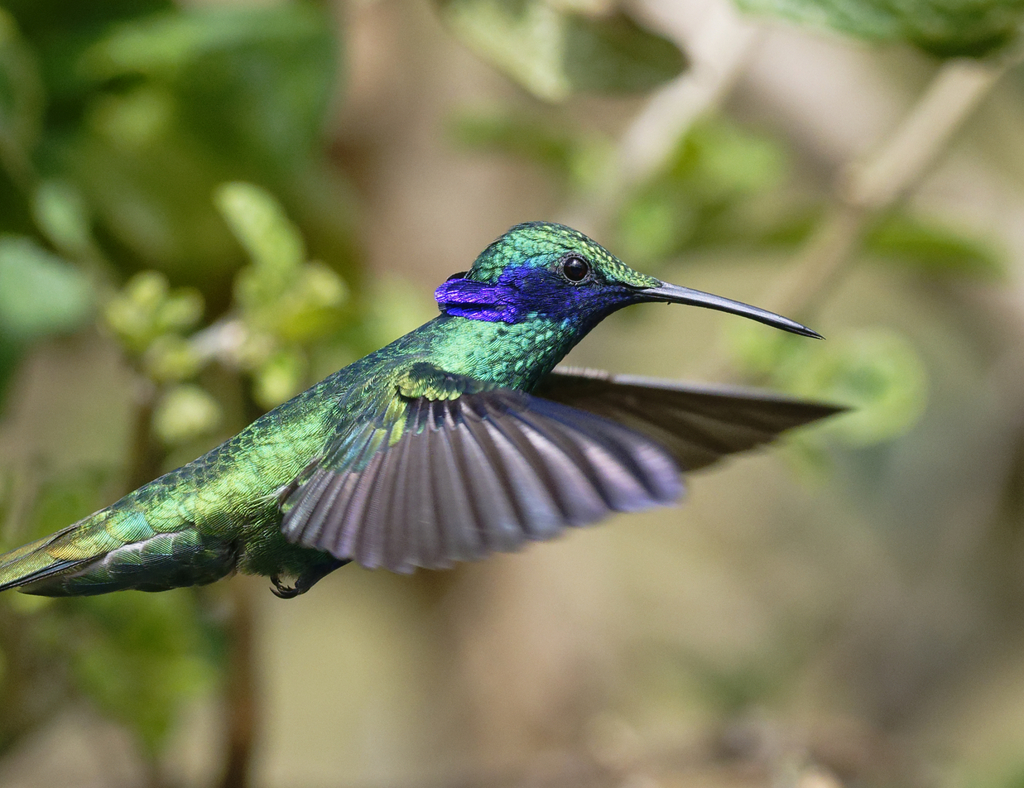
The sparkling violetear (Colibri coruscans) is a species of hummingbird. It is widespread in highlands of northern and western South America, including a large part of the Andes (from Argentina and northwards), the Venezuelan Coastal Range and the Tepuis. It occurs in a wide range of semi-open habitats, even in gardens and parks within major cities such as Quito, and is often the most common species of hummingbird in its range. The sparkling violetear is most...
From the article Sparkling violetear on Wikipedia (CC BY-SA), quoted section by section
Description
The sparkling violetear is the largest violetear at 13 to 14 cm (5 to 5.5 in) long. Male birds weigh 5.8 to 8.5 g (0.20 to 0.30 oz) and females 6 to 7.5 g (0.21 to 0.26 oz). The nominate male's upperparts are metallic bluish green, the chin bluish violet, the belly blue, and the rest of the underparts green. Long erectile bluish violet plumes cover the ears. The tail is metallic green with a steely blue band near the end. Females are similar but smaller, and often have a white spot behind the eye. C. c. germanus is essentially the same as the nominate but the forehead, underparts, and tail are somewhat bluer.
Range & habitat
The nominate subspecies of sparkling violetear is widely distributed. It is found in Venezuela's Sierra de Perijá, Colombia's Sierra Nevada de Santa Marta, and the Andes from Venezuela through Colombia, Ecuador, Peru, and Bolivia into northern Chile and northwestern Argentina. C. c. germanus is found on the tepuis of southern Venezuela, western Guyana, and the adjacent Brazilian state of Roraima. The species inhabits a variety of open landscapes including the edges of subtropical and temperate forest, woodland, gardens, city parks, and páramo. In elevation it mostly ranges from 1,000 to 4,500 m (3,300 to 14,800 ft).
Wikipedia: “Distribution and habitat”
What it does
The sparkling violetear forages for nectar from a wide variety of flowering plants at all levels of the forest from the ground to the canopy. It also captures insects on the wing. It is very aggressive in most habitats, dominating all other hummingbirds while defending flowering trees, but aggression has not been observed in the páramo.
Wikipedia: “Feeding”
Listen
Looking for field recordings…
Where it lives
Recorded sightings
—
geo-referenced records in GBIF, from museums, herbaria and field observers.
Drag the globe to turn it. Dots are where records exist, not a range map; darker means more records.
In the stacks
Searching the stacks…
Every page naming Colibri coruscans in the Biodiversity Heritage Library →
This page is assembled live from iNaturalist, GBIF, Wikipedia, the Source Library and the Internet Archive. It is not yet part of the hand-edited codex. iNaturalist taxon 6072.