- Animals
- ›Chordates
- ›Vertebrates
- ›Birds
- ›Parrots
- ›Old World Parrots
- ›Long-tailed Parrots and allies
- ›Psittacula
On eBird ↗
Long-tailed Parakeet
Live sightings near you, the range map, bar charts of when it is seen, and Macaulay Library photos and recordings.
Long-tailed Parakeet
Psittacula longicauda
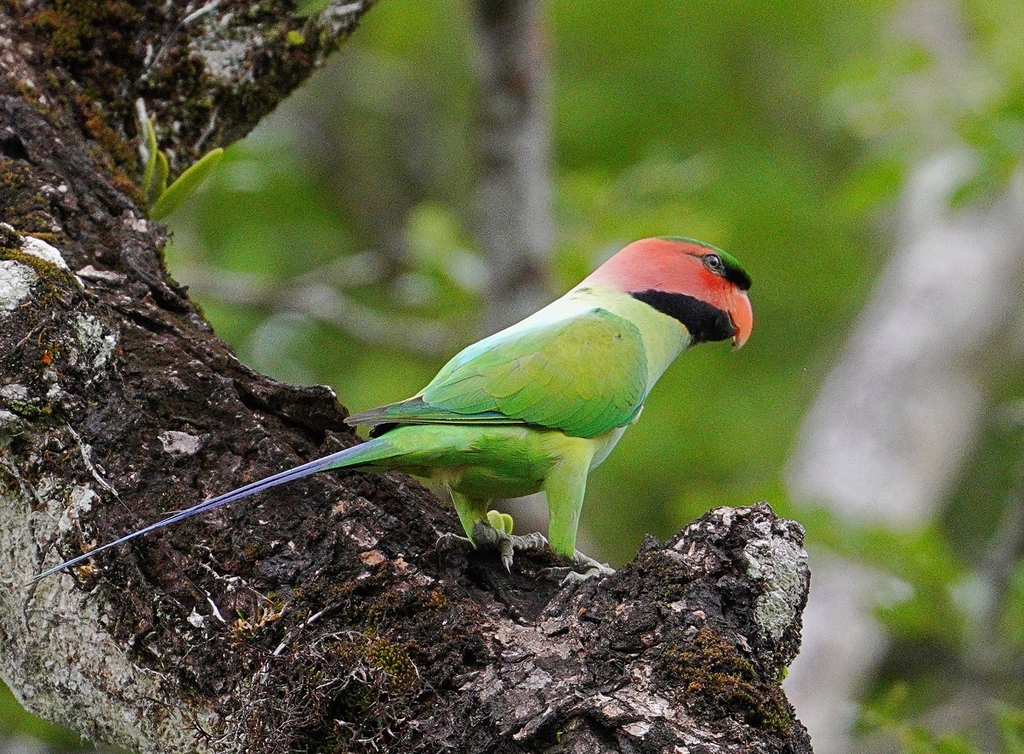
The long-tailed parakeet (Psittacula longicauda) or Burung Bayan Nuri in Malay is a parakeet endemic to the regions of Andaman and Nicobar Islands, Sumatra, Borneo and Peninsular Malaysia (including Singapore). It is allopatric with the congener, the Red-breasted parakeet, Psittacula alexandri, except in the Andaman Islands where they occur together.
From the article Long-tailed parakeet on Wikipedia (CC BY-SA), quoted section by section
Description
It is mainly green with a long blue tail. The male has a black cap and red cheek or face. The female lacks the black cap and has less red cheek.
Range & habitat
The long-tailed parakeet is able to live in a wide variety of habitats such as in swamp forests, lowland evergreen forest, oil palm plantations, coconut plantations, gardens, public parks, and is a frequent visitor to agricultural areas (especially those who yield tropical fruits and seeds). It is usually seen in elevations of up to 300 metres (980 ft).
Wikipedia: “Habitat”
What it does
The long-tailed parakeet is an extremely social bird, always seen communicating with other birds of its species. Even though small groups are usually seen, flocks of thousands of birds have been in the Andaman Islands and Borneo. However, the large flocks tend to appear during breeding season. It is a colony breeder. Birds on the Malay Peninsula tend to breed from December to February while birds on the Nicobar and Andaman Islands tend to breed from February to March. Females tend to lay a clutch of 2 to 4 eggs approximately 30.5 x 24.5mm. It usually takes about 23 to 24 days for the eggs to hatch. Chicks fledge at around 7 weeks old. Its diet consists of a variety of berries, papaya, areca nuts, a wide variety of cultivated and wild fruit (Dillenia indica and Sonneratia alba, as well as Dryobalanops, Elaeis, and Pandanus spp.), flowers (Acacia and Bombax spp.), seeds (Dipterocarpus crinitus and Vitex pinnata, as well as Ixonanthes, Lagerstroemia, and Macaranga spp.), and cultivated grains such as corn and rice. It is a curious species, as it is often seen playing with sticks or other materials found in its environment. This bird species tend to find a breeding area or nest in a high tree trunk almost same behavioral as the Psittacidae family.
Wikipedia: “Ecology and behavior”
Listen
Looking for field recordings…
Where it lives
Recorded sightings
—
geo-referenced records in GBIF, from museums, herbaria and field observers.
Drag the globe to turn it. Dots are where records exist, not a range map; darker means more records.
In the stacks
Searching the stacks…
Every page naming Psittacula longicauda in the Biodiversity Heritage Library →
This page is assembled live from iNaturalist, GBIF, Wikipedia, the Source Library and the Internet Archive. It is not yet part of the hand-edited codex. iNaturalist taxon 18913.