 NL·0417
Herbarium of the Nature Library
- Name
- Diomedea exulans
- Family
- Diomedeidae
- Native to
- Southern Ocean; breeds on South Georgia, Crozet, Kerguelen, Prince Edward and Macquarie islands
- Habitat
- Open ocean, Subantarctic islands
On eBird ↗
Snowy Albatross
Live sightings near you, the range map, bar charts of when it is seen, and Macaulay Library photos and recordings.
Wandering albatross
Diomedea exulans
Also calledToroa (Māori, albatross) · Albatros viajero (Spanish) · Grand albatros (French) · Xìntiānwēng (Chinese)
The bird with the longest wingspan alive, up to about 3.5 m. It can circle the Southern Ocean and travel thousands of kilometres with barely a wingbeat.
The snowy albatross, also known as the wandering albatross, white-winged albatross, or goonie, is a large seabird from the family Diomedeidae; they have a circumpolar range in the Southern Ocean. It is the largest species of albatross and was long considered to be the same species as the Tristan albatross and the Antipodean albatross. Together with the Amsterdam albatross, it forms the wandering albatross species complex, which some began referring to more recently as "snowy". Wikipedia
What it can do
- iWingspan up to ~3.5 m, the largest of any living bird
- iiDynamic soaring: harvests energy from wind gradients over waves
- iiiA shoulder lock holds wings outstretched with little muscle effort
- ivCan cover over 10,000 km in a single foraging trip
- vSmells prey and oily slicks from far away with tube nostrils
In the field
Field marks
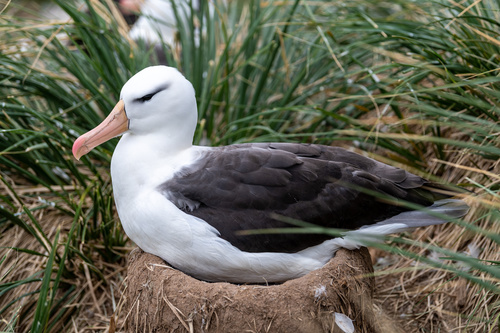
- aEnormous wingspan, often 2.5–3.5 m
- bAdult males the whitest of the great albatrosses, with black only at the wingtips and trailing edge
- cLarge pink bill
- dJuveniles chocolate brown with a white face, whitening over many years
- Voice
- At the nest: braying, screams, whistles and loud bill-clapping during courtship dances
- Not to be confused with
- Royal albatrosses have a black cutting edge to the upper bill; on adult royals the upperwing whitens from the leading edge back, not from the centre. Several other 'wandering-type' albatrosses (Tristan, Antipodean, Amsterdam) are browner.
- Where to see it
- Prion Island, South Georgia (boardwalk, cruise landings); at sea in the Drake Passage and Southern Ocean
- When
- Lays Dec–early Jan; chicks remain at the nest through the austral winter. Prion Island is closed 20 Nov–7 Jan
Listen
Looking for field recordings…
Life & habits
- Diet
- Squid, fish and carrion taken at the surface
- Habitat
- Open ocean; nests on grassy subantarctic islands
- Size
- 1.07–1.35 m long; 6–12 kg
- Lifespan
- Over 50 years
Pairs bond for life after years of elaborate dancing with wing-spreading and bill-clapping, and raise one chick every two years.
Where it lives
Recorded sightings
—
geo-referenced records in GBIF, from museums, herbaria and field observers.
Native range
Southern Ocean; breeds on South Georgia, Crozet, Kerguelen, Prince Edward and Macquarie islands
Drag the globe to turn it. Dots are where records exist, not a range map; darker means more records.
In the old herbals & bestiaries
No plate in the Source Library names this exact species, so these show its closest relatives as the old naturalists drew them: same genus, or the same kind of animal. Click a plate to read the page it came from, with translation.

In the stacks
Searching the stacks…
Every page naming Diomedea exulans in the Biodiversity Heritage Library →
Marginalia
In Coleridge's 'Rime of the Ancient Mariner' (1798), killing an albatross brings a curse on a ship. Sailors long believed albatrosses carried the souls of drowned seamen.
Curiosity
Tens of thousands of albatrosses have drowned on longline fishing hooks, the main threat to the species.
Kinship




Photographs: iNaturalist contributors under the licences shown. Records: GBIF.org. Historical plates: Source Library (CC BY-SA 4.0; originals public domain). Summary text: Nature Library editors and Wikipedia (CC BY-SA). Medicinal and edibility notes are historical and educational, not advice. iNaturalist taxon 4117.