On eBird ↗
Manx Shearwater
Live sightings near you, the range map, bar charts of when it is seen, and Macaulay Library photos and recordings.
Manx Shearwater
Puffinus puffinus
The Manx shearwater (Puffinus puffinus) is a medium-sized shearwater in the seabird family Procellariidae. The scientific name of this species records a name shift: Manx shearwaters were called Manks puffins in the 17th century. Puffin is an Anglo-Norman word (Middle English pophyn) for the cured carcasses of nestling shearwaters. The Atlantic puffin acquired the name much later, possibly because of its similar nesting habits.
From the article Manx shearwater on Wikipedia (CC BY-SA), quoted section by section
Description
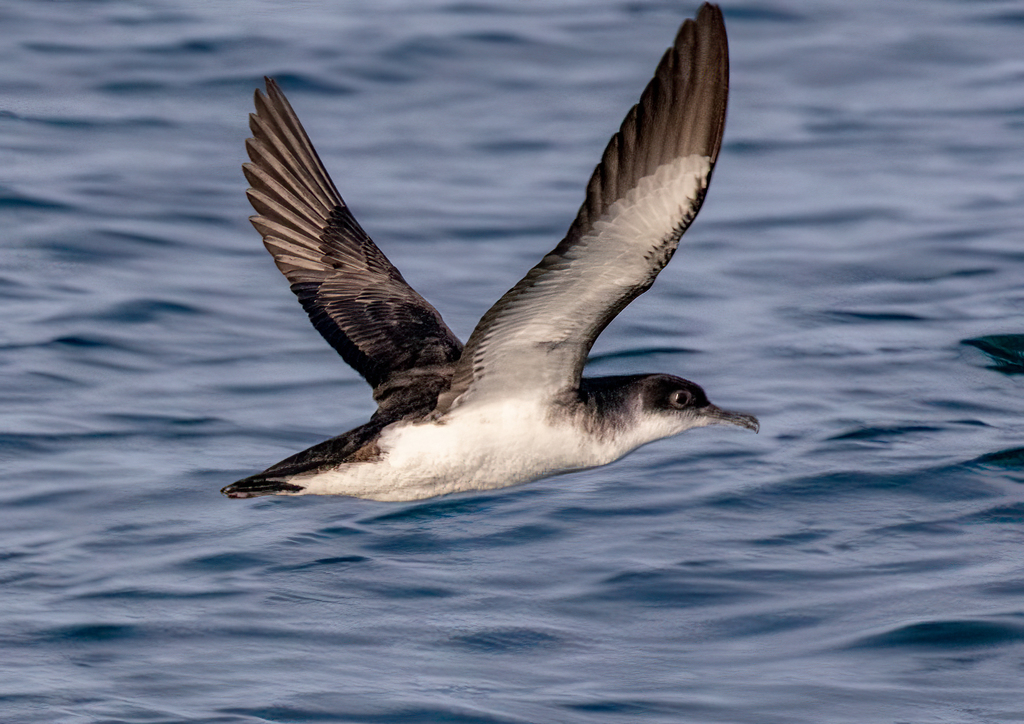
The Manx shearwater is 30–38 cm (12–15 in) with a 76–89 cm (30–35 in) wingspan and weighs 350–575 g (12+1⁄2–20+1⁄2 oz). It has the typically "shearing" flight of the genus, dipping from side to side on stiff wings with few wingbeats, the wingtips almost touching the water. This bird looks like a flying cross, with its wings held at right angles to the body, and it changes from black to white as the black upper parts and white under sides are alternately exposed as it travels low over the sea.
Voice. This shearwater is mainly silent at sea, even when birds are gathered off the breeding colonies. It calls on its nocturnal visits to the nesting burrows in flight, on the ground, and in the burrows, although moonlight depresses the amount of calling. The vocalisations largely consists of a raucous series of croons, howls, and screams, typically in groups of a few syllables, which become weaker and throatier. The male has some clear ringing and shrieking tones absent from the harsher repertoire of the female, the difference being obvious when a pair duets. The nocturnal vocalisations of Manx shearwater are notorious for their eerie character and the alarm they might arouse in uninitiated hearers. …
Range & habitat
The Manx shearwater is entirely marine, typically flying within 10 m (30 ft) of the sea surface. It nests in burrows on small islands, which it visits only at night. Its nesting colonies are in the north Atlantic Ocean in the United Kingdom, Ireland, Iceland, the Faroe Islands, France, the Isle of Man, the Channel Islands, the Azores, Canary Islands, and Madeira. The most important colonies, with a total of more than 300,000 pairs, are on islands off Wales, Scotland, and Northern Ireland. Three-quarters of the British and Irish birds breed on just three islands; Skomer, Skokholm, and Rùm. Around 7000–9000 pairs breed in Iceland, with at least 15,000 pairs on the Faeroes. Other populations are of at most a few hundred pairs. The northeast of North America has recently been colonised from Newfoundland and Labrador to Massachusetts; although breeding was first recorded in 1973, populations remain small. Records in the northeast Pacific are increasing, and breeding has been suspected in British Columbia and Alaska. During the breeding-season birds regularly commute between their colonies and offshore feeding grounds that can be up to 1,500 km away. …
Wikipedia: “Distribution and habitat”
What it does
Manx shearwaters are long-lived birds. A Manx shearwater breeding on Copeland Island, Northern Ireland, was as of 2003/04, the oldest known living wild bird in the world: ringed as an adult (at least 5 years old) in July 1953, it was retrapped in July 2003, at least 55 years old. This is a gregarious species, which can be seen in large numbers from boats or headlands, especially on migration in autumn. It is silent at sea, but at night, the breeding colonies are alive with raucous cackling calls.
Breeding. Although shearwaters return to the breeding colonies from March onwards, the females often then leave again for 2–3 weeks before egg-laying in early May. Males return to the colonies in which they were hatched, but up to half of females may move elsewhere. The nest is a burrow, often previously excavated by a European rabbit, although shearwaters can dig their own holes. Suitable holes under rocks may also be used. The burrows may be reused in subsequent years. The single white egg averages 61 mm × 42 mm (2+1⁄2 in × 1+3⁄4 in) and weighs 57 g (2 oz), of which 7% is shell.
Food and feeding. The Manx shearwater feeds on small fish (herrings, sprats, and sand eels), crustaceans, cephalopods, and surface offal. The bird catches food off the surface or by pursuit diving, and forages alone or in small flocks. …
Wikipedia: “Behaviour”
In human culture
The large chicks of the Manx shearwater are very rich in oil from their fish diet and have been eaten since prehistoric times. They are easily extricated from their burrows, and the annual crop from the Calf of Man may have been as high as 10,000 birds per year in the 17th century. The young birds were also eaten in Ireland, Scotland, and the Scottish islands. The eerie, nocturnal cries of nesting shearwaters and petrels has led to associations with the supernatural. The breeding colonies at Trollaval on Rùm and Trøllanes and Trøllhøvdi in the Faroe Islands are believed to have acquired their troll associations from the night-time clamour.
Wikipedia: “In culture”
Listen
Looking for field recordings…
Where it lives
Recorded sightings
—
geo-referenced records in GBIF, from museums, herbaria and field observers.
Drag the globe to turn it. Dots are where records exist, not a range map; darker means more records.
In the stacks
Searching the stacks…
Every page naming Puffinus puffinus in the Biodiversity Heritage Library →
This page is assembled live from iNaturalist, GBIF, Wikipedia, the Source Library and the Internet Archive. It is not yet part of the hand-edited codex. iNaturalist taxon 4093.