On eBird ↗
African Openbill
Live sightings near you, the range map, bar charts of when it is seen, and Macaulay Library photos and recordings.
African Openbill
Anastomus lamelligerus
The African openbill (Anastomus lamelligerus) is a species of stork from the family Ciconiidae. It is widely distributed in Sub-Saharan Africa and western regions of Madagascar. This species is considered common to locally abundant across its range, although it has a patchy distribution. Some experts consider there to be two sub-species, A. l. lamelligerus distributed on the continent and A. l. madagascariensis living on the island of Madagascar. Scientists distinguish between the two sub-species due to the more pronounced longitudinal ridges on the bills of adult A. l. madagascariensis. The Asian openbill (Anastomus oscitans) found in Asia is the African openbill's closest relative. The two species share the same notably large bill of a peculiar shape that gives them their name.
From the article African openbill on Wikipedia (CC BY-SA), quoted section by section
Description
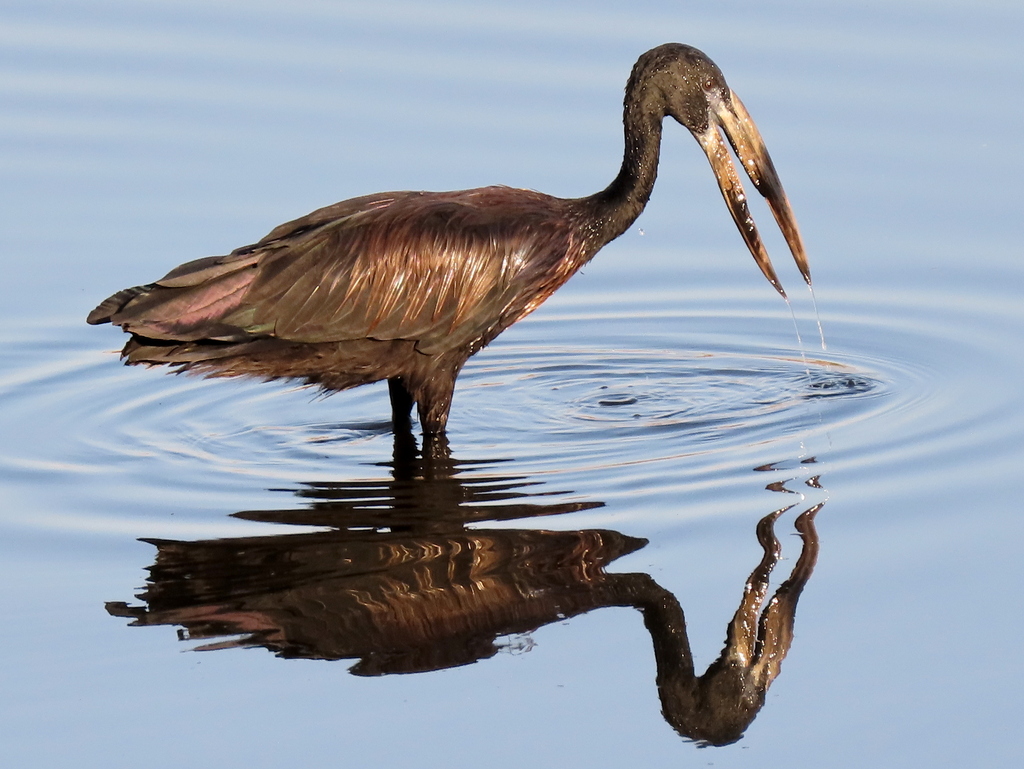
The African openbill is a stork measuring 80–94 cm (31–37 in) and weighing 1–1.3 kg (2.2–2.9 lb). The species does not exhibit any major sexual dimorphism, although the males are slightly larger than the females and have a longer and heavier bill. The adult bill is between 135–196 mm (5.3–7.7 in) in length, brownish in color and has a gap between the upper and lower mandible. This gap is non-existent in juvenile birds and develops as the bird ages. It is because the two mandibles of the beak only meet at the tip and not in the middle that this stork genus received the name of "openbill".
The adult plumage is overall black with iridescent green feathers on their backs, coverts and abdomens. The juvenile plumage is usually less vibrant and browner in color with the feathers of the underparts having pale tips. The legs and feet are black. The eyes are grey with grey lores and no distinct coloration of the eye-ring.
Bill shape. The gap in the bill of the African openbill was first hypothesized to serve as a nutcracker, crushing the shells of the snails this stork feeds on. Scientists later demonstrated that the bill does not serve this function. Rather the opening between the two mandibles facilitates grasping the shells of the snails. The convergent tips of the mandibles prevent the slipping forward of a spherical object being carried by the storks. …
Range & habitat
African openbill storks live in every habitat where suitable mollusc prey can be found. Their preferred habitats remain long stretches of freshwater. They can sometimes be seen far from humid habitats, but only exceptionally. The place you are most likely to see them are on large freshwater wetlands with nearby tall trees or shrubs for them to nest in.
Migration. Some African openbill population are trans-equatorial migrants. Timing their migration to arrive in West Africa for the start of the dry period. They migrate in flocks and most of the reason and organisation behind these movements remain unknown. Some populations migrate while others are residents, migration in African openbill highly depends on the weather conditions.
Wikipedia: “Habitat”
What it does
These birds primarily feed on aquatic snails of the genus Pila. They have been observed to also eat freshwater mussels. In different parts of their range, some individuals have been observed to eat terrestrial snails, frogs, crabs, fish, worms and large insects. None of these are the preferred food choice of the African openbill.
Foraging. To forage for snails, the African openbill stands in shallow water, repeatedly dipping its beak in. They hold their bill slightly ajar and will snap it shut if they encounter a prey. Once they have a hold on the prey, they hold it with the tip of their mandibles and carry it back to shore. The storks will start slowly walking around and changing location, if they do not capture anything in the area they decided to forage in. The African openbill sometimes forages by standing on the back of hippopotamuses (Hippopotamus amphibius). As the hippopotamus wades through the vegetation, it upturns it and exposes the multiple snails that cling to the undersides of the plants. The stork will then feed on these exposed snails that have become easy prey. The hippopotamus does not seem to mind the presences of the bird on its back and is not harmed by it in any way. Lastly, very few individuals have been observed to forage visually from afar. There are accounts of African openbill storks swooping down from their nest and immediately securing a prey. …
Wikipedia: “Diet”
Toxicity
In Kenya, the African openbill stork is subject to deliberate poisoning from poachers. They are being poisoned through a special baiting technique that uses a live decoy. The poachers set up the decoy and then disturb flocks of storks so that they have no other choice than to settle near the decoy. The African openbill feed directly on the snails near the decoy which have been poisoned by the poachers. This method disproportionately affects the African openbill stork because they are a flocking species that lives year-round on the areas poisoned by the poachers. They are also preferentially poisoned because poachers can turn a greater profit from these birds. The stork isn't currently at risk, but the continuation of this method of poaching could be detrimental to the populations. This practice continues in Kenya because of the social importance of eating wild bird meat. It has become a habit of the population as the people believe wild meat is the best available option, especially when it is not expensive.
Wikipedia: “Pesticide poisoning”
Listen
Looking for field recordings…
Where it lives
Recorded sightings
—
geo-referenced records in GBIF, from museums, herbaria and field observers.
Drag the globe to turn it. Dots are where records exist, not a range map; darker means more records.
In the stacks
Searching the stacks…
Every page naming Anastomus lamelligerus in the Biodiversity Heritage Library →
This page is assembled live from iNaturalist, GBIF, Wikipedia, the Source Library and the Internet Archive. It is not yet part of the hand-edited codex. iNaturalist taxon 4776.