On eBird ↗
White-tufted Grebe
Live sightings near you, the range map, bar charts of when it is seen, and Macaulay Library photos and recordings.
White-tufted Grebe
Rollandia rolland
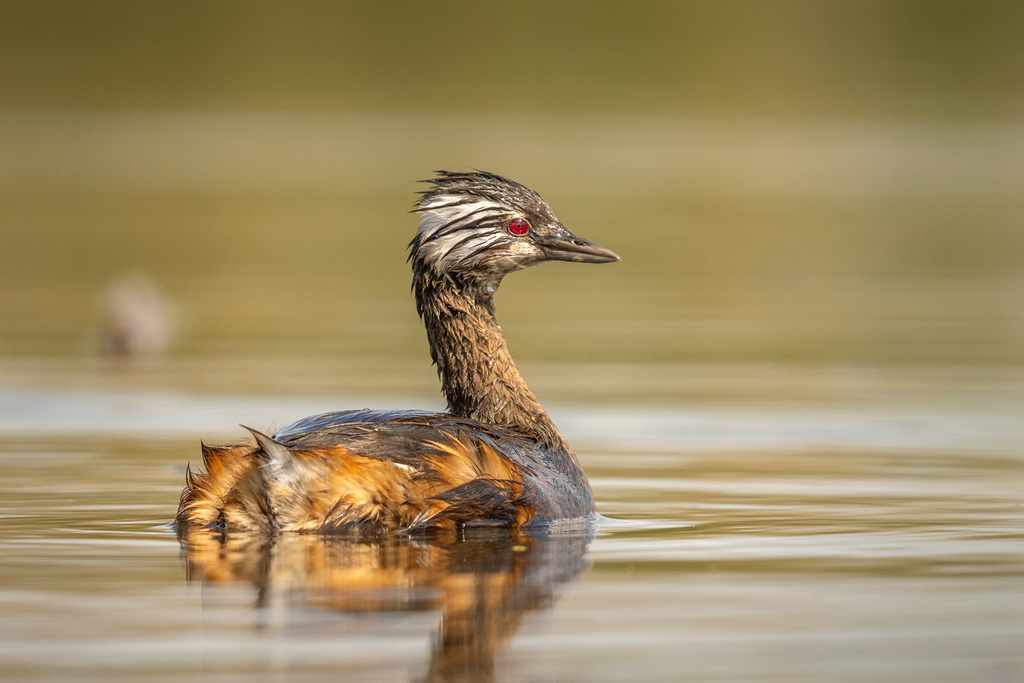
The white-tufted grebe (Rollandia rolland), also known as Rolland's grebe, is a species of grebe in the family Podicipedidae. Found in the southern and western South America, its natural habitat is freshwater lakes, ponds and sluggish rivers and streams.
From the article White-tufted grebe on Wikipedia (CC BY-SA), quoted section by section
Description
The male and female white-tufted grebe look alike and are between 24 and 36 cm (9.4–14.2 in) in length, with lower and medium measurements being typical for the South American mainland populations and upper measurements typical for the Falkland population. Adults in breeding plumage have a prominent black crest on the back of their heads. There is a large white tuft of feathers around the ear but otherwise the head, neck and back are black, with a slight greenish sheen, and the feathers of the mantle and back are narrowly bordered with brown. The underparts are a dull reddish-brown, often mottled with brown or grey. The secondary wing feathers are white, pale grey or have white tips. The eye is red, the beak black and the legs grey or olive-brown. Adults in non-breeding plumage are dark brown rather than black. The crest becomes inconspicuous, the sides of the head and throat are white and the white wing patches are retained. The neck and chest are buff, gradually paling to white on the belly. Immature birds resemble adults in non-breeding plumage but their throats and the sides of their necks have brown streaking.
Range & habitat
The white-tufted grebe is found in the southern and western parts of South America, occurring from lowlands up to an altitude of 4,500 m (14,800 ft) above sea level. Its range includes south-eastern Brazil, Uruguay, Paraguay, Bolivia, Chile, Peru, Argentina and the Falkland Islands. It occurs as a vagrant in the South Sandwich Islands and South Georgia. Its typical habitat is lakes, marshy ponds, ditches and slow-moving rivers and streams. Birds in southernmost South America form into flocks after the breeding season and migrate northwards up the coast. These are often seen in bays and other sheltered marine locations.
Wikipedia: “Distribution and habitat”
What it does
The white-tufted grebe feeds mostly on fish, but also takes arthropods and sometimes aquatic vegetation. The fish are typically quite small, but may be up to about 15 cm (6 in) long. The white-tufted grebe catches its prey in rather sluggish dives that may last up to 20 seconds or by only submerging its head while swimming on the surface.
Wikipedia: “Feeding”
Listen
Looking for field recordings…
Where it lives
Recorded sightings
—
geo-referenced records in GBIF, from museums, herbaria and field observers.
Drag the globe to turn it. Dots are where records exist, not a range map; darker means more records.
In the stacks
Searching the stacks…
Every page naming Rollandia rolland in the Biodiversity Heritage Library →
This page is assembled live from iNaturalist, GBIF, Wikipedia, the Source Library and the Internet Archive. It is not yet part of the hand-edited codex. iNaturalist taxon 4251.