On eBird ↗
Caribbean Elaenia
Live sightings near you, the range map, bar charts of when it is seen, and Macaulay Library photos and recordings.
Caribbean Elaenia
Elaenia martinica
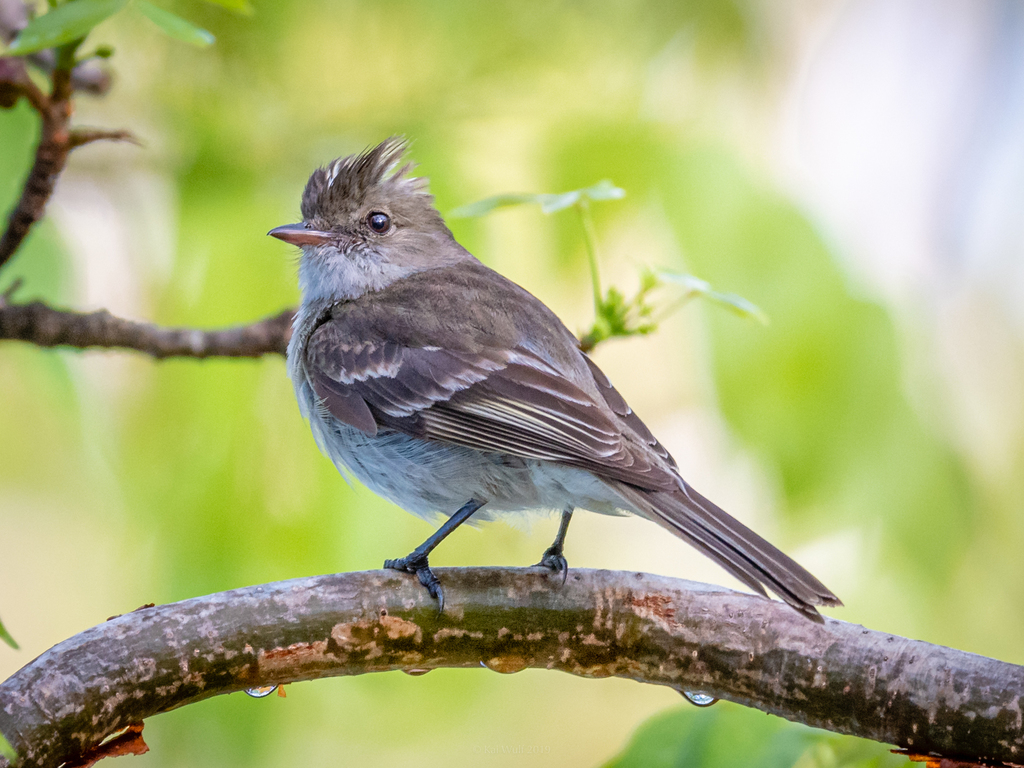
The Caribbean elaenia (Elaenia martinica) is a species of bird in the family Tyrannidae found in the West Indies and parts of Central America. Its natural habitats are tropical and subtropical dry broadleaf forests, subtropical or tropical moist lowland forests, and heavily degraded former forest.
From the article Caribbean elaenia on Wikipedia (CC BY-SA), quoted section by section
Description
The Caribbean elaenia is 14 to 18 cm (5.5 to 7.1 in) long and weighs 18 to 29 g (0.63 to 1.0 oz). It is largish elaenia and has a bushy crest. The sexes have the same plumage. Adults of the nominate subspecies E. m. martinica have a dull olive to brownish olive crown with a white stripe in the middle of the crest. They have whitish lores and a faint whitish eyering on an otherwise mottled gray-brown face. Their upperparts are dull olive to brownish olive. Their wings are dusky with yellowish to whitish edges on the flight feathers and tips on the coverts; the latter show as two wing bars. Their tail is dusky. Their throat is sooty gray, their breast pale gray, their belly whitish to dull yellowish, and their undertail coverts yellowish to whitish. The other subspecies of the Caribbean elaenia differ from the nominate and each other thus:
E. m. riisii: smaller and overall paler than nominate E. m. barbadensis: larger than nominate with darker underparts E. m. remota: smaller than nominate with a browner rump and grayer throat and breast E. m. chinchorrensis: dark brownish (less greenish olive) upperparts than nominate with no yellow on the belly E. m. cinerescens: larger than nominate with a stronger yellow wash on the belly E. m. …
Range & habitat
The subspecies of the Caribbean elaenia are found thus:
E. m. riisii: Puerto Rico and its offshore islands, the Virgin Islands, Anguilla, St. Martin, St. Bartholomew, Antigua, Barbuda, and Aruba, Bonaire, and Curaçao in the Netherlands Antilles (see (1) below) E. m. martinica: Lesser Antilles from Saba and St. Eustatius south to Grenada E. m. barbadensis: Barbados E. m. remota: Culebra Cay and Cozumel, Holbox, Meco, and Mujeres islands of Quintana Roo, southeastern Mexico E. m. chinchorrensis: on Great Cay Island off Quintana Roo, on Half Moon Caye, Middle Caye, Glover's Reef, Caye Caulker, and Ambergris Caye off Belize, and as a vagrant on the Belizean mainland (but see (2) below) E. m. cinerescens: San Andrés, Providéncia, and Santa Catalina islands off Nicaragua (but see (3) below) E. m. caymanensis: Cayman Islands (1) A vagrant photographed and audio recorded in northwestern Florida, though not definitively, is possibly an individual of E. m. riisii. It is listed by the Florida Ornithological Society as "Elaenia species". (2) The Clements taxonomy states that the population on the Belizean cayes may belong to E. m. remota. (3) The Archipelago of San Andrés, Providencia and Santa Catalina is a department of Colombia but is east of Nicaragua and closer to that country than to mainland Colombia. The Clements taxonomy assigns the population there to E. m. …
Wikipedia: “Distribution and habitat”
What it does
The Caribbean elaenia feeds on insects and fruit. It usually forages singly or in pairs and mostly in the lower to middle levels of its habitat. It captures prey and plucks fruit by gleaning while perched and while briefly hovering.
Wikipedia: “Feeding”
Listen
Looking for field recordings…
Where it lives
Recorded sightings
—
geo-referenced records in GBIF, from museums, herbaria and field observers.
Drag the globe to turn it. Dots are where records exist, not a range map; darker means more records.
In the stacks
Searching the stacks…
Every page naming Elaenia martinica in the Biodiversity Heritage Library →
This page is assembled live from iNaturalist, GBIF, Wikipedia, the Source Library and the Internet Archive. It is not yet part of the hand-edited codex. iNaturalist taxon 16702.