On eBird ↗
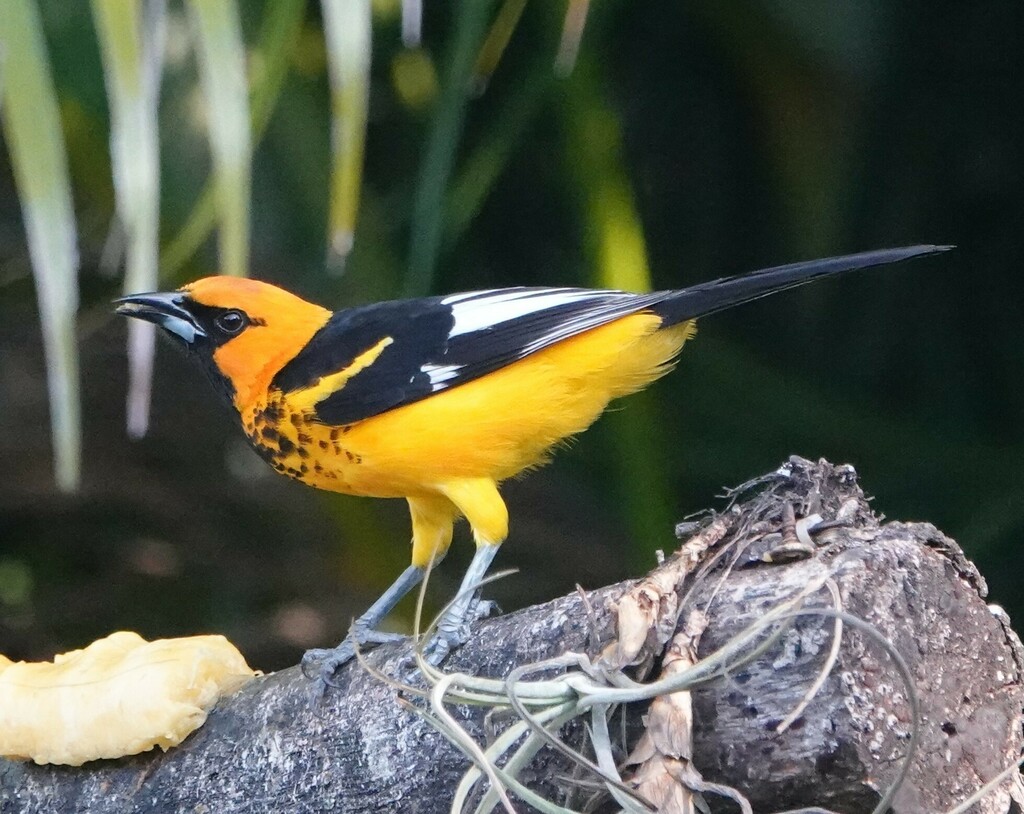
Spot-breasted Oriole
Live sightings near you, the range map, bar charts of when it is seen, and Macaulay Library photos and recordings.
Spot-breasted Oriole
Icterus pectoralis
The spot-breasted oriole (Icterus pectoralis) is a species of bird in the family Icteridae, the oropendolas, New World orioles, and New World blackbirds. It is found from Mexico to Costa Rica. It also has an introduced population in southern Florida.
From the article Spot-breasted oriole on Wikipedia (CC BY-SA), quoted section by section
Description
The spot-breasted oriole is about 21 cm (8.3 in) long. Its wing chord is 8.8 to 11.4 cm (3.5 to 4.5 in), its tail 8.5 to 11.2 cm (3.3 to 4.4 in), its culmen 1.9 to 2.4 cm (0.75 to 0.94 in), and its tarsus 2.6–3 cm (1.0–1.2 in). Males weigh an average of about 53 g (1.9 oz) and females about 45 g (1.6 oz). The sexes have the essentially same plumage though females are duller than males. Adults of the nominate subspecies I. p. pectoralis have a mostly deep orange head and nape. They have a black "mask", throat, "bib" on the upper breast, mantle, and back. Their rump is orange. Their wings are mostly black with orange-yellow lesser and median coverts and white edges on the flight feathers; the white shows as a large patch on the closed wing. Their tail is entirely black. Their underparts below the black bib are pale orange with the eponymous black spots on the breast and breast sides. Juveniles are duller and more yellow where adults are orange, with an olive-brown back and no black on the face and breast. Subspecies I. p. carolynae is mostly like the nominate but its breast spots are larger and usually merge with the bib. I. p. espinachi is more brightly colored than the nominate and I. p. guttulatus has the brightest orange of all. All subspecies have a dark brown iris, a black bill with a gray base to the mandible, and grayish blue legs and feet.
Range & habitat
The spot-breasted oriole is mostly a bird of the Pacific slope of Mexico and much of Central America. The subspecies are found thus:
I. p. carolynae: western Mexico from Jalisco south to Oaxaca I. p. pectoralis: southern Mexico in eastern Oaxaca and central Chiapas I. p. guttulatus from Chiapas south through southern Guatemala, El Salvador, and Honduras into northwestern Nicaragua. In Honduras it also is on the Caribbean slope. I. p. espinachi: from Nicaragua into northwestern Costa Rica's Guanacaste and northern Puntarenas provinces A population of subspecies I. p. espinachi has been breeding in southeastern Florida since the 1940s and is established in the Miami to West Palm Beach area. Another introduced population of the same subspecies is on Cocos Island about 550 km (340 mi) from the Pacific coast of Costa Rica. In its native range the spot-breasted oriole primarily inhabits arid woodlands and scrublands with much Acacia, mesquite (Prosopsis), and similar trees. It also is found in lightly treed pastures, ranches, and villages and on the edges of shade coffee plantations. In much of its range it occurs up to 1,500 m (4,900 ft). However, it reaches 1,600 m (5,200 ft) in northern Central America and only 500 m (1,600 ft) in Costa Rica. In Florida it appears to be dependent on introduced shrubs and trees that among them bear flowers and fruit all year.
Wikipedia: “Distribution and habitat”
What it does
The spot-breasted oriole feeds primarily on insects and other invertebrates, fruits, and nectar. It captures prey by gleaning and probing foliage. It usually forages in pairs or in small family groups, and in small flocks in the non-breeding season. In its native range it is often seen with other orioles.
Wikipedia: “Feeding”
Listen
Looking for field recordings…
Where it lives
Recorded sightings
—
geo-referenced records in GBIF, from museums, herbaria and field observers.
Drag the globe to turn it. Dots are where records exist, not a range map; darker means more records.
In the stacks
Searching the stacks…
Every page naming Icterus pectoralis in the Biodiversity Heritage Library →
This page is assembled live from iNaturalist, GBIF, Wikipedia, the Source Library and the Internet Archive. It is not yet part of the hand-edited codex. iNaturalist taxon 9333.