On eBird ↗
Scott's Oriole
Live sightings near you, the range map, bar charts of when it is seen, and Macaulay Library photos and recordings.
Scott's Oriole
Icterus parisorum
Scott's oriole (Icterus parisorum) is a species of bird in the family Icteridae, the oropendolas, New World orioles, and New World blackbirds. It is found in Mexico and the United States.
From the article Scott's oriole on Wikipedia (CC BY-SA), quoted section by section
Description
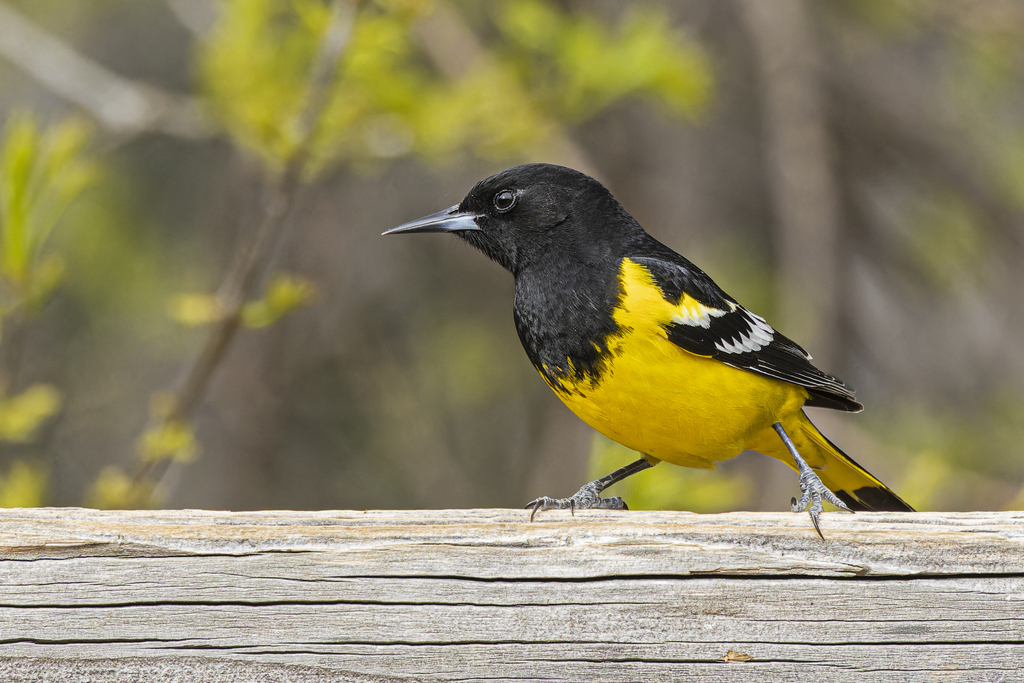
Scott's oriole is about 23 cm (9.1 in) long with a wingspan of 32 cm (13 in); it weighs 32 to 41 g (1.1 to 1.4 oz). Adult males in breeding plumage have a black head, back, scapulars, throat, and breast. Their rump, uppertail coverts, and underparts below the breast are lemon yellow. Their wings are black with pale yellow lesser and median coverts that show as an epaulet. The wing's greater coverts have white tips that show as a wing bar. Their tail feathers are mostly black with yellow bases and white tips, both of which are larger towards the outer feathers. Adult females have a grayish olive top of the head, back, scapulars, rump, and uppertail coverts. Most of these areas have darker streaks. Most individuals have a black chin, throat, and upper breast. The rest of their underpart are pale olive-yellow that is slightly more olive on their sides and flanks. Their wings are blackish brown with olive to yellowish edges on the lesser coverts. Their median and greater coverts have white tips that show as two wing bars. The wing's flight feathers have pale edges. Their tail feathers are mostly olive with progressively larger yellowish bases from the inner to the outer ones. Both sexes have a dark brown or black iris, a black or bluish black bill with a gray base to the mandible, and slate or grayish blue legs and feet.
Range & habitat
Scott's oriole is found in the U. S. discontinuously in southern California. Its main range in the country is south of southern Utah (with "extensions" to northwestern Utah and northeastern Utah/northwestern Colorado), northwestern to southeastern New Mexico, and southwestern Texas with some gaps in Arizona and New Mexico. In Mexico it is found throughout the Baja California peninsula and in the mainland except coastally from the U. S. south to Oaxaca. The species has wandered as far north as Washington, Minnesota, and western Ontario. One individual spent from early December 2007 to early February 2008 in New York City's Union Square Park. Scott's oriole primarily inhabits moderately elevated arid landscapes but shuns true deserts that lack trees. It is commonly found in pinyon–juniper woodland, pine-oak woodland, oak and other scrublands, and areas with yucca. In elevation it ranges from sea level to 3,000 m (9,800 ft).
Wikipedia: “Distribution and habitat”
What it does
Scott's oriole feeds primarily on adult and larval insects with smaller amounts of fruit and nectar and occasionally small vertebrates like lizards in its diet. it takes prey on the ground and in trees and other vegetation. It takes fruit from trees and cacti and nectar from plants and sugar water feeders. During the breeding season it forages singly, in pairs, and in family groups. In winter it often joins mixed-species feeding flocks.
Wikipedia: “Feeding”
Listen
Looking for field recordings…
Where it lives
Recorded sightings
—
geo-referenced records in GBIF, from museums, herbaria and field observers.
Drag the globe to turn it. Dots are where records exist, not a range map; darker means more records.
In the stacks
Searching the stacks…
Every page naming Icterus parisorum in the Biodiversity Heritage Library →
This page is assembled live from iNaturalist, GBIF, Wikipedia, the Source Library and the Internet Archive. It is not yet part of the hand-edited codex. iNaturalist taxon 9318.