On eBird ↗
Jamaican Oriole
Live sightings near you, the range map, bar charts of when it is seen, and Macaulay Library photos and recordings.
Jamaican Oriole
Icterus leucopteryx
The Jamaican oriole (Icterus leucopteryx) is found chiefly on the island of Jamaica. On the island of San Andrès extant subspecies of the bird can be found. The species is considered extinct on the island of Grand Cayman. Subspecies are restricted geographically to their island homes. The species is closely related to the orioles of the “Northern Oriole” such as the Baltimore oriole (Icterus galbula) rather than other Caribbean members of the genus.
From the article Jamaican oriole on Wikipedia (CC BY-SA), quoted section by section
Description
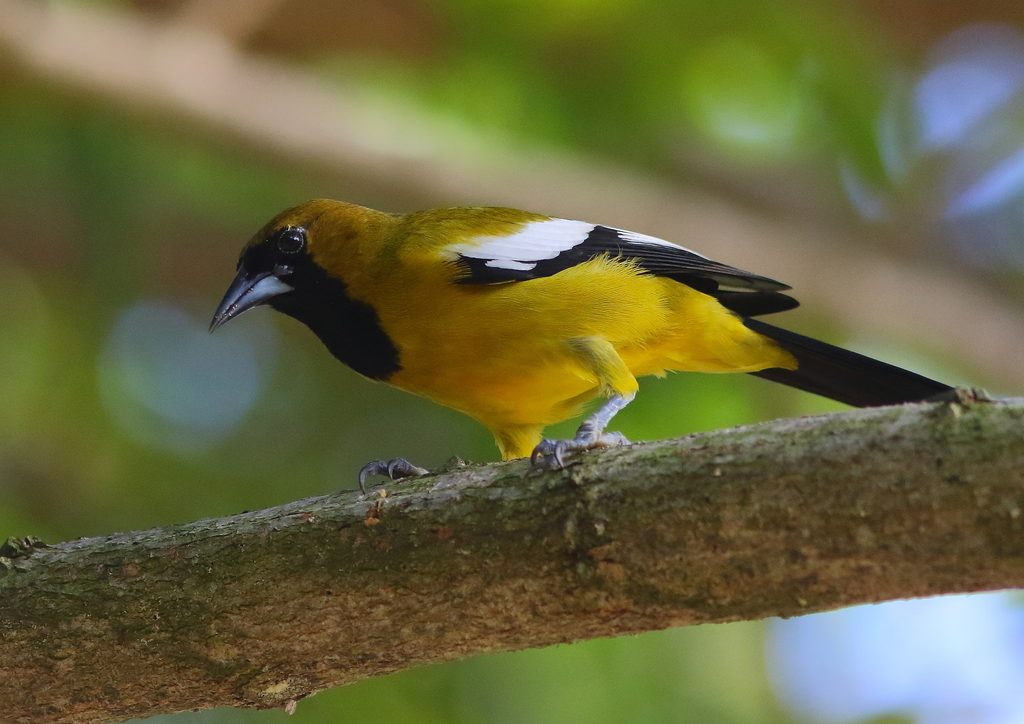
The Jamaican oriole is about 21 cm (8.3 in) long and weighs 34 to 42 g (1.2 to 1.5 oz). The sexes have the same plumage though females are somewhat duller than males. Adults of the nominate subspecies are mostly olivaceous yellow with a somewhat yellower belly. They have a black mask, throat, and upper breast. Their wings are mostly black with wide white edges on the inner flight feathers and white coverts; the last show as a large white patch on the folded wing. Their tail is black. Subspecies I. l. lawrencii is a brighter yellow-green than the nominate and has lemon-yellow underparts. Both subspecies have a dark brown iris, a bluish gray bill with a black culmen, and dark gray legs and feet.
Range & habitat
The nominate subspecies of the Jamaican oriole is found on the island of Jamaica. Subspecies I. l. lawrencii is found on San Andrés Island, which is off the coast of Nicaragua despite being Colombian territory. Subspecies I. l. bairdi was found on Grand Cayman Island. On Jamaica the species inhabits all forest types except mangroves. It also inhabits woodlands, generally any treed area, and gardens. Though it is mostly a bird of the lowlands it occurs at all elevations. Its habitat associations on San Andrés have not been studied.
Wikipedia: “Distribution and habitat”
What it does
The Jamaican oriole feeds primarily on insects and other arthropods, smaller amounts of fruit and nectar, and possibly small vertebrates. It feeds on both wild and cultivated fruits and takes nectar from flowers and hummingbird feeders. It often captures prey exposed by scaling off bark; it also finds it in epiphytic bromeliads. It forages in pairs and family groups.
Wikipedia: “Feeding”
Listen
Looking for field recordings…
Where it lives
Recorded sightings
—
geo-referenced records in GBIF, from museums, herbaria and field observers.
Drag the globe to turn it. Dots are where records exist, not a range map; darker means more records.
In the stacks
Searching the stacks…
Every page naming Icterus leucopteryx in the Biodiversity Heritage Library →
This page is assembled live from iNaturalist, GBIF, Wikipedia, the Source Library and the Internet Archive. It is not yet part of the hand-edited codex. iNaturalist taxon 9335.