On eBird ↗
Black-headed Saltator
Live sightings near you, the range map, bar charts of when it is seen, and Macaulay Library photos and recordings.
Black-headed Saltator
Saltator atriceps
The black-headed saltator (Saltator atriceps) is a seedeating bird. Traditionally placed in the cardinal family (Cardinalidae), it actually seems to be closer to the tanagers (Thraupidae). It breeds from central Mexico to eastern Panama.
From the article Black-headed saltator on Wikipedia (CC BY-SA), quoted section by section
Description
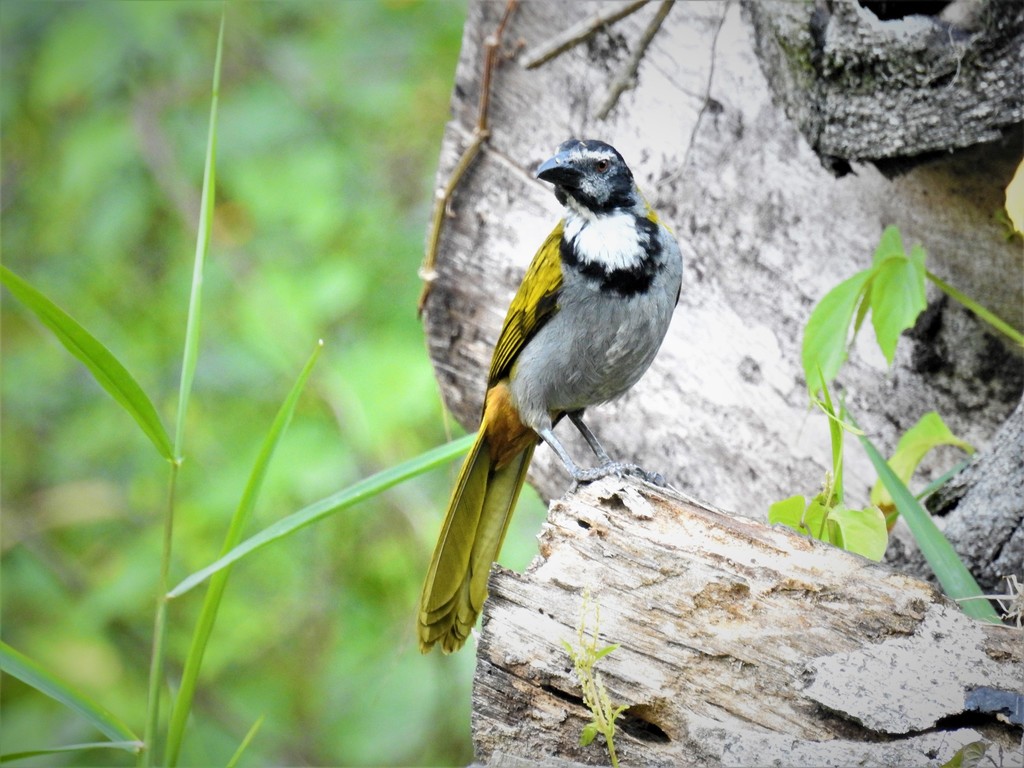
The black-headed saltator is 25.5 to 28 cm (10 to 11 in) long and weighs about 71 to 93 g (2.5 to 3.3 oz). The sexes have the same plumage. Adults of the nominate subspecies S. a. atriceps have a mostly black head with a thin supercilium to just past the eye; it begins gray and becomes white to the rear. Their face is gray below the eye and onto the cheek. Their back, scapulars, rump, uppertail coverts, wings, and tail are bright yellowish olive-green; it is brightest on the tail. The flight- and tail feathers have black shafts. The center of their throat and their upper breast are white surrounded by black. Their lower breast and belly are ash-gray that pales to the rear, their lower flanks ash-gray with a brown tinge, and their undertail coverts orange ochraceous. Their tibial feathers are brown or pale olive. The other subspecies of the black-headed saltator differ from the nominate and each other thus:
S. a. suffuscus: like nominate but with a cinnamon throat center S. a. flavicrissus: smaller white throat than nominate with wider black breast band, less brown wash on flanks, and more olive ochraceous undertail coverts S. a. peeti: larger than nominate but otherwise the same S. a. raptor: paler underparts than nominate with flanks similar to upperparts S. a. …
Range & habitat
The black-headed saltator has a disjunct distribution. Subspecies S. a. flavicrissus is separate from all the others, whose ranges are contiguous. The subspecies are found thus:
S. a. atriceps: Gulf slope from southern Tamaulipas in northeastern Mexico south to Guatemala, then on Caribbean and Pacific slopes through Guatemala and Belize, and south through all of Honduras and central Nicaragua through most of eastern Costa Rica (but skipping coastal southeastern Veracruz and the Yucatán Peninsula) S. a. suffuscus: Sierra de Los Tuxtlas in southeastern Veracruz S. a. flavicrissus: Pacific slope of Mexico from central Guerrero south to Oaxaca short of the Isthmus of Tehuantepec S. a. peeti: southern Mexico in Oaxaca east of the Isthmus and Chiapas S. a. raptor: Yucatán, Quintana Roo, and Campeche states on the Yucatán Peninsula S. a. lacertosus: from extreme eastern Costa Rica east to the Canal Zone in Panama The black-headed saltator inhabits a variety of landscapes in the tropical and lower subtropical zones. These include the edges of humid to semi-arid forest, younger secondary forest, plantations, brushy and scrubby areas, and gardens. In elevation it ranges from sea level to 1,750 m (5,700 ft) in Mexico, to 1,900 m (6,200 ft) in northern Central America, and to 1,300 m (4,300 ft) in Costa Rica.
Wikipedia: “Distribution and habitat”
What it does
The black-headed saltator's diet has not been studied but is known to include fruits, seeds, and insects and smaller amounts of flowers and buds. It has been observed feeding on the fruits of Bursera simaruba, Ficus cotinifolia, Ehretia tinifolia, and Palicourea padifolia. A study in southern Mexico added Cymbopetalum mayanum and Trophis racemosa fruits. It forages at all levels of its habitat, typically in small groups, and it occasionally joins mixed-species feeding flocks. It takes most food by gleaning from vegetation.
Wikipedia: “Feeding”
Listen
Looking for field recordings…
Where it lives
Recorded sightings
—
geo-referenced records in GBIF, from museums, herbaria and field observers.
Drag the globe to turn it. Dots are where records exist, not a range map; darker means more records.
In the stacks
Searching the stacks…
Every page naming Saltator atriceps in the Biodiversity Heritage Library →
This page is assembled live from iNaturalist, GBIF, Wikipedia, the Source Library and the Internet Archive. It is not yet part of the hand-edited codex. iNaturalist taxon 9854.