On eBird ↗
White-crowned Sparrow
Live sightings near you, the range map, bar charts of when it is seen, and Macaulay Library photos and recordings.
White-crowned Sparrow
Zonotrichia leucophrys
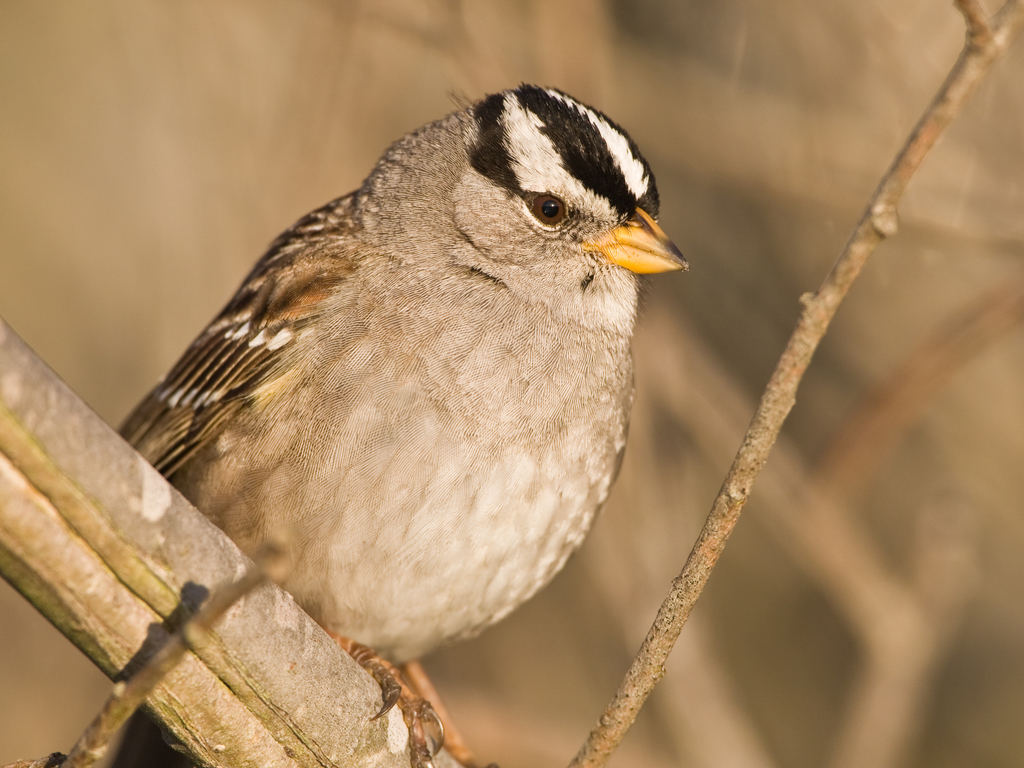
The white-crowned sparrow (Zonotrichia leucophrys) is a species of passerine bird native to North America. A medium-sized member of the New World sparrow family, this species is marked by a grey face and black and white streaking on the upper head. It breeds in brushy areas in the taiga and tundra of the northernmost parts of the continent and in the Rocky Mountains and Pacific coast. While southerly populations in the Rocky Mountains and coast are largely resident, the breeding populations of the northerly part of its range are migratory and can be found as wintering or passage visitors through most of North America south to central Mexico.
From the article White-crowned sparrow on Wikipedia (CC BY-SA), quoted section by section
Description
Adults have black and white stripes on their head, a gray face, brown streaked upper parts and a long tail. The wings are brown with bars and the underparts are gray. Their bill is pink or yellow. They are similar in appearance to the white-throated sparrow, but do not have the white throat markings or yellow lores. Measurements:
Length: 5.9–6.3 in (15–16 cm) Weight: 0.9–1.0 oz (25–28 g) Wingspan: 8.3–9.4 in (21–24 cm)
Range & habitat
Their breeding habitat is brushy areas across northern Canada and the western United States. The white-crowned sparrow is a very rare vagrant to western Europe. It has been sighted in England, Scotland, Ireland, and Norway. In 2008 a white-crowned sparrow was spotted in Cley next the Sea in Norfolk, England. To commemorate the event an image of the bird was included in a window at St Margaret's Church.
Wikipedia: “Distribution”
What it does
These birds forage on the ground or in low vegetation, but sometimes make short flights to catch flying insects. They mainly eat seeds, other plant parts and insects. In winter, they often forage in flocks. White-crowned sparrows nest either low in bushes or on the ground under shrubs and lay three to five brown-marked gray or greenish-blue eggs. The white-crowned sparrow is known for its unihemispheric slow-wave sleep, which allows it to stay half-awake for up to two weeks during migration. This effect has been studied for possible human alertness applications in shift work and truck driving. Recent studies by ornithologists including Elizabeth Derryberry have shown that white-crowned sparrow songs are affected by human activity and noise.
Wikipedia: “Behaviour”
In human culture
The scientific name is from Ancient Greek. The genus name Zonotrichia is from Ancient Greek ζώνη (zone, transl. band) and θρίξ (thrix, transl. hair). The species name leucophrys is from λευκός (leukos, transl. white) and ὀφρῡ́ς (ophrus, transl. eyebrow).
Wikipedia: “Etymology”
Listen
Looking for field recordings…
Where it lives
Recorded sightings
—
geo-referenced records in GBIF, from museums, herbaria and field observers.
Drag the globe to turn it. Dots are where records exist, not a range map; darker means more records.
In the stacks
Searching the stacks…
Every page naming Zonotrichia leucophrys in the Biodiversity Heritage Library →
This page is assembled live from iNaturalist, GBIF, Wikipedia, the Source Library and the Internet Archive. It is not yet part of the hand-edited codex. iNaturalist taxon 9176.