On eBird ↗
Spanish Sparrow
Live sightings near you, the range map, bar charts of when it is seen, and Macaulay Library photos and recordings.
Spanish Sparrow
Passer hispaniolensis
The Spanish sparrow or willow sparrow (Passer hispaniolensis) is a passerine bird of the sparrow family Passeridae. It is found in the Mediterranean region and south-west and central Asia. It is very similar to the closely related house sparrow, and the two species show their close relation in a "biological mix-up" of hybridisation in the Mediterranean region, which complicates the taxonomy of this species.
From the article Spanish sparrow on Wikipedia (CC BY-SA), quoted section by section
Description
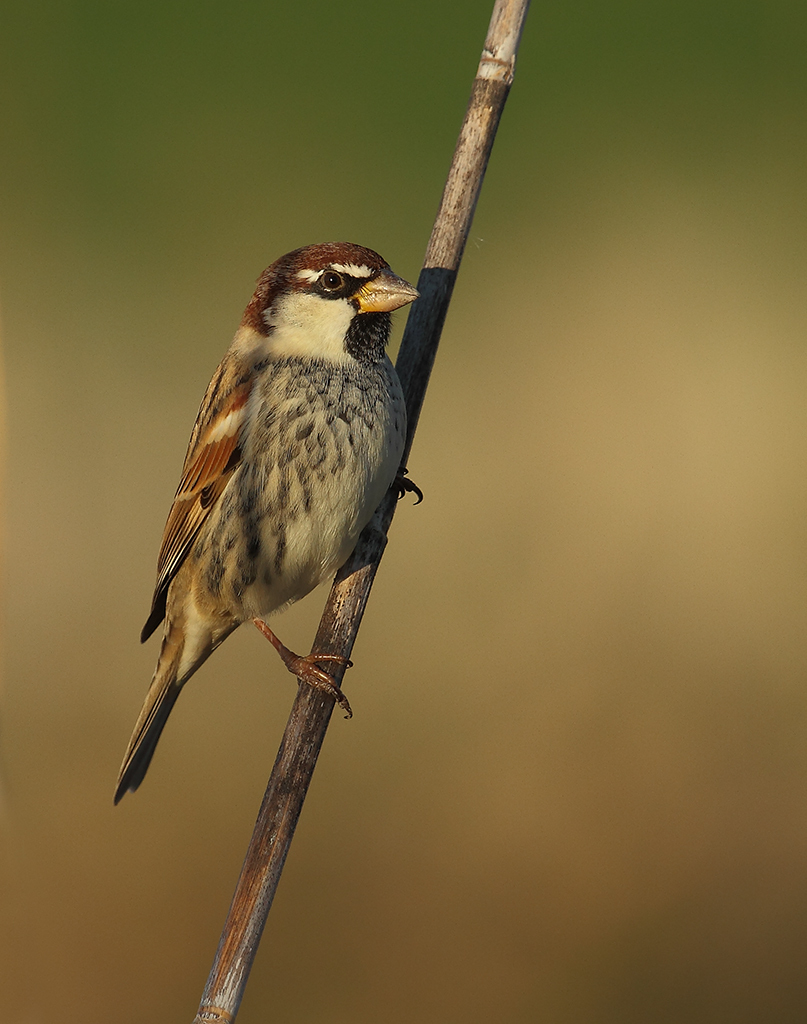
The Spanish sparrow is a rather large sparrow, at 15–16 cm (6–6.5 in) in length, and 22–36 g (0.78–1.27 oz) in weight. It is slightly larger and heavier than house sparrows, and also has a slightly longer and stouter bill. The male is similar to the house sparrow in plumage, but differs in that its underparts are heavily streaked with black, has a chestnut rather than grey crown, and has white rather than grey cheeks. The female is effectively inseparable from the house sparrow in its basic plumage, which is grey-brown overall but more boldly marked. The female has light streaking on its sides, a pale cream supercilium, and broad cream streaks on its back. Two subspecies of the Spanish sparrow – the western Spanish sparrow (P. h. hispaniolensis) and eastern Spanish sparrow (P. h. transcaspicus) – are recognised, with little visible difference between them in worn breeding plumage. They are more easily distinguished in fresh winter plumage, with the eastern subspecies P. h. transcaspicus being paler with less chestnut.
Voice. The Spanish sparrow's vocalisations are similar to those of the house sparrow. The male gives a call somewhat different from that of the house sparrow when displaying at its nest. This call is a pair of strident, disyllabic chirps, similar to those of the house sparrow, but louder and high-pitched, transcribed as chweeng-chweeng, cheela-cheeli. …
Range & habitat
The Spanish sparrow has a highly complex distribution in the Mediterranean region, Macaronesia, and southwest to central Asia. It breeds mostly in a band of latitude about 15 degrees wide, from the Danube Valley and the Aral Sea in the north to Libya and central Iran in the south. Its range has expanded greatly by natural colonisation over the last two centuries, in the Balkans, where it reached Romania, Serbia, and Moldova from 1950 onwards; and in Macaronesia, where its range expansion has been attributed to introductions and travel by ship, but was more likely natural colonisation by migrating birds. Vagrants occur widely, as far north as Scotland and Norway. A study has shown that vagrant individuals tend to occur very close to railway lines, much closer than with other vagrant passerines. This results suggests that Spanish sparrows' vagrancy and expansion may be facilitated in part by cargo trains.
Subspecies hispaniolensis. The western subspecies hispaniolensis breeds in parts of Iberia and North Africa, some islands, and the Balkans. In Iberia it is uncommon, occurring in the Tagus valley and sporadically in the northern meseta, the eastern coast, and in the Guadalquivir and Guadiana valleys. While the house sparrow and the Spanish sparrow form a "hybrid swarm" in the eastern half of the Maghreb, they coexist with little hybridisation in the western half. …
Wikipedia: “Distribution and habitat”
What it does
The Spanish sparrow is strongly gregarious, flocking and breeding in groups. In the winter, it mostly wanders nomadically or makes regular migrations. Little is known of the Spanish sparrow's survival rate, and the maximum age recorded is 11 years.
Feeding. Like other sparrows, it feeds principally on the seeds of grains and other grasses, also eating leaves, fruits, and other plant materials. Young birds are fed mostly on insects, and adults also feed on insects and other animals during and before the breeding season. Nestlings are fed almost exclusively on insects for their first few days, and are gradually fed larger amounts of grains. The portion of insects in nestling diets is recorded at a range from 75 to over 90 percent. In preying on insects, the Spanish sparrow is opportunistic, feeding on whichever insects are most common. In Central Asia, these are caterpillars, ants, grasshoppers, and crickets. While migrating through Central Asia in the spring, the Spanish sparrow feeds mostly on crops in cultivated areas, and while breeding it feeds mostly on insects, wild plants, and seeds from the previous year.
Breeding. The Spanish sparrow nests in large colonies of closely spaced or even multiple shared nests. Nests are usually placed in trees or bushes, amongst branches or underneath the nests of larger birds such as white storks. …
Wikipedia: “Behaviour and ecology”
Listen
Looking for field recordings…
Where it lives
Recorded sightings
—
geo-referenced records in GBIF, from museums, herbaria and field observers.
Drag the globe to turn it. Dots are where records exist, not a range map; darker means more records.
In the stacks
Searching the stacks…
Every page naming Passer hispaniolensis in the Biodiversity Heritage Library →
This page is assembled live from iNaturalist, GBIF, Wikipedia, the Source Library and the Internet Archive. It is not yet part of the hand-edited codex. iNaturalist taxon 13854.