On eBird ↗
Chalk-browed Mockingbird
Live sightings near you, the range map, bar charts of when it is seen, and Macaulay Library photos and recordings.
Chalk-browed Mockingbird
Mimus saturninus
The chalk-browed mockingbird (Mimus saturninus) is a bird found in most of Brazil, and parts of Bolivia, Uruguay, Paraguay, Argentina, and Suriname. It's a bird of open wooded areas, including urban and suburban gardens. It feeds on fruits, insects and small vertebrates.
From the article Chalk-browed mockingbird on Wikipedia (CC BY-SA), quoted section by section
Description
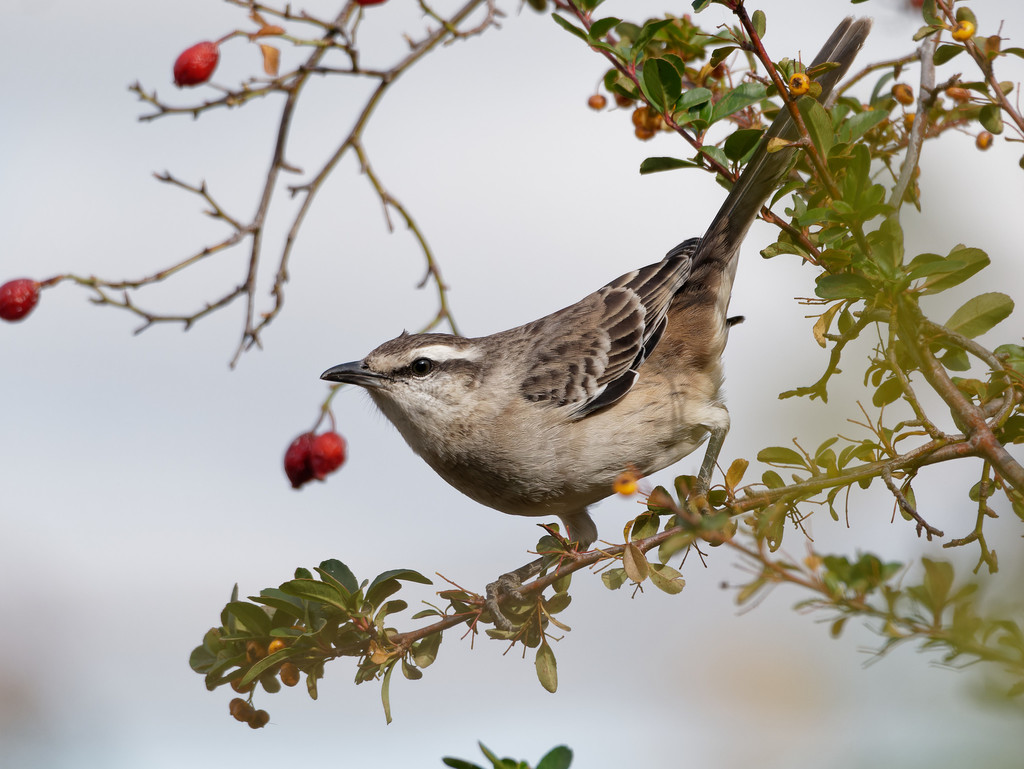
The chalk-browed mockingbird is 23.5 to 26 cm (9.3 to 10.2 in) long and weighs 55 to 73 g (1.9 to 2.6 oz). Males are slightly larger than females. Adults of the nominate subspecies have a dark brown crown, a broad white supercilium, a blackish line through the eye, and white cheeks. Their upperparts are brownish with some darker streaks; the rump is buffier. Their wings are blackish and show two obscure bars when folded. The tail is also blackish; most feathers have white tips and the outermost have white edges. The underside of their body is white from the throat to the vent, though the breast has a gray tinge and the flanks are buffy with faint dark streaks. The juvenile is browner than the adult and has buffier underparts with dark streaks on the breast. M. s. frater is browner than the nominate, including the rump that is not buffy like the nominate's. M. s. arenaceus is essentially the same as frater but has a larger bill. M. s. modulator has some blackish brown spotting on its crown and back, lacks the gray tinge on the breast, and the flanks are paler and often unstreaked.
Range & habitat
The nominate subspecies of chalk-browed mockingbird is found in southern Suriname and adjoining Pará state in Brazil. M. s. arenaceus is found in eastern Brazil from Paraíba state south to eastern Bahia state. M. s. frater is found in central and eastern Bolivia and much of central Brazil. M. s. modulator is found from southeastern Bolivia and Paraguay into central Argentina and extreme southeastern Brazil. The chalk-browed mockingbird inhabits open areas such as savannas, forest edges, open woodland, pastures with scattered trees, and urban and suburban gardens. It is generally a bird of the lowlands but reaches as high as about 2,500 m (8,200 ft) in northern Argentina.
Wikipedia: “Distribution and habitat”
What it does
The chalk-browed mockingbird is omnivorous; it feeds on fruits, seeds, berries, insects, and other small vertebrates. It occasionally predates the eggs and nestlings of other birds. It forages mostly on the ground.
Wikipedia: “Feeding”
Listen
Looking for field recordings…
Where it lives
Recorded sightings
—
geo-referenced records in GBIF, from museums, herbaria and field observers.
Drag the globe to turn it. Dots are where records exist, not a range map; darker means more records.
In the stacks
Searching the stacks…
Every page naming Mimus saturninus in the Biodiversity Heritage Library →
This page is assembled live from iNaturalist, GBIF, Wikipedia, the Source Library and the Internet Archive. It is not yet part of the hand-edited codex. iNaturalist taxon 14878.