On eBird ↗
Bahama Mockingbird
Live sightings near you, the range map, bar charts of when it is seen, and Macaulay Library photos and recordings.
Bahama Mockingbird
Mimus gundlachii
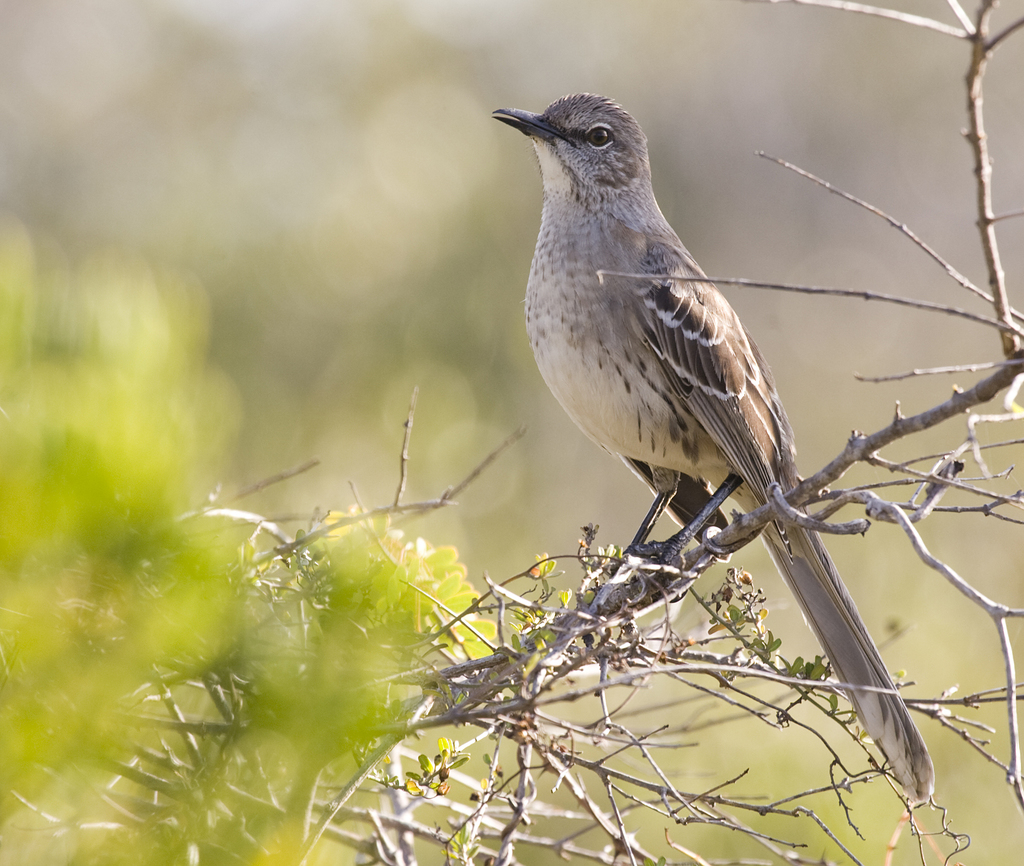
The Bahama mockingbird (Mimus gundlachii) is a species of bird in the family Mimidae. It is found in the Bahamas, Cuba, Jamaica and the Turks and Caicos Islands, and is a vagrant to the United States. Its natural habitats are subtropical or tropical dry forest, subtropical or tropical moist lowland forest, subtropical or tropical dry shrubland, and heavily degraded former forest.
From the article Bahama mockingbird on Wikipedia (CC BY-SA), quoted section by section
Description
The Bahama mockingbird is 28 cm (11 in) long and weighs between 57 and 85 g (2.0 and 3.0 oz) with an average of 66.8 g (2.36 oz). Adults of the nominate subspecies have a mottled face with a pale supercilium. Their upperparts are brownish gray with dark streaks from the crown to the lower back. Their outer tail feathers have whitish tips. Their underparts are light gray with light streaking on the upper breast and more prominent streaks on the flanks. The juvenile is similar but has more densely spotted underparts. M. g. hillii has more prominent streaking on its back than the nominate and the white tips on the tail feathers are larger.
Range & habitat
The nominate subspecies of Bahama mockingbird is found in the Bahamas, the Turks and Caicos Islands, and the Sabana-Camagüey Archipelago off Cuba's north coast. M. g. hillii is found only in southern Jamaica. Except in Jamaica, the Bahama mockingbird inhabits a variety of biomes including coastal strand, semi-arid scrub, open woodland, and plantations. In Jamaica it inhabits dry scrubby woodland on limestone hills. It appears to favor taller, denser vegetation than the similar northern mockingbird (Mimus polyglottus) where their ranges overlap.
Wikipedia: “Distribution and habitat”
What it does
The Bahama mockingbird is omnivorous; its diet includes invertebrates, nectar, small fruits, and little lizards. It mainly forages on the ground, searching through leaf litter, but also hunts up to 6 m (20 ft) high in vegetation. It aggressively defends feeding sites.
Wikipedia: “Feeding”
Listen
Looking for field recordings…
Where it lives
Recorded sightings
—
geo-referenced records in GBIF, from museums, herbaria and field observers.
Drag the globe to turn it. Dots are where records exist, not a range map; darker means more records.
In the stacks
Searching the stacks…
Every page naming Mimus gundlachii in the Biodiversity Heritage Library →
This page is assembled live from iNaturalist, GBIF, Wikipedia, the Source Library and the Internet Archive. It is not yet part of the hand-edited codex. iNaturalist taxon 14880.