On eBird ↗
Dunnock
Live sightings near you, the range map, bar charts of when it is seen, and Macaulay Library photos and recordings.
Dunnock
Prunella modularis
The dunnock (Prunella modularis) is a small passerine, or perching bird, found throughout temperate Europe and into Asian Russia. Dunnocks have also been introduced and become common in New Zealand. It is the most widespread member of the accentor family; most other accentors are limited to mountain habitats. Other, largely archaic, English names for the dunnock include hedge accentor, hedge sparrow, hedge warbler, and titling.
From the article Dunnock on Wikipedia (CC BY-SA), quoted section by section
Description
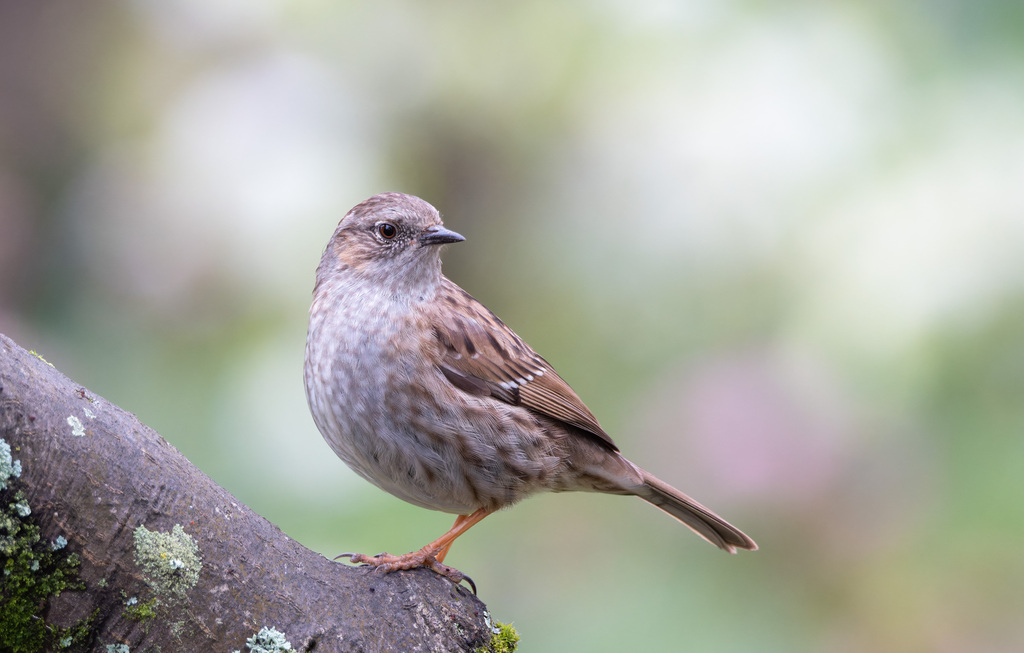
A robin-sized bird, the dunnock typically measures 13–14.5 cm (5.1–5.7 in) in length. It has a brown back streaked blackish, somewhat resembling a small house sparrow. Like that species, the dunnock has a drab appearance which may have evolved as camouflage to avoid predation. It is brownish underneath, and has a fine pointed bill. Adults have a dull grey head, and both sexes are similarly coloured; juveniles are browner on the head, looser, 'fluffy' feathering, and more obviously streaked overall. Unlike any similar sized small brown bird in Europe, dunnocks exhibit frequent wing flicking, especially when engaged in territorial disputes or when competing for mating rights. This gave rise to the old nickname of "shufflewing". The main call of the dunnock is a shrill, persistent tseep along with a short, weak trilling note, which betrays the bird's otherwise inconspicuous presence. The song is rapid, thin and tinkling, a sweet warble.
Range & habitat
Dunnocks are native to large areas of Eurasia, inhabiting much of Europe and southwest Asia including Lebanon, northern Iran, and the Caucasus. It is the only accentor commonly found in temperate lowland areas; the others all inhabit upland areas, or (Siberian accentor) subarctic lowlands. Favoured habitats include woodlands, shrubs, gardens, and hedgerows where they typically feed on the ground, often seeking out detritivores as food. Dunnocks were intentionally introduced into New Zealand during the 19th century, and are now widely distributed around the country and some offshore islands.
Wikipedia: “Distribution and habitat”
Listen
Looking for field recordings…
Where it lives
Recorded sightings
—
geo-referenced records in GBIF, from museums, herbaria and field observers.
Drag the globe to turn it. Dots are where records exist, not a range map; darker means more records.
In the old herbals & bestiaries

In the stacks
Searching the stacks…
Every page naming Prunella modularis in the Biodiversity Heritage Library →
This page is assembled live from iNaturalist, GBIF, Wikipedia, the Source Library and the Internet Archive. It is not yet part of the hand-edited codex. iNaturalist taxon 13988.