- Animals
- ›Chordates
- ›Vertebrates
- ›Mammals
- ›Therians
- ›Placental Mammals
- ›Primates, Rodents, and Allies
- ›Primates
- ›Monkeys, Apes, and Tarsiers
- ›Monkeys and Apes
- ›Apes and Old World Monkeys
- ›Old World Monkeys
- ›Cercopithecines
- ›Baboons, Macaques, and Mangabeys
- ›Papio
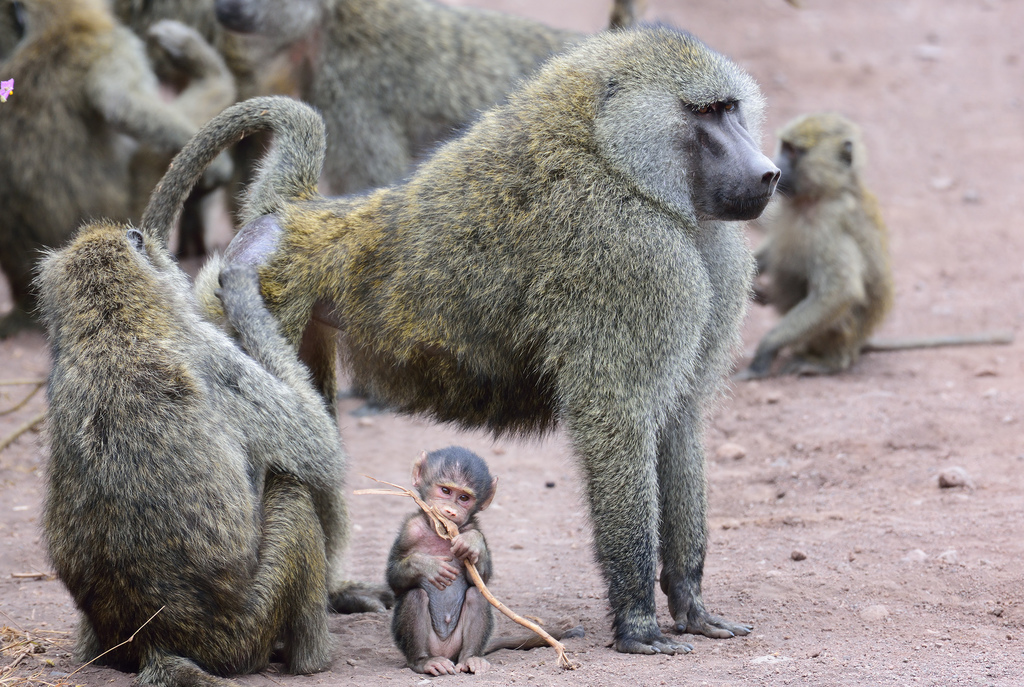
Olive Baboon
Papio anubis
The olive baboon (Papio anubis), also called the Anubis baboon, is a member of the family Cercopithecidae Old World monkeys. The species is the most wide-ranging of all baboons, being native to 25 countries throughout Africa, extending from Mali eastward to Ethiopia and Tanzania. Isolated populations are also present in some mountainous regions of the Sahara. It inhabits savannahs, steppes, and forests. The common name is derived from its coat colour, which is a shade of green-grey at a distance. A variety of communications, vocal and non-vocal, facilitate a complex social structure.
From the article Olive baboon on Wikipedia (CC BY-SA), quoted section by section
Description
The olive baboon is named for its coat, which, at a distance, is a shade of green-grey. At closer range, its coat is multicoloured, due to rings of yellow-brown and black on the hairs. The hair on the baboon's face is coarser and ranges from dark grey to black. This coloration is shared by both sexes, although males have a mane of longer hair that tapers down to ordinary length along the back. Besides the mane, the male olive baboon differs from the female in terms of weight, body and canine tooth size; males are, on average, 70 cm (28 in) tall while standing and females measure 60 cm (24 in) in height. The olive baboon is one of the largest species of monkey; along with chacma baboons, mandrills, and muriquis. The head-and-body length can range from 50 to 114 cm (20 to 45 in), with a species average of around 85 cm (33 in). At the shoulder on all fours, females average 55 cm (22 in) against males, which average 70 cm (28 in). The typical weight range for both sexes is reportedly 10–37 kg (22–82 lb), with males averaging 24 kg (53 lb) and females averaging 14.7 kg (32 lb). Some males may weigh as much as 50 kg (110 lb). Like other baboons, the olive baboon has an elongated, dog-like muzzle. Its 38 to 58 cm (15 to 23 in) long tail and four-legged gait can make it seem canine. …
Wikipedia: “Characteristics”
Range & habitat
The olive baboon inhabits a strip of 25 equatorial African countries, very nearly ranging from the east to west coasts of the continent. The exact boundaries of this strip are not clearly defined, as its range overlaps with that of other baboon species, which has resulted in cross-breeding between species in many places. For example, considerable hybridisation has occurred between the olive baboon and the hamadryas baboon in Ethiopia. Cross-breeding with the yellow baboon and the Guinea baboon has also been observed, but the hybrids have not as yet been well studied. Throughout its wide range, the olive baboon occurs in a number of different habitats. It is usually classified as savannah-dwelling, living in the wide plains of the grasslands. The grasslands, especially those near open woodland, make up a large part of its habitat, but it also inhabits rainforests and deserts. Uganda and the Democratic Republic of the Congo support olive baboon populations in dense tropical forests. A small introduced population was present in the Province of Cádiz and possibly in the Province of Málaga in Spain. It is considered extinct in Spain.
Wikipedia: “Distribution and habitat”
What it does
Females are sexually mature at seven to eight years old, and males at seven to 10 years. The beginning of a female's ovulation is a signal to the males that she is ready to mate. During ovulation, the skin of the female's anogenital area swells and turns a bright red/pink. The swelling makes it difficult to move and increases the female's chance of microbial or parasitic infection. Females with more swollen anogenital areas reproduce while younger, produce more offspring per year, and those offspring have a better chance of surviving. These females also attract more males, and are more likely to cause aggressive fights between them. Olive baboons tend to mate promiscuously. A male forms a mating consortship with an estrous female, staying close to and copulating with her. Males guard their partner against any other male trying to mate with her. Unless a female is in a multiday consortship, she often copulates with more than one male each day. Multiple copulations are not necessary for reproduction, but may function to make the actual paternity of the female's offspring ambiguous. This lack of paternal certainty could help reduce the occurrence of infanticide. Occasionally, male olive baboons monopolize a female for her entire period of probable conception. …
Wikipedia: “Reproduction and parenting”
Listen
Looking for field recordings…
Where it lives
Recorded sightings
—
geo-referenced records in GBIF, from museums, herbaria and field observers.
Drag the globe to turn it. Dots are where records exist, not a range map; darker means more records.
In the stacks
Searching the stacks…
Every page naming Papio anubis in the Biodiversity Heritage Library →
This page is assembled live from iNaturalist, GBIF, Wikipedia, the Source Library and the Internet Archive. It is not yet part of the hand-edited codex. iNaturalist taxon 74832.