- Animals
- ›Chordates
- ›Vertebrates
- ›Ray-finned Fishes
- ›Spiny-rayed fishes
- ›Rivulines, Killifishes, and Livebearers
- ›Cyprinodontoidei
- ›Topminnows
- ›Fundulus
- ›Fundulus
- ›Fundulus diaphanus
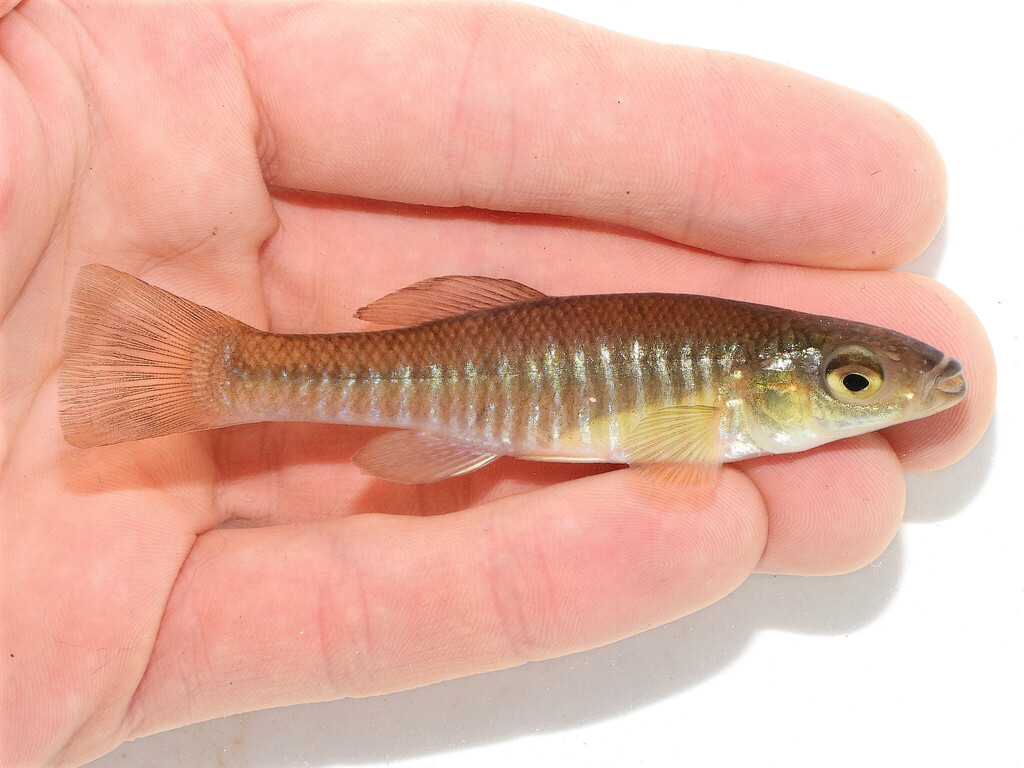
Banded Killifish
Fundulus diaphanus
The banded killifish (Fundulus diaphanus) is a North American species of temperate freshwater killifish belonging to the Fundulus genus of the Fundulidae family. The natural geographic range extends from Newfoundland to South Carolina, and west to Minnesota. It includes the Great Lakes drainages. The banded killifish is the only freshwater killifish found in the northeastern United States. While it is primarily a freshwater species, it can occasionally be found in brackish water.
From the article Banded killifish on Wikipedia (CC BY-SA), quoted section by section
Description
The banded killifish has a narrow, elongate bluish-gray or olive-colored body with a darker dorsal surface and white or yellowish underparts extending to the anal fin. Spawning males develop yellow pectoral and pelvic fins, a bright blue patch on the anal fin, and brilliant blue iridescence on the lower portion of the body including the area around the anal fin. There are 12–20 vertical bands along the sides. In females the bands usually appear as thin and distinct black bands that often do not span the full width of the body. In males, the bands are silvery in color, are less distinct, and are closer together. The number of bands are useful in sexing an individual; male banded killifish have a greater (approximately >9) number of bands anterior to the dorsal fin. Fins rounded, base of first dorsal ray slightly ahead of or directly over first anal ray. Snout is blunt, with small superior mouth and projecting lower jaw. Lateral line is missing; 39–43 scales in the lateral series. There are 10 to 13 dorsal fin rays, 9 to 11 anal fin rays and 6 pelvic fin rays. Max length is 13 cm (5.1 in) total length (TL), average length is 6.3 cm (2.5 in) TL. The eastern subspecies, F. d. diaphanus, can be differentiated from the western subspecies, F. d. …
Range & habitat
The banded killifish is widely distributed throughout eastern North America, ranging from the Pee Dee River, South Carolina to Newfoundland; also found in southern Pennsylvania, northeastern Nebraska, and northern Illinois, and north to St. Lawrence-Great Lakes and Mississippi River basins from Manitoba to Quebec. The eastern subspecies is found on the Atlantic Slope, and the western subspecies in the rest of its range. Westward expansion by the eastern subspecies may be the result of introductions as bait or aquarium fish into novel waterbodies, climate change expanding favorable habitat, or a higher pollution tolerance compared to the western subspecies. The population of banded killifish in Newfoundland was assigned a status of special concern by the Committee on the Status of Endangered Wildlife in Canada (COSEWIC) due to biogeographical isolation and limitation of potential for range expansion. In the United States, Ohio and Illinois list the western subspecies as endangered and threatened, respectively, due to range expansion of the eastern subspecies which has been documented to hybridize wherever the ranges of the subspecies overlap. As such, Ohio also classifies F. d. diaphanus as an injurious aquatic invasive species. …
Wikipedia: “Range and distribution”
What it does
Adults range from 2 to 3 years in age. Banded killifish are schooling fish, usually traveling in groups of 3–6 individuals, while the juveniles travel in groups of 8–12. The fish are most often found in the shallow and quiet areas of clear lakes, ponds, rivers, and estuaries with sandy gravel or muddy bottoms and with abundant aquatic vegetation. The sand and gravel provides hatchlings and juveniles with places to hide when threatened by predatory fish such as the largemouth bass Micropterus salmoides, northern pike Esox lucius, bluegill Lepomis macrochirus, and trout. Because the banded killifish is small, it generally does not venture into deeper waters, where it would be vulnerable to predation as well as unable to swim in the fast currents. However, adult banded killifish have been observed to travel into deep bodies of water to feed. Banded killifish often congregate near aquatic vegetation, as it provides protection as well as breeding habitat. Banded killifish are euryhaline, but they usually inhabit freshwater streams and lakes. The largest adult recorded, observed in Indian Bay, Canada, was 12.8 cm (5.0 in). People have used banded killifish as fish bait. Most people do not favor them as pets because they require a high level of maintenance and therefore do not survive well in an aquarium setting. …
Wikipedia: “Habitat and ecology”
In human culture
The common name, "banded killifish", commonly refers to the distinct black and white vertical bandings found along their sides. The Latin genus name Fundulus is the diminutive of fundus, which means "bottom", and the specific name diaphanus means "transparent" in Greek.
Wikipedia: “Etymology”
Where it lives
Recorded sightings
—
geo-referenced records in GBIF, from museums, herbaria and field observers.
Drag the globe to turn it. Dots are where records exist, not a range map; darker means more records.
In the stacks
Searching the stacks…
Every page naming Fundulus diaphanus in the Biodiversity Heritage Library →
This page is assembled live from iNaturalist, GBIF, Wikipedia, the Source Library and the Internet Archive. It is not yet part of the hand-edited codex. iNaturalist taxon 101053.