- Animals
- ›Chordates
- ›Vertebrates
- ›Ray-finned Fishes
- ›Spiny-rayed fishes
- ›Rivulines, Killifishes, and Livebearers
- ›Cyprinodontoidei
- ›Topminnows
- ›Fundulus
- ›Fundulus
- ›Fundulus heteroclitus
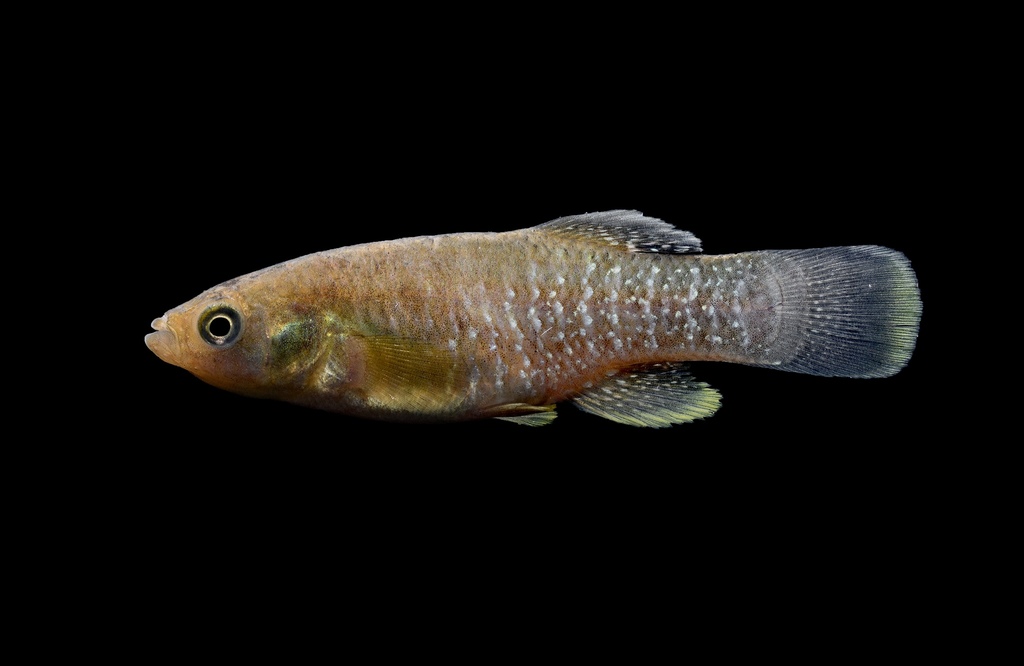
Mummichog
Fundulus heteroclitus
The mummichog (Fundulus heteroclitus) is a small killifish found along the Atlantic coast of the United States and Canada. Also known as Atlantic killifish, mummies, gudgeons, and mud minnows, these fish inhabit brackish and coastal waters, including estuaries and salt marshes. The species is noted for its hardiness and ability to tolerate highly variable salinity, temperature fluctuations from 6 to 35 °C (43 to 95 °F), very low oxygen levels (down to 1 mg/L), and heavily polluted ecosystems. As a result, the mummichog is a popular research subject in embryological, physiological, and toxicological studies. It is also the first fish ever sent to space, aboard Skylab in 1973.
From the article Mummichog on Wikipedia (CC BY-SA), quoted section by section
Description
The body of the mummichog is elongate but thick, with a deep caudal peduncle. Usual length is 7.5 to 9 cm (3.0 to 3.5 in) but a maximum length of up to 15 cm (5.9 in) is possible. The mouth is upturned and the lower jaw protrudes when the mouth is closed. Pectoral and tail fins are round. Mummichogs have 10–13 dorsal fin rays, 9–12 anal fin rays and 16–20 pectoral fin rays. Males have larger dorsal and anal fins than females. There is no lateral line on the body, but lateral line pores are present on the head. The colour is variable (and may even change in shade within the same individual when placed near different backgrounds) but is generally olive-brown or olive-green. There can be vertical bars on the sides that are thin, wavy, and silvery. Colors are more intense in males during the reproductive season, as they become dark olive-green on the back, steel-blue on the sides with about 15 silvery bars, and yellow or orange-yellow on the underside; the dorsal fin is mottled and a small eyespot may be present near the rear edge. Females tend to be paler, without bars or the intense yellow on the belly, and their dorsal fin is uniformly coloured. Adults of the two subspecies can be distinguished based on slight morphological and genomic differences. Further, eggs of the northern subspecies have filaments (adhesive chorionic fibrils) that eggs of the southern subspecies lack. …
Range & habitat
This species ranges along the Atlantic coast of North America, from Gaspé Peninsula, Anticosti Island and Port au Port Bay in the north to northeastern Florida in the south. It is present on Sable Island, 175 km (109 mi) southeast of the closest point of mainland Nova Scotia in the Atlantic Ocean. The approximate geographical division between the two subspecies lies in New Jersey, Delaware and Virginia. Introduced populations have become established on the Atlantic coast of Portugal and southwestern Spain, starting in the 1970s and some have now reached the western Mediterranean basin. There may also be introduced populations in Hawaii and the Philippines. As bait fish, mummichogs are sometimes released in freshwater habitats, where they can survive, and there have been reports of individuals in New Hampshire ponds, as well as the upper Ohio River and Beaver River. In the European Union, due to the significant negative impacts of its introduction to the ecosystem, it is included in the list of invasive alien species of Union concern and hence cannot be imported, bred, transported, commercialized, or intentionally released into the environment in any of its member states. The mummichog is a common fish in coastal habitats such as salt marshes, muddy creeks, tidal channels, brackish estuaries, eelgrass or cordgrass beds, and sheltered shorelines. …
Wikipedia: “Distribution and habitat”
What it does
Mummichogs are agastric omnivores. Analyses of their gut contents have found diatoms, amphipods and other crustaceans, molluscs, fish eggs (including their own species), very small fish, insect larvae, and bits of eelgrass.
Wikipedia: “Diet”
Where it lives
Recorded sightings
—
geo-referenced records in GBIF, from museums, herbaria and field observers.
Drag the globe to turn it. Dots are where records exist, not a range map; darker means more records.
In the stacks
Searching the stacks…
Every page naming Fundulus heteroclitus in the Biodiversity Heritage Library →
This page is assembled live from iNaturalist, GBIF, Wikipedia, the Source Library and the Internet Archive. It is not yet part of the hand-edited codex. iNaturalist taxon 58642.