- Animals
- ›Chordates
- ›Vertebrates
- ›Ray-finned Fishes
- ›Spiny-rayed fishes
- ›Needlefishes, Halfbeaks, and Allies
- ›Flyingfishes
- ›Cheilopogon
- ›Cheilopogon pinnatibarbatus
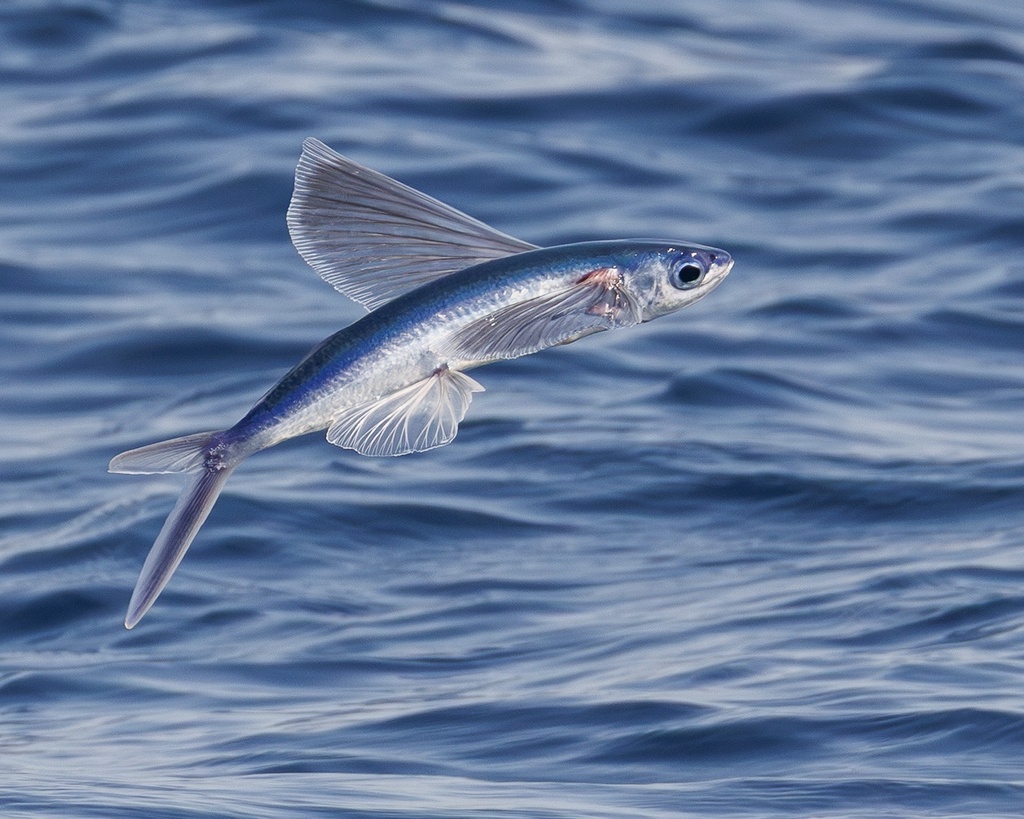
California Flyingfish
Cheilopogon pinnatibarbatus californicus
The California flying fish (Cheilopogon pinnatibarbatus californicus) is a subspecies of Bennett's flying fish, Cheilopogon pinnatibarbatus. Prior to the 1970s, the California flying fish was known as a distinct species, with the scientific classification Cypselurus californicus. The California flying fish is one of 40 distinct classifications of flying fish. It is the largest member of the flying fish family, growing up to 19 inches (48 cm) in length. It is a marine species found in the Eastern Pacific Ocean, from Oregon to Baja California. As with all other flying fish, the California can not actually fly, it launches itself into the air, using its specially adapted fins to glide along the surface. The California flying fish spends most of its time in the open ocean but comes close to shore at night to forage and lay eggs in the protection of kelp beds.
From the article California flying fish on Wikipedia (CC BY-SA), quoted section by section
Description
California flying fish have 9–13 dorsal rays and 9–12 anal rays. They have a deeply forked caudal fin with the bottom lobe larger than the top lobe. Their lateral line, an organ that helps fish detect movement in the water, is located relatively low on the body. Their scales are large and smooth, contributing to this fish's shiny appearance. They have only about 50 scales located in front of their dorsal fin. They have 48–51 vertebrae and 10–12 branchiostegal rays.
Wikipedia: “Anatomy”
Range & habitat
California flying fish live in the Eastern Pacific Ocean, ranging from Oregon to Baja California. The mean sea surface temperature is the largest factor in determining where flying fish live. Their flight is energetically limited by water temperature, so their population richness is limited to southern California and Baja California waters. Data shows that their top speed is ten meters per second, which can only be achieved at temperatures above 20 degrees Celsius. As a result, flying fish prefer tropical and temperate climates. The Eastern Tropical Pacific Ocean (ETP) supports the vast majority of this species and their predators. They do not have a niche diet and can find cyanobacteria and small eukaryotes almost anywhere. Thus their habitat at a taxonomic scale spans not only the Atlantic and Pacific coasts of the United States but also the Atlantic, Pacific, and Indian oceans. California flying fish live in the epipelagic zone, the top 200 meters of the ocean where there is ample sunlight. They are also neritic, meaning that they live in more shallow areas of the ocean.
Wikipedia: “Habitat and Distribution”
What it does
All flying fish are oviparous, meaning they reproduce by laying eggs rather than giving birth to live young. California flying fish undergo multiple stages of development: the egg, larval, juvenile, and adult stages.
Egg
California flying fish lay their eggs on kelp beds. Their eggs have been observed to have about 60 adhesive filaments, structures that help the egg attach to surfaces like kelp and other debris in the open ocean. Their ova is about 1.64 mm in diameter.
Larval
At the larval stage, they have a yolk sac, which functions as a source of nutrients for the young fish. There are also important hormones and enzymes stored in the yolk for the developing fish. Their mouth is inferior, or subterminal. Their body is heavily pigmented with cells called melanophores. The dorsal and anal fin are still connected to the caudal fin. These fins are separated as the fish grows.
Juvenile
Juvenile California flying fish can easily be spotted by their large barbel, a sensory organ near the mouth of the fish. It is made up of 14 flaps that make a fan-like shape. The barbel is lost as the fish matures into an adult. At this stage, their mouth develops into a superior mouth type, which is useful for eating at the top of the water column. The snouts of juvenile California flying fish are shorter than the snouts of adults. …
Wikipedia: “Life Stages and Reproduction”
In human culture
The California flying fish has gone through various scientific name changes over the years. It was first described by naturalist James Graham Cooper in 1864 as Cypselurus californicus. It was then renamed to Cypsilurus californicus by Jordan and Evermann in 1898, and slightly modified again to Cypselurus californicus in 1907 by Starks and Morris. The California flying fish underwent a major name change in 1944, described by Fowler as Parexocoetoides vanderbilti. Today, the California flying fish is classified as Cheilopogon californicus. Cheilopogon originates from the Greek words cheilos and pogon, cheilos meaning lip, and pogon meaning barbed or bearded. This most likely refers to the large barbel on the mouth of juvenile flying fish. The oldest known "flying" relative of the California flying fish, Potanichthys xingyiensis, was discovered in 2013 by paleontologists in southwest China. Potanichthys xingyiensis is a member of Thoracopteridae, an extinct family of bony fish that existed during the Triassic period.
Wikipedia: “Taxonomy and Etymology”
Where it lives
Recorded sightings
—
geo-referenced records in GBIF, from museums, herbaria and field observers.
Drag the globe to turn it. Dots are where records exist, not a range map; darker means more records.
In the stacks
This page is assembled live from iNaturalist, GBIF, Wikipedia, the Source Library and the Internet Archive. It is not yet part of the hand-edited codex. iNaturalist taxon 115496.